MCP Server Language Selection Guide: How to Choose Between Rust, Go, TypeScript, Python, and Java

A practical guide to choosing the right language for MCP Server development across five popular options.
This guide compares Rust, Go, TypeScript, Python, and Java for MCP Server development across three key dimensions: ecosystem maturity, deployment complexity, and user-friendliness. It argues that deployment friendliness should be the top priority, favoring Rust/Go for open-source tools, TypeScript for prototyping, Python for AI integration, and Java for enterprise apps.
When developing an MCP (Model Context Protocol) Server, have you ever struggled with which programming language to use? TypeScript, Python, Rust, Go, or Java? Choose wisely and you'll save tons of effort; choose poorly and you might end up fighting issues the entire way. Based on the hands-on experience of a Bilibili content creator, this article helps you clarify MCP development language selection from three dimensions: ecosystem maturity, deployment complexity, and user-friendliness.
MCP is an open protocol released by Anthropic in late 2024, designed to provide LLMs with a standardized way to connect to external data sources and tools. Think of it as the "USB-C port" for AI applications — through a unified protocol specification, different AI applications (clients like Claude Desktop, Cursor, etc.) can invoke various external capabilities (servers) in a consistent manner. MCP uses a client-server architecture where the Server exposes tools, resources, and prompt templates, while the Client communicates with it via the protocol. With this context in mind, let's dive into language selection with a clearer perspective.
Overall Comparison of Five Languages
Different languages each have their strengths in MCP development, and there's no single "best" solution — the key is your project goals.
From a high-level view:
- TypeScript / Python: Very mature ecosystems with well-supported official SDKs; currently the mainstream choices for MCP Server development.
- Rust / Go: Excel in performance, deployment, and user-friendliness, particularly strong in packaging into a single executable.
- Java: Still holds advantages in enterprise application scenarios, with proven stability and maturity.
The mention of "well-supported official SDKs" deserves further explanation. Anthropic's earliest official SDKs covered TypeScript and Python, meaning these two languages lead in protocol implementation completeness, documentation richness, and community examples. SDKs for Rust, Go, and Java are mostly community-driven — while their functionality is progressively improving, there may be some lag in API stability and edge case handling. The advantage of official SDKs goes beyond feature completeness; when the MCP protocol itself gets upgraded, official SDKs are typically the first to adapt, reducing maintenance costs for developers.
That said, this is just a macro overview. What truly determines your choice often lies in the easily overlooked details of real-world implementation — especially deployment.
Deployment Complexity: The Most Critical Pain Point in the MCP Ecosystem
If there's one factor that most determines the success or failure of an MCP tool, it's deployment complexity. This is also the pain point most easily underestimated by developers in the entire MCP ecosystem.
The Core Advantage of Rust and Go: Single Binary
Both Rust and Go can compile projects into a single binary file. Users download it and run it directly — zero dependencies, no environment configuration needed, achieving true "download and run" simplicity. This experience is extremely attractive for tool-type products — fast startup, minimal onboarding friction.
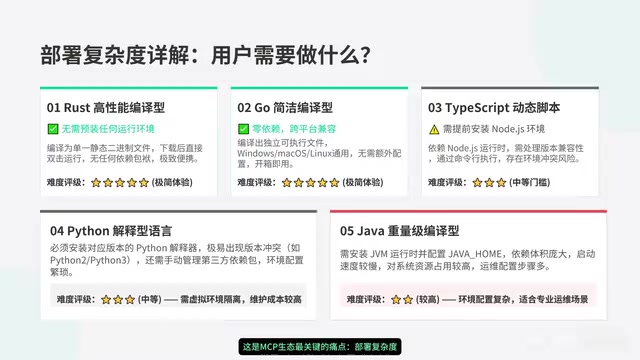
From a technical perspective, this is thanks to both languages' AOT (Ahead-of-Time) compilation strategy. They convert source code directly into target platform machine code during the compilation phase and statically link runtime libraries into the final artifact. While Go comes with a lightweight runtime (including a garbage collector and goroutine scheduler), this runtime is embedded in the compiled output — users don't need to install anything extra. Rust, on the other hand, has no runtime overhead by default and generates highly optimized native code through the LLVM backend. More importantly, both support cross-compilation — developers can generate executables for Windows, macOS, Linux, and other platforms from a single machine, greatly simplifying cross-platform distribution.
Environment Dependency Issues with Other Languages
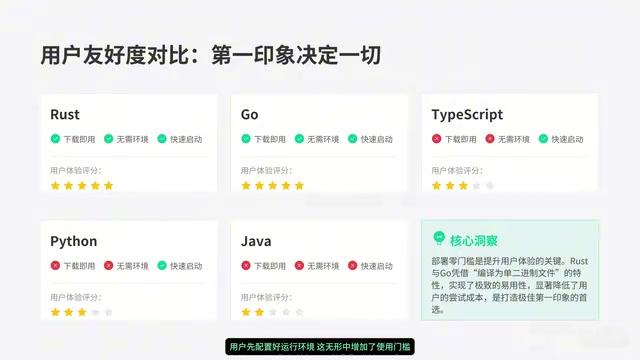
In contrast, TypeScript and Python require users to first install a Node.js or Python runtime environment, and they may encounter various issues like version conflicts along the way. Java requires JVM installation, which poses an even higher barrier for average users.
These extra environment configuration steps may seem minor, but they silently raise the barrier to entry and can even drive away a large number of potential users — they might give up at the "install dependencies" step. Take Python as an example: a user might have Python 3.9 installed locally, but the MCP Server requires version 3.11 or above; or different projects depend on different versions of the same library, causing package conflicts. While tools like virtualenv and conda can mitigate these issues, for non-Python developers, these concepts themselves represent additional cognitive overhead.
Core Selection Principle: Prioritize User Deployment Friendliness
The author puts forward a core argument that runs throughout the article: In MCP language selection, user deployment friendliness should be the top priority.
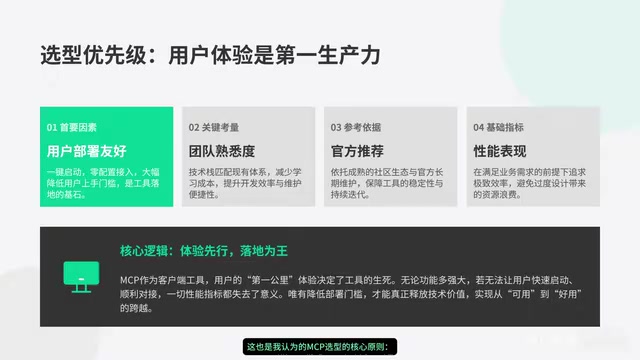
The underlying logic is clear: MCP is fundamentally a tool, and the first experience with a tool is crucial. If users can't get it up and running quickly after downloading, then no amount of performance or rich features matter — because users never get the chance to experience them.
This also explains why in many tool-oriented scenarios, Rust and Go are actually more favored than the more ecosystem-mature TypeScript and Python. Technology selection isn't just a technical question — it's a product experience question.
Scenario-Based Decision Guide
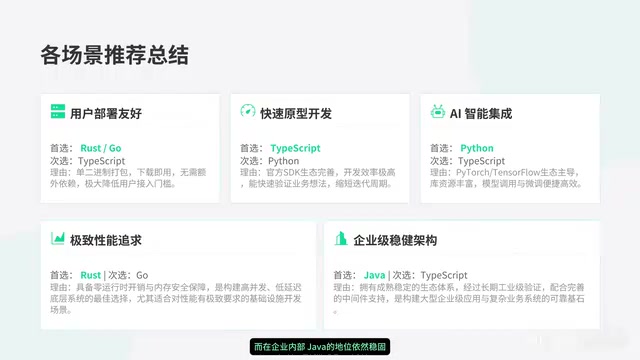
Considering different project requirements, here's a clear decision framework for MCP development language selection:
Open-Source Projects Pursuing Ultimate User Experience
Go with Rust or Go. The "compile to single binary, download and run" experience is critical for the distribution and adoption of open-source tools.
Rapid Prototyping to Validate Ideas
Choose TypeScript. It has the best official MCP SDK support and high development efficiency, making it ideal for quickly building prototypes and validating product logic. TypeScript's type system also catches errors early during development, offering better maintainability compared to plain JavaScript. Combined with the vast library of ready-made packages in the npm ecosystem — from HTTP requests to data parsing — almost every common need has a mature solution, letting developers focus on business logic itself.
Projects Heavily Dependent on AI Models
Python is still king. Its rich AI ecosystem and library support make it irreplaceable in model integration scenarios.
Python dominates the AI/ML space thanks to its long-accumulated massive ecosystem: NumPy, PyTorch, TensorFlow, Hugging Face Transformers, LangChain, LlamaIndex, and other core libraries almost all use Python as their primary language. When an MCP Server needs to load models locally for inference, call vector databases for semantic search, or orchestrate complex AI Agent workflows, Python's library support is unmatched by other languages. Additionally, reference implementations from cutting-edge AI papers are often provided in Python first, giving Python a natural advantage in quickly integrating the latest research.
Scenarios Demanding Maximum Performance
Rust is unrivaled. When performance is a hard requirement, Rust is the clear choice. Rust's zero-cost abstractions and ownership model ensure memory safety without a garbage collector, meaning that in high-concurrency, low-latency MCP Server scenarios, Rust delivers near C/C++ performance while avoiding common issues like memory leaks and data races.
Enterprise Internal Applications
Java's position remains solid. Its stability and mature enterprise ecosystem still hold clear advantages in internal systems.
Java's strengths in enterprise MCP development span multiple levels: mature frameworks like Spring Boot provide comprehensive enterprise-grade features including security authentication, monitoring, logging, and configuration management; the JVM ecosystem has rich enterprise middleware connectors (databases, message queues, ERP systems, etc.), and when an MCP Server needs to integrate with internal enterprise systems, Java offers the most abundant existing integration solutions. Additionally, enterprise IT teams usually have mature Java application operations systems, with extensive experience in deployment, monitoring, and troubleshooting. Notably, the Spring AI project already provides native support for the MCP protocol, further lowering the barrier for Java developers. In enterprise internal scenarios, the deployment environment is typically controlled — operations teams manage JVM versions uniformly, so environment dependency issues are less of a concern.
Clarification on Client Compatibility
Some developers worry: will the language choice affect compatibility with MCP clients?
The answer is very clear: No need to worry at all. Whether it's Rust, Go, TypeScript, Python, or Java, all of them can seamlessly connect with MCP clients through standard HTTP or Stdio protocols. The Model Context Protocol itself is language-agnostic — compatibility is never an obstacle in language selection.
It's worth understanding MCP's two transport modes in depth. In Stdio (standard input/output) mode, the MCP Client starts the Server as a subprocess, and both sides communicate via the process's stdin/stdout using JSON-RPC. This is suitable for locally-run tool scenarios — simple configuration but limited to the same machine. HTTP mode (typically based on SSE, or Server-Sent Events) communicates over the network, with the Server running as an independent HTTP service and the Client interacting with it through HTTP requests. This is suitable for remote deployment and multi-user sharing scenarios. Regardless of the transport mode used, the upper-layer MCP protocol semantics are completely consistent, and the underlying communication is based on the JSON-RPC 2.0 specification — this is the fundamental reason why language choice doesn't affect client compatibility.
This once again confirms that language selection is more about trade-offs between development efficiency and user experience, rather than technical feasibility.
Summary: A Simple Mnemonic for MCP Language Selection
Here's a simple, easy-to-remember mnemonic for MCP Server development language selection:
- User-friendly → Choose Rust / Go
- Rapid prototyping → Use TypeScript
- AI integration → Use Python
- Enterprise-grade → Use Java
Of course, the most practical advice is always: Use the language you're most proficient in. A familiar tech stack lets you focus your energy on solving real problems instead of fighting the language itself.
But always remember this premise — for tool-type products like MCP, enabling users to quickly start the service is where all value begins.
Related articles

What Happens When an AI Agent's Task Changes Midway?
What happens when an AI agent's task changes midway? Based on Reddit community discussion, this article analyzes planner fragility, context management dilemmas, and state rollback challenges in dynamic task scenarios for agents, and outlines strategies developers can adopt.

AI Agent Verification Tool Invites Beta Testers: Orinyx Open-Source MCP Opens 5 Spots
Developer recruits 5 beta testers to try Orinyx, an independent AI Agent verification tool initially focused on healthcare, plus an open-source MCP for testing Agents with synthetic data. Internal testing already found a failure mode where the system can't judge output correctness yet gives reassuring wording.

Small Models Fail at Structured Output: Why They Copy Prompt Labels Instead of Schema Enum Values
Developer shares pitfall of using cheap small models for structured output: models copy prompt labels instead of schema enum values, plus three practical fixes.