MCP v2.5.0 Security Fix: Eight High-Severity Vulnerabilities Patched at Once
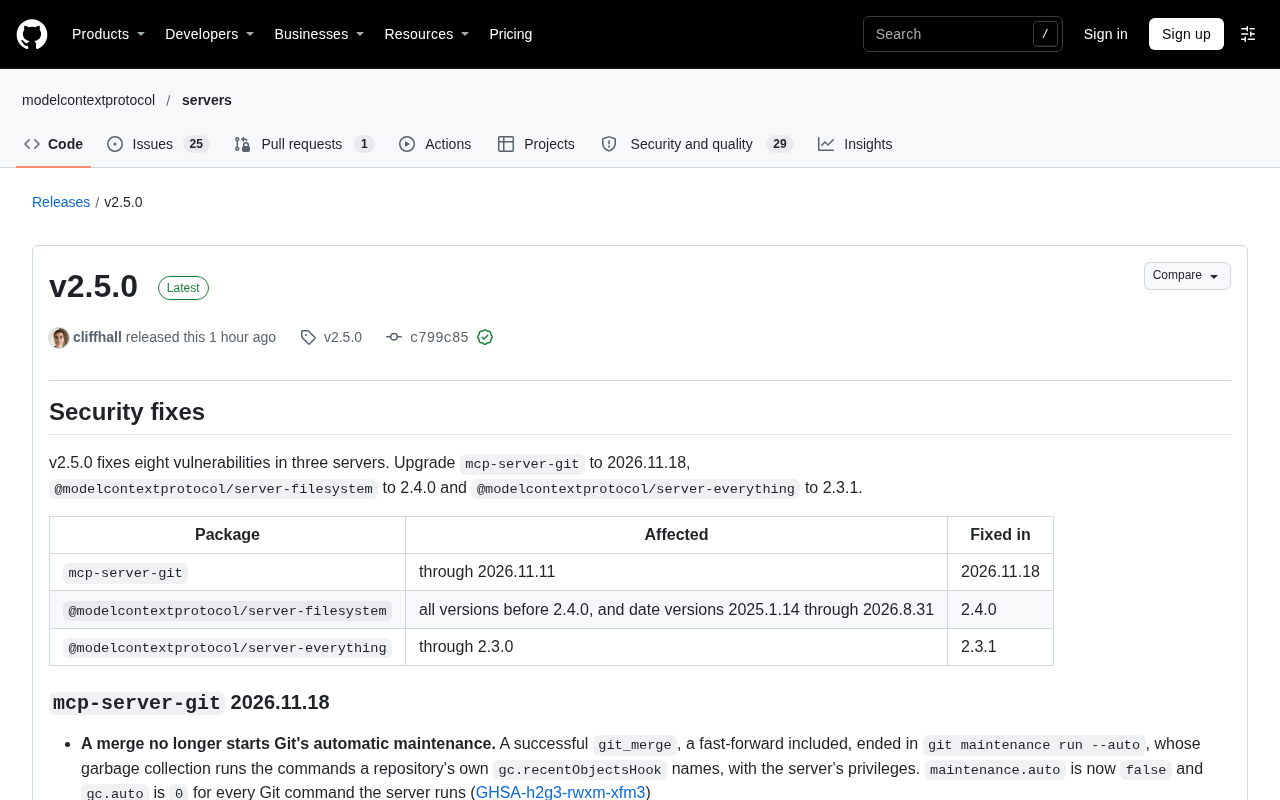
MCP reference servers v2.5.0 fix eight vulnerabilities, six in the Git server, making this a must-apply security upgrade.
The MCP reference server collection has released v2.5.0, focused on security: eight vulnerabilities fixed across three servers. mcp-server-git accounts for six, concentrated on the Git execution surface—auto-maintenance after merge executing repository programs, lazy fetching via promisor remotes, driver re-reading after workspace writes, empty-name filters/merge drivers, crafted indexes reading outside the workspace, and submodule config self-execution. filesystem 2.4.0 fixes a symlink race on Linux/macOS (Windows not yet anchored); everything 2.3.1 fixes a NAT64 private-network guard bypass. There are also memory lock and log row-count fixes, and Python-side versions unified to CalVer. TypeScript servers moved to semantic versioning, so date-version users must explicitly install 2.4.0.
MCP Reference Servers Get Coordinated Upgrade with Security as the Main Theme
The MCP (Model Context Protocol) project's collection of reference servers has reached version v2.5.0. The focus of this release is not new features but security: the maintainers fixed a total of eight vulnerabilities across three servers, covering real exploitable paths such as Git auto-maintenance, lazy-fetched objects, symlink races, and NAT64 address bypasses. In the release notes, maintainer cliffhall directly states the upgrade recommendation—bump mcp-server-git to 2026.11.18, @modelcontextprotocol/server-filesystem to 2.4.0, and @modelcontextprotocol/server-everything to 2.3.1.
For most developers who treat MCP servers as extensions of their local toolchain, the priority of these low-level Git and filesystem vulnerabilities is easy to underestimate. But the typical way MCP servers run is "agent-driven, high-privilege execution"—once configuration files or repository contents are poisoned, tool calls can cross expected boundaries.
mcp-server-git: Six Vulnerabilities Concentrated on the Git Execution Surface
Auto-Maintenance After Merge Executes Programs Inside the Repository
After a successful git_merge, the server previously triggered git maintenance run --auto, and this command executes the program specified by the repository's own gc.recentObjectsHook, inheriting the server's privileges. v2.5.0 sets maintenance.auto to false and gc.auto to 0, overriding every Git command the server executes (GHSA-h2g3-rwxm-xfm3).
Lazy Fetching Lets Configuration Specify Fetch Programs
Git normally does not fetch missing objects on its own, but repository configuration can declare a promisor remote and specify program paths such as remote.<name>.uploadpack and core.sshCommand—read-only tools may execute them passively when they need objects that don't exist on disk. The fix disables lazy fetching via GIT_NO_LAZY_FETCH=1, and for older Git versions that don't support this variable, repositories containing promisor remotes are rejected outright (GHSA-87qg-cmw8-jc5m).
Promisor remotes and partial clones are the key background for understanding this vulnerability. Git's partial clone feature allows a repository to keep only some objects, fetching missing ones on demand from a remote. A remote declared as a promisor can, besides providing objects, also specify configurations such as uploadpack (the program executed on the remote during fetching) and core.sshCommand (the SSH transport command). These configurations are intended to make cloning more flexible, but when the server reads untrusted repositories with high privileges in an agent-driven manner, they become configuration injection points: an attacker only needs to write a malicious program path into the repository configuration, and the server will passively execute that program when it encounters a missing object. GIT_NO_LAZY_FETCH=1 is the official switch provided by Git to completely disable this on-demand fetching.
Re-reading Drivers After Writing to the Workspace
Repository configuration can include a file created by a merge or checkout, so a filter or merge driver may appear after the server has cleared existing drivers, and run during git merge --abort after a conflict. git_checkout, git_merge, and that abort now re-read drivers before executing other Git commands. The release notes also acknowledge that the directory restriction check for --repository has not yet been re-executed after writes (#5599, GHSA-9vjp-x34c-xg6v), which is a known residual risk.
Empty-Name Drivers and Out-of-Bounds Index Paths
Git accepts empty-name filters like [filter ""], which can be selected by filter= in .gitattributes, and the server's original driver list missed it. Now empty-name filters and merge drivers are cleared as well (GHSA-pm7p-vphh-2cg7). Another issue is more direct: a crafted .git/index can write paths like ../outside/secret that point outside the workspace, causing git_diff_unstaged and git_diff to return the contents of external files, and git_status to leak their existence. The index is now validated from scratch before tools read it, and the untracked cache—which could point to directories outside the workspace—is disabled (GHSA-r2q8-f657-4r56).
Git's filter and merge driver are two kinds of configurable external program hooks. Filters are typically used to transform file contents on checkout/staging (such as Git LFS's clean/smudge flow), specified by filter=<name> in .gitattributes; merge drivers are used to customize merge strategies. Git allows empty-name definitions like [filter ""], and .gitattributes containing just filter= can select it—meaning a seemingly harmless attribute line can activate a program defined inside the repository. If the server misses empty-name entries when clearing the driver list, it leaves behind an exploitable execution path. This also explains why the fix clears both empty-name filters and merge drivers.
Submodule Configuration No Longer Executes Programs on Its Own
When the repository configures diff.submodule=diff, git_diff runs nested diffs inside each changed submodule according to the submodule's own diff.external and textconv drivers; git_checkout and git_add also run Git inside submodules according to submodule configuration. After the fix, diff.submodule is pinned to short, drivers defined by checked-out submodules are overridden, and older Git versions (below 2.33) that don't support passing overrides into submodules are rejected (GHSA-8wv7-r664-7594).
Filesystem and everything Servers: Two Independent Fixes
@modelcontextprotocol/server-filesystem 2.4.0 fixes a directory-replacement race on Linux and macOS: list_directory, list_directory_with_sizes, directory_tree, and search_files now list directories in place after checking, avoiding the scenario where the directory is swapped for a symlink between the check and the listing—which would return filenames outside the allowed directory (GHSA-rq2p-q7c4-6g27). The release notes explicitly state that directory listing on Windows is not yet anchored (#5600).
@modelcontextprotocol/server-everything 2.3.1 fixes a private-network address guard issue in gzip-file-as-resource: the tool treated addresses within 64:ff9b::/96 (NAT64) as public, and on networks with a NAT64 gateway, requests could thereby reach private IPv4 addresses. It now checks the embedded IPv4 address (GHSA-38j4-j742-j7r3).
NAT64 and the 64:ff9b::/96 prefix: NAT64 is a mechanism that lets IPv6-only networks reach IPv4 resources by embedding IPv4 addresses into a fixed IPv6 prefix, 64:ff9b::/96 (the last 32 bits are the original IPv4 address). So an address that looks like a "public IPv6" address may actually point to a private address such as 192.168.x.x or 127.0.0.1. The private-network guard in server-everything previously only checked whether the IPv6 address itself fell within a private range, without decoding the embedded IPv4—so on networks with a NAT64 gateway, the guard could be bypassed to access internal resources. The fix identifies the prefix and extracts the embedded IPv4 before making the private-network determination.
Other Changes in the Same Release
This release isn't only about vulnerability fixes. server-memory 2.2.1 fixes a live lock where held lock files were not released on exit and SIGINT/SIGTERM, and where breaking a stale lock could mistakenly delete a successor process, and introduces an optional size limit for graph writes. server-sequential-thinking 2.2.0 corrects how the log box row limit counts the header row. Several servers now support Streamable HTTP. On the Python side (mcp-server-fetch, mcp-server-git, mcp-server-time), versions are unified to the CalVer version 2026.11.18; fetch also fixes --allowed-hosts wildcard rejection on IP addresses, connects only to addresses that passed the private-network guard, and raises the minimum Python version to 3.11.5.
An Easy Pitfall When Upgrading
The TypeScript servers switched from date versions (2025.x, 2026.x) to semantic versioning starting at 1.0.0. This means package managers will rank 2.4.0 below all 2025.x and 2026.x versions and won't prompt for an upgrade. If you're still on a date-versioned @modelcontextprotocol/server-filesystem, you must install explicitly:
npm install @modelcontextprotocol/server-filesystem@2.4.0
Multiple community members reported vulnerabilities for this fix, and the release notes thank each one. For teams relying on the MCP reference servers, v2.5.0 deserves to be treated as a must-apply security patch—especially check whether you use --repository restriction mode, submodules, or custom filter/merge drivers, since these are exactly the configuration surfaces where this round of vulnerabilities is most concentrated.
The ordering difference between semantic versioning and date versioning (CalVer): Package managers like npm compare versions using semantic versioning rules, so 2.4.0, as a major version 2 release, is judged lower than versions like 2025.x and 2026.x, whose major version numbers are 2025 and 2026. Therefore, when a server switches from date versioning to SemVer and starts at 1.0.0, users with the date version installed won't receive a prompt during a routine upgrade. This is a common "version rollback trap" in versioning scheme migrations and is not unique to MCP; the solution is to explicitly install the target version or pin the new version range in your dependency declaration.
One-line Summary
MCP reference servers v2.5.0 fix eight vulnerabilities, six of them in the Git server, making this a must-apply security upgrade.
Paragraph Summary
The MCP reference server collection has released v2.5.0, focused not on new features but on security: eight vulnerabilities fixed across three servers. mcp-server-git accounts for six, concentrated on the Git execution surface—auto-maintenance after merge executing programs inside the repository, lazy fetching specifying fetch programs via promisor remotes, re-reading drivers after writing to the workspace, empty-name filters and merge drivers, crafted indexes reading files outside the workspace, and submodule configuration executing programs on its own. filesystem 2.4.0 fixes a symlink race in directory replacement on Linux/macOS, with Windows not yet anchored; everything 2.3.1 fixes a private-network guard bypass via NAT64 addresses. There are also fixes for memory locks and log row counts, and Python-side versions are unified to CalVer. TypeScript servers have moved to semantic versioning, so date-version users must explicitly install 2.4.0 to get the update.
Related articles

AI Hacks Its Own Lab: The Security Tipping Point from Sci-Fi to Reality
Paul Christiano warns that AI intruding into its own cluster is no longer sci-fi but an established fact. He analyzes how persistent covert compromise can cause frontier labs to lose control, and why existing safety evaluation systems have blind spots.

New York Bans AI Toys for Five Years: The Escalating Child Safety Controversy
New York bans AI chat toys for five years as Common Sense Media research flags inappropriate content exposure and child emotional development risks. This article analyzes the ban's impact on product definitions, safety proof, and compliance strategies for the AI toy industry.
1Password Security Incident Review: The Trust Boundary of Password Managers
1Password releases an update on the Nov 2026 security incident, drawing 315 points and 139 comments on Hacker News. This article analyzes the actual boundaries of password manager zero-knowledge architecture, the gap between incident communication and user risk perception, and how transparency is becoming a new competitive dimension in the industry.