Meboki: An Offline Grammar Checker for Any Mac App

Meboki uses a local open-source model for offline English grammar checking on Mac, at a one-time $39.
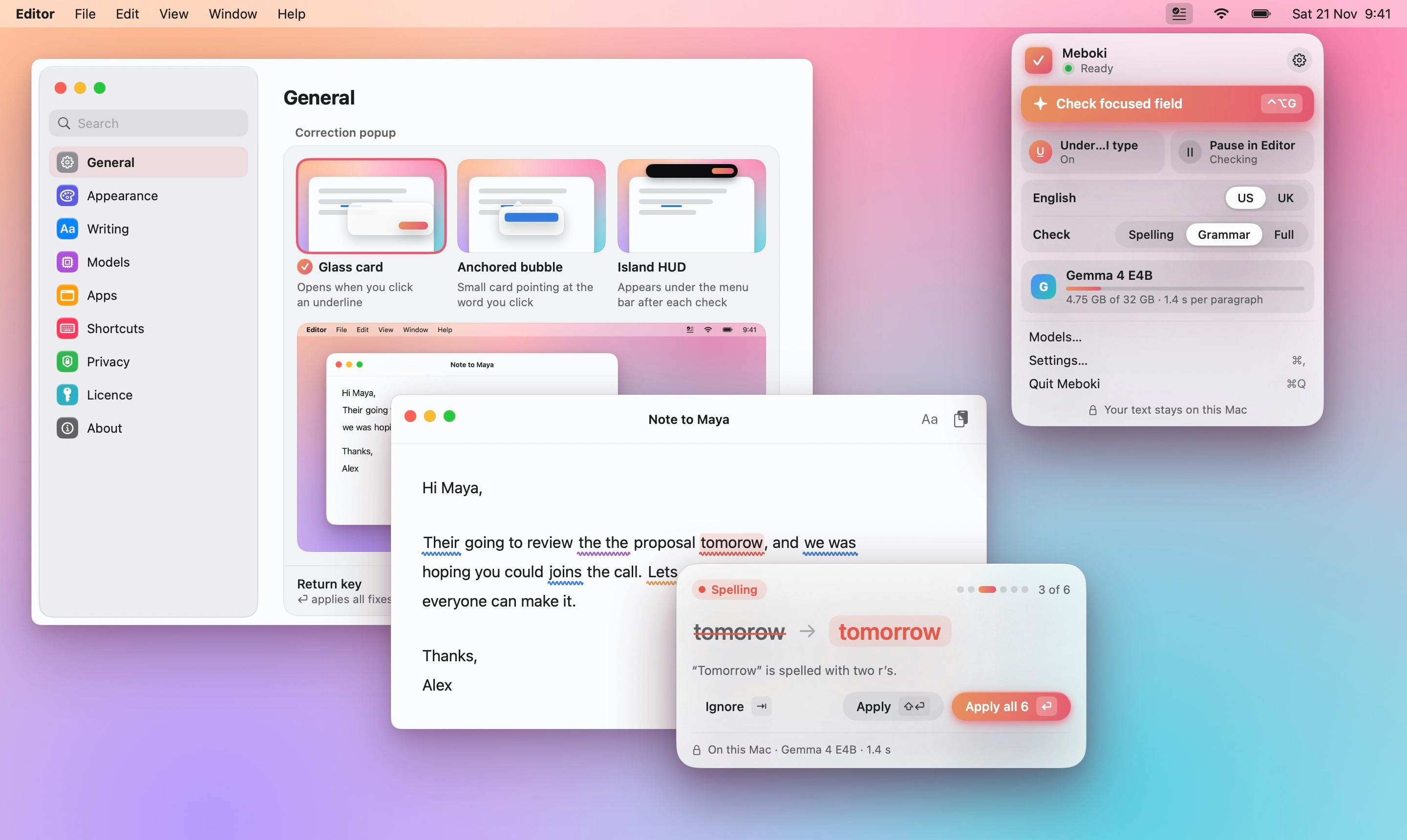
Meboki is an open-source Mac grammar checker launched on Product Hunt that offers a Grammarly-style experience with all computation kept local. It uses an open-source AI model running on the user's Mac, never uploading text to servers, with no accounts, subscriptions, or telemetry. It mimics system spell checking: type in Mail, Slack, Notion, Gmail, or most apps and errors get squiggly underlines, fixed with one Return press. GPL-3.0 licensed, one-time $39 with multi-license discounts and a 7-day trial; hotkey mode stays free afterward. Limits: Apple Silicon and macOS 14+ only, English only.
A Grammarly-style grammar correction experience, but with all computation kept on your Mac. The open-source tool Meboki launched on Product Hunt and garnered 80 upvotes and 16 comments, ranking 15th — targeting exactly those users who don't want to hand their emails, chats, and work documents over to cloud servers.
Why Offline Grammar Checking Deserves Its Own Tool
The business model of mainstream grammar checkers on the market is built on the cloud: text uploaded, model inference, results sent back. This pipeline is vendor-friendly, but not so friendly for privacy-sensitive scenarios — email bodies, Slack direct messages, project plans in Notion are all, in essence, transient passengers on third-party servers.
Meboki's approach is to run open-source AI models directly on-device. The developer puts it bluntly in the product description: most grammar checkers send everything you type to someone else's server, whereas Meboki checks English using an open-source model running on your own Mac, and it works even without an internet connection. It offers functionality close to Grammarly's grammar and spelling correction, but strips away the account system, subscription, and telemetry.
This is what makes it a different kind of product from Grammarly: the former sells correction accuracy and ecosystem integration, while the latter sells data that never leaves your machine.
Accuracy Trade-offs Between Local and Cloud Models
Grammar correction tasks are typically modeled as sequence labeling or text-to-text generation: the model reads a sentence, marks error spans, and provides replacement suggestions. Cloud services can call on large models with tens of billions of parameters and continuously fine-tune them with massive user data, giving them an edge in complex sentence structures, contextual coherence, and style suggestions. Local execution is limited by memory and compute, generally using much smaller, quantized and compressed open-source models. Spelling and basic grammar error detection rates can approach cloud levels, but judgment on semantic ambiguity, long-distance dependencies, and stylistic register is noticeably weaker. This also means the selling point of offline tools isn't "more accurate" but "data doesn't leak out" — users must weigh accuracy against privacy themselves.
Interaction Design: Squiggly Lines Plus the Return Key
Meboki's usage mimics the intuition of system-level spell checking. When typing in Mail, Slack, Notion, Gmail, and most other apps, problematic English is marked with squiggly underlines, and pressing the Return key fixes all suggestions at once.
The cleverness of this design is that it doesn't require apps to provide a plugin interface. It works at the input layer, so in theory any Mac app that accepts keyboard input can benefit — which is the practical meaning of "any Mac app" in the title. For people who habitually switch between multiple writing tools, this saves the hassle of installing a separate extension for each app.
After the trial period ends, hotkey mode remains free. That is, even without paying, users can still trigger checks via a keyboard shortcut rather than losing the tool entirely.
System-Level Input Monitoring and Accessibility Permissions
To achieve squiggly underlines and one-key correction in any Mac app, the tool typically needs to use macOS's Accessibility interface to read the text in the current input field, and write back corrections by simulating keyboard events. This approach bypasses each app's proprietary plugin system, offering strong universality, but it comes with two practical constraints: users must grant Accessibility permissions in System Settings on first use; and different apps respond to text replacement somewhat differently, with some apps potentially requiring compatibility handling for cursor position or selection. This is also the technical path commonly adopted by such "system-level writing tools."
Open Source, Pricing, and Hardware Requirements
Meboki is open-sourced under the GPL-3.0 license, with source code available on GitHub. Pricing is a one-time $39, with 50% off per license for 3 or more, and a 7-day trial. Compared to Grammarly's subscription model, this buyout approach is more cost-effective for long-term users and aligns with the business logic of offline tools — there are no ongoing server costs to amortize.
There are clear hardware requirements: Apple Silicon only, with macOS 14 or later. This is unsurprising — running AI models locally places demands on both the chip and system frameworks, and Intel Mac users are excluded. Open source plus local inference means both the model itself and the inference process can be examined, a plus for users who care about auditability.
Apple Silicon and Local Inference Performance
Apple Silicon refers to Apple's self-designed ARM-based chips used in Macs since 2020 (M1 and later models). Its unified memory architecture lets the CPU and GPU share the same high-speed memory, so the GPU can access model weights directly without the frequent data copying required by discrete graphics cards. This is particularly crucial for running AI models locally: grammar correction models typically have only a few hundred million to just over a billion parameters, and after quantization can fit entirely in unified memory, keeping inference latency within acceptable limits. By contrast, Intel Macs' integrated graphics lack corresponding acceleration frameworks, and CPU inference is an order of magnitude slower — which explains why Meboki excludes Intel models. The macOS 14 requirement relates to updates in Apple's machine learning frameworks, as only newer systems provide the complete local inference APIs and model format support.
Who It's For, and Who It's Not
Meboki's target user profile is quite clear: privacy-conscious, writes in English daily, primarily works on a Mac. Freelancers, writers handling sensitive content, and users who simply dislike subscriptions all fit.
Its limitations are equally obvious. Local small models usually fall short of cloud large models on complex grammar and style suggestions — the specific gap depends on the model used, and the product description doesn't provide accuracy comparisons. English-only and Apple Silicon-only also shut out some potential users.
If what you need is a cross-platform, in-depth writing assistant, Meboki isn't the answer; if you just want a tool that works offline, requires no subscription, and can flag English errors in any Mac app at any time, it offers a noteworthy option.
One-line Summary
Meboki uses a local open-source model to do offline English grammar checking on Mac, for a one-time $39.
Paragraph Summary
Meboki is an open-source Mac grammar checking tool launched on Product Hunt, offering a Grammarly-style correction experience but with all computation kept on-device. It checks English using an open-source AI model running on the user's Mac, with text never uploaded to servers, and no account system, subscription, or telemetry. Its interaction mimics system spell checking: when typing in most apps like Mail, Slack, Notion, and Gmail, errors are marked with squiggly underlines and fixed with one press of the Return key. The product is open-sourced under GPL-3.0, priced at a one-time $39 with 50% off for multiple licenses, and hotkey mode remains free after the 7-day trial. Its limitations are also clear: Apple Silicon and macOS 14+ only, and English only. It's positioned differently from Grammarly, trading privacy and a buyout model for in-depth writing suggestions and cross-platform capability.
Related articles

Nothing CMF Buds 2A Drops to $17.89 on Black Friday: A New Low for ANC Earbuds
Nothing CMF Buds 2A wireless earbuds Black Friday deal: just $17.89 on Amazon, about $11 off retail and a record low. ANC earbuds at an entry-level price.

When AI Creation Gets Accused of "Spitting": Hacker News Heats Up Over the Glaude Controversy
A Hacker News post, "Spitting in the Face of Glaude," sparks debate on AI creation transparency and attribution ethics. This analysis examines the blurred creator identity behind the controversy and offers practical advice for AI content production.

Akai Embraces Custom Firmware: MPC Sample 1.4 Lets Users AI-Program Their Sampler
Akai embraces the modding community with MPC Sample 1.4 firmware, supporting vibe-coded custom firmware and effects. We analyze the impact of this open strategy on music hardware and AI-assisted programming.