Media's Pivot to Video 2.0: An Irreversible Wave of Transformation
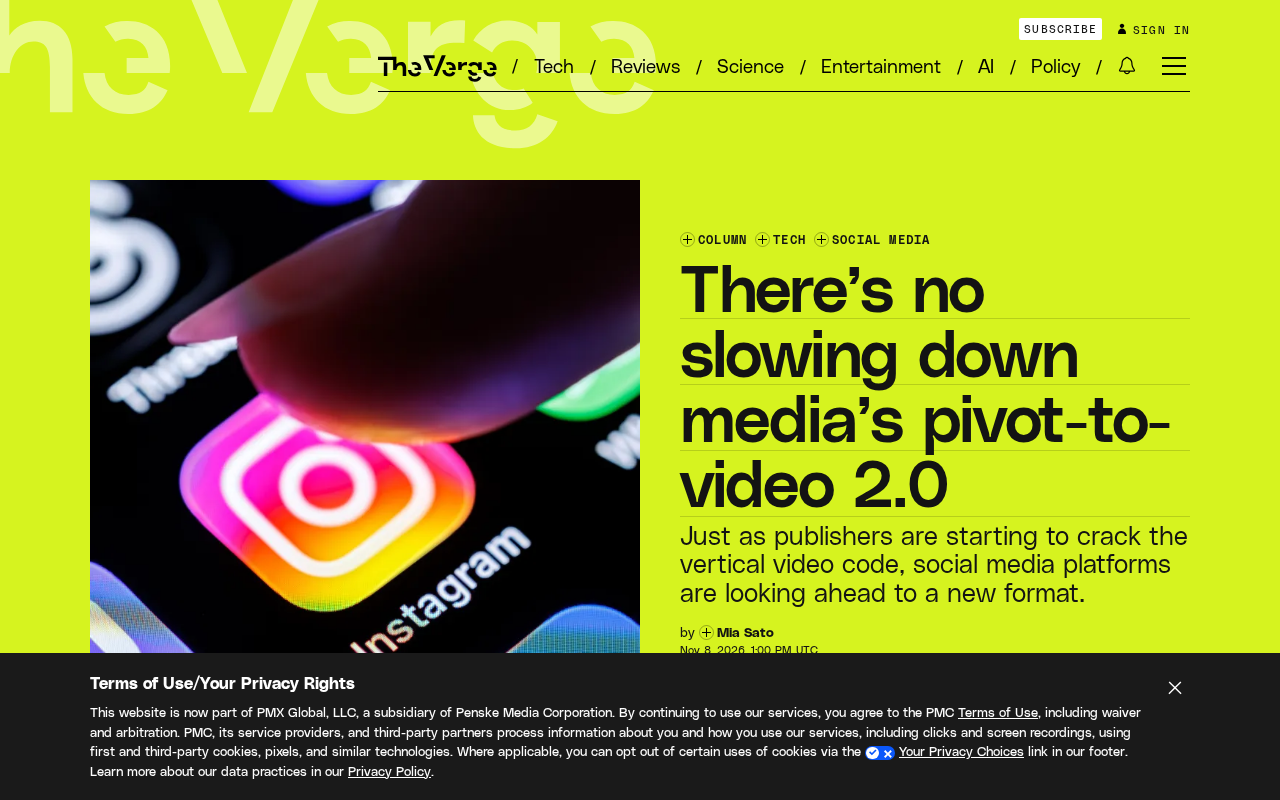
Media's pivot to video enters 2.0, with sustained production pressure and platform power struggles as core challenges.
The article outlines the media industry's pivot to video in its 2.0 phase. Unlike the first wave a decade ago, video is now embedded in media production and commercial loops, shifting the core question from "whether to do video" to "how to produce efficiently and sustainably." The Verge's The Stepback, written by Mia Sato, highlights algorithm-driven pressure on creators, content homogenization, and burnout. Platform-media entanglement and algorithm changes threaten video strategies, while tension exists between vertical storytelling and journalistic professionalism. 5G and AI tools lower barriers, ad budgets tilt toward video, and the transformation won't slow down. Differentiation and sustainable production are key.
Title
Media's Pivot to Video 2.0: An Irreversible Wave of Transformation
Meta Description
Media's pivot to video has entered its 2.0 phase. The Verge's The Stepback newsletter examines creator pressure, the platform-media power struggle, and why this transformation won't slow down.
Article Content
The media industry's pivot to video hasn't stopped — it's entering a "2.0 phase" with greater maturity. The Verge's newsletter The Stepback recently turned its attention to this trend, with Mia Sato analyzing the pressure content creators face in continuously producing video for the internet. Although only the opening excerpt of the original article has surfaced, by combining industry dynamics with the platform ecosystem, we can still piece together the key threads of this transformation.
From "Experiment" to "Standard": A Decade of Video Evolution
About a decade ago, media organizations began experimenting with video content at scale. At the time, "pivoting to video" was more like an arms race: text-based outlets rushed to set up video departments, and social platforms lavished subsidies on short-video creators. Yet the first wave was littered with casualties — many teams pulled back after hitting high costs and monetization difficulties.
Now in the "2.0" phase, the logic of transformation has quietly shifted. Video is no longer just a traffic funnel but is directly embedded in media content production and the commercial loop. From live news coverage to in-depth explainers, from horizontal long-form video to vertical short-form, the diversification of formats reflects a complete reshaping of user consumption habits. The core question of this phase is no longer "should we do video?" but "how do we produce efficiently and sustainably?"
Creator Pressure: The Never-Stopping Content Machine
The Stepback newsletter explicitly points to "the pressure of creating content for the internet." In the video 2.0 era, this pressure is especially pronounced. Algorithmic recommendation systems favor high-frequency updates, audience attention windows keep shrinking, and creators are forced to become round-the-clock content machines.
Mia Sato has long covered the internet content ecosystem, and her analyses often focus on how platform rules shape creator behavior. While the pivot to video brings richer forms of expression, it also intensifies content homogenization and creator burnout. When every media outlet and individual is chasing video traffic, differentiation becomes harder to achieve.
Algorithmic recommendation systems are the key backdrop for understanding creator pressure. Major platforms (such as YouTube, TikTok, and Facebook) widely adopt recommendation algorithms based on user behavior, with core metrics including click-through rate, completion rate, engagement rate, and update frequency. Algorithms tend to allocate traffic to frequently updated content with good engagement, because this extends user dwell time and increases ad exposure. This mechanism creates a "feedback loop": creators must increase update frequency to maintain visibility, and high-frequency updates further train the algorithm to prefer more frequent content supply. The result is that creators fall into a "content treadmill" — once they stop or slow down, traffic drops rapidly. Meanwhile, algorithmic opacity makes it hard for creators to reliably predict performance; they can only adapt to rule changes through constant trial and error, which exacerbates burnout and content homogenization.
The Symbiotic Game Between Platforms and Media
The other side of media's pivot to video 2.0 is the deep entanglement between platforms and content providers. Social platforms need quality video to retain users, and media need platform traffic to achieve reach. This interdependence has spawned new collaboration models while also planting hidden risks. A single algorithm adjustment by a platform can render a media outlet's video strategy moot.
That said, short-video platforms are becoming an important entry point for news consumption. Traditional media are forced to adapt to new grammar such as vertical storytelling and fast-paced editing, which creates inherent tension with the rigorous requirements of journalistic professionalism. How to maintain content quality while catering to platform logic is an unavoidable question in the 2.0 phase.
The "symbiotic game" between platforms and media can be understood through platform dependency theory. When pivoting to video, media organizations often rely on social platforms' distribution capabilities to reach audiences, while platforms rely on quality content produced by media to attract and retain users. This interdependence appears equal but is actually asymmetric in power: platforms hold the dominant position over algorithm rules, traffic allocation, and monetization policies, while media are in a relatively passive position. When platforms adjust algorithms (for example, reducing the weight of external links or changing recommendation logic), media's video strategies may instantly fail. This "platform risk" prompts some media to attempt multi-channel distribution or build their own platforms, but high technical and operational costs make it difficult for most organizations to escape dependence on large platforms. Therefore, media's pivot to video in the 2.0 phase is not only a shift in content format but also an adaptation to and game with platform power structures.
The Transformation Won't Slow Down
The original title "There's no slowing down media's pivot-to-video 2.0" delivers a clear judgment: there is no sign of this transformation slowing. On the technology side, the spread of 5G and the maturation of AI video tools further lower the barrier to video production; on the commercial side, advertising budgets continue to tilt toward video, and brands' appetite for video content shows no sign of waning.
For content creators and media organizations, pivoting to video is no longer a multiple-choice question but a survival question. Yet the lesson of the 2.0 era is that simply chasing video quantity is unwise; finding a sustainable production rhythm and a differentiated content positioning is the key to navigating cycles. This issue of The Stepback newsletter provides a calm footnote to this ongoing transformation.
The maturation of 5G and AI video tools is an important technological driver of the video 2.0 phase. The high speed and low latency of 5G networks significantly improve the loading and playback experience of mobile video, enabling HD, interactive, and even live-streamed video content to become widely available. At the same time, AI video tools (such as automated editing, smart subtitles, voice synthesis, and generative video models) dramatically lower the technical threshold and labor costs of video production. Editing, dubbing, and special effects work that once required a professional team hours to complete can now potentially be done in minutes with AI assistance. These tools not only boost production efficiency but also enable small and mid-sized media and independent creators to continuously produce video content at lower cost. However, lower technical barriers also mean further excess in content supply; creators must invest more effort in creativity and differentiation to stand out in algorithm-driven competition.
One-line Summary
Media's pivot to video enters its 2.0 phase, with sustained production pressure and platform power struggles as core challenges.
Paragraph Summary
The article outlines the characteristics of the media industry's pivot to video in its 2.0 phase. Unlike the first wave of experimentation a decade ago, video has evolved from a traffic funnel into a standard component embedded in media production and the commercial loop, with the core question shifting from "should we do video?" to "how do we produce efficiently and sustainably?" The Verge's newsletter The Stepback, written by Mia Sato, focuses on the high-frequency update pressure creators face under algorithm-driven systems, noting intensified content homogenization and burnout. Meanwhile, platforms and media are deeply entangled, and algorithm adjustments can directly impact media video strategies; tension exists between vertical storytelling and journalistic professionalism. 5G and AI video tools have lowered production barriers, advertising budgets continue to tilt toward video, and the transformation won't slow down. The article concludes that differentiated positioning and a sustainable production rhythm are the key to navigating cycles.
Related articles
 Tech Frontiers
Edge AI on Microcontrollers: When Is It Actually Worth Deploying?
Drawing on Reddit discussions and Arm case studies, this article analyzes the real-world use cases for edge AI on microcontrollers: when each device needs independent inference, when a gateway or cloud is more reasonable, and the costs and boundaries of specialized hardware.
 Tech Frontiers
Pushing the Limits of Extreme Sudoku on a 16GB GPU: Insights from Depth and Flow Matching
A researcher trained a 16.54M-parameter model on a 16GB GPU to solve extreme Sudoku, finding effective depth breaks the 60% plateau and flow matching with improved sampling pushes accuracy past 99% with ~50× lower layer-evaluation budget.
 Tech Frontiers
AI Agent Approval Workflows: Why Human Confirmations Always Get Mindlessly Clicked
Why do AI agent approval workflows always get mindlessly clicked? A Reddit discussion shows that separating rules from keys, low-frequency high-risk approvals, and GitHub Environments-style gates are the keys to effective approvals.