Meelo v3.12.0: A Self-Hosted Music Server That Excels at Metadata Management

Meelo v3.12.0 brings mobile apps, local lyrics, and smart thumbnails to self-hosted music management.
Meelo v3.12.0, an open-source self-hosted music server focused on metadata management and UI experience, adds cross-platform mobile apps (Android APK + iOS TestFlight), local lyrics support (embedded and .lrc), OpenCV-powered smart thumbnails, and MusicBrainz integration for record labels and areas. Its roadmap includes offline playback, crossfade, Chromecast support, and better non-ASCII character handling.
In an era where streaming music services have a near-monopoly on how people listen to music, a dedicated group of developers continues to build and maintain their own music libraries. The self-hosted music server Meelo is one such project. Recently, this open-source project—whose core selling points are its user interface (UI) and metadata integration—released v3.12.0, bringing a mobile app, local lyrics support, and a host of other noteworthy updates.
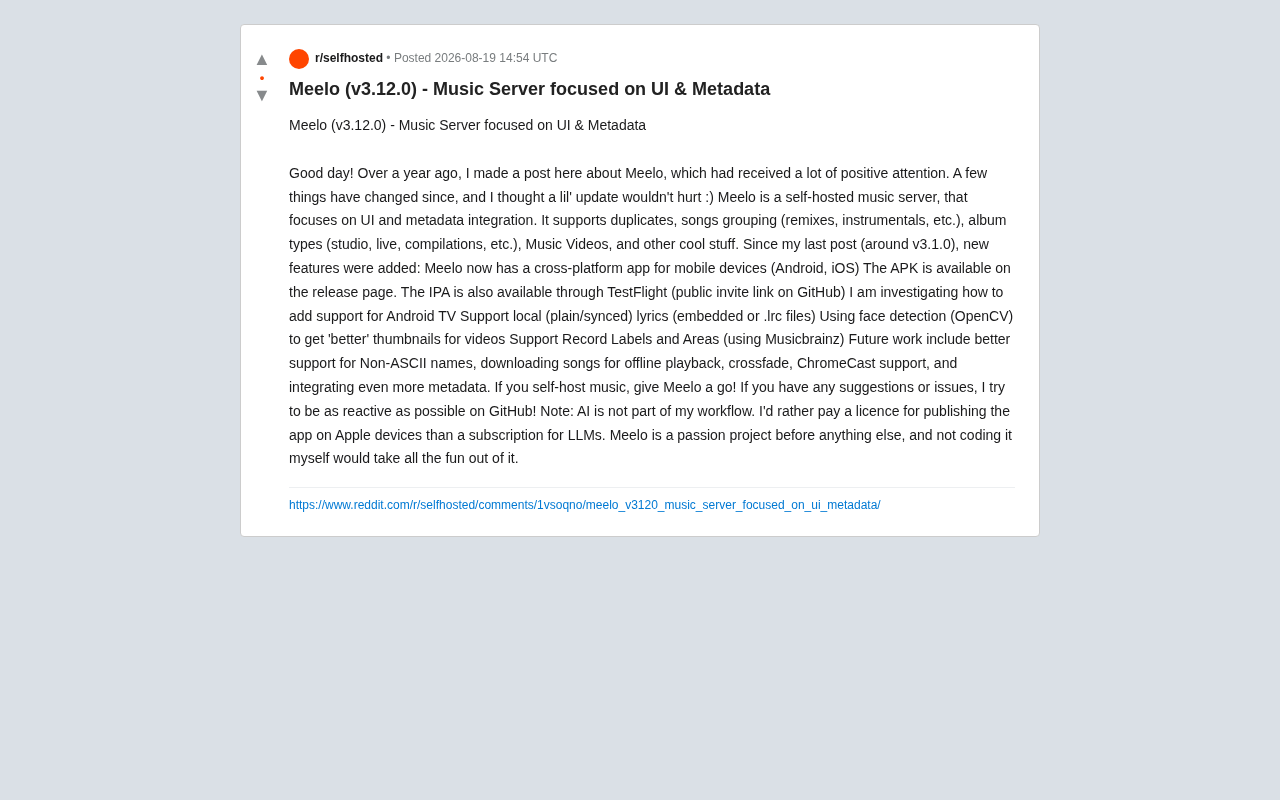
What Is Meelo: More Than Just a Music Player
Meelo is a music server application you can deploy on your own server. A self-hosted music server is a solution where users store their music files on a server they own or rent, managing and playing them through dedicated software. This space already has several mature open-source projects—Navidrome, Jellyfin, Subsonic, Funkwhale, and others—each with its own strengths. Navidrome is known for being lightweight and efficient, while Jellyfin is a full-featured media server covering both audio and video. Compared to these alternatives, Meelo doesn't simply list audio files for playback. Instead, it focuses on fine-grained music organization, choosing meticulous metadata management as its core competitive advantage. This positions it functionally closer to a music database management system.
Why Metadata Matters So Much
Music metadata refers to the descriptive information embedded in audio files or stored externally, including track titles, artists, album names, release years, genres, track numbers, cover art, and more. Common metadata standards include ID3 (for MP3), Vorbis Comment (for FLAC/OGG), and APE Tag. High-quality metadata is the foundation of a well-organized music library—without accurate metadata, even the most powerful player can't properly categorize and display your music. Many self-hosted users have music files from diverse sources (CD rips, digital purchases, online downloads), and the metadata quality varies wildly. Cleaning up and completing this data in a unified way is one of the biggest pain points for music collectors. Meelo is designed squarely around this challenge.
With the needs of serious music collectors in mind, Meelo natively supports the following capabilities:
- Duplicate file handling: Multiple versions of the same song can be identified and managed;
- Song grouping: Remixes, instrumentals, and other variants can be grouped under a single song;
- Album type differentiation: Distinguishes between studio albums, live albums, compilations, and more;
- Music video support;
- And other practical features geared toward metadata management.
These design choices make Meelo feel more like a "music archive" than a simple player. For users with large, high-quality local music collections who care about proper categorization, this metadata-centric approach is a perfect fit.
v3.12.0 Update Highlights
According to the developer, Meelo has accumulated a significant number of feature iterations since the last community post (around v3.1.0). Several highlights in this update stand out.
Cross-Platform Mobile App Officially Launches
The most important update is that Meelo finally has a cross-platform mobile app, covering both Android and iOS.
- Android users can download the APK directly from the project's Release page;
- iOS users can join the public beta via TestFlight, with the invitation link available on GitHub.
TestFlight is Apple's official beta testing distribution platform, allowing developers to invite up to 10,000 external testers to try an app before it officially launches on the App Store. Testers simply tap the invitation link to install the beta version, and each build remains valid for 90 days. For indie developers and open-source projects, TestFlight is the most convenient and compliant way to distribute iOS apps, since Apple's closed ecosystem doesn't allow direct APK-style installations like Android. Distributing via TestFlight still requires the developer to hold an Apple Developer account (annual fee of $99), which is precisely the "license fee" the Meelo developer mentions in his "no AI" statement later—he considers this money a more worthwhile investment than an AI subscription.
Additionally, the developer is exploring Android TV support. This means Meelo could eventually extend from phones and tablets to living room big screens, further filling the multi-device gap in self-hosted music solutions.
Local Lyrics Support and Smart Thumbnails
The new version adds support for local lyrics, including both plain text lyrics and time-synced lyrics. Sources can be either lyrics embedded within audio files or standalone .lrc files.
LRC is a widely used lyrics file format that is essentially a plain text file with time tags. Each line of lyrics is preceded by a timestamp accurate to hundredths of a second (e.g., [01:23.45]), which the player uses to synchronize scrolling lyrics with the music line by line. In contrast, plain text lyrics (without timing information) can only be displayed as a block without synchronized highlighting. In recent years, some players have also started supporting "word-by-word synced lyrics" (Enhanced LRC or TTML format), which can highlight individual words with KTV-like precision. Meelo supports both embedded lyrics and standalone .lrc files, accommodating different users' lyrics management habits.
Even more interesting is Meelo's introduction of OpenCV face detection technology to automatically select "better-looking" thumbnails for music videos. OpenCV (Open Source Computer Vision Library) is an open-source computer vision library that originated in 1999, initially developed by Intel, and has since become one of the most widely used open-source tools in image processing and machine vision. Its face detection capability is based on the classic Haar cascade classifier (implemented via the Viola-Jones algorithm) or more modern deep learning models, enabling rapid face localization in images. Meelo uses OpenCV to detect frames containing faces from multiple frames of a music video, selecting these as video thumbnails. Compared to random frame captures or fixed-timestamp captures, this significantly improves the visual appeal and recognizability of covers, avoiding thumbnails that capture black screens or meaningless frames. It's a detail-level optimization that clearly demonstrates the project's commitment to UI experience.
Richer Metadata Source Integration
Leveraging the MusicBrainz database, Meelo now also supports record labels and area information.
MusicBrainz is one of the world's largest open music encyclopedia databases, maintained by the MetaBrainz Foundation and operating on a community-collaborative editing model, similar to a Wikipedia for music. It assigns a globally unique identifier (MBID) to every music entity (artists, albums, tracks, record labels, etc.) and provides free API endpoints for third-party applications to query. The MusicBrainz database contains information on over 2 million artists and 3 million albums, serving as the core metadata source for numerous open-source projects including Picard (an auto-tagging tool), Kodi, and Jellyfin. With MusicBrainz integration, Meelo can automatically match and fill in missing information in users' music libraries, dramatically reducing the effort required for manual curation.
For collectors who want to browse and search their music by label or region, the addition of this metadata further broadens the organizational dimensions available.
Meelo's Future Development Roadmap
The developer has also shared upcoming development plans, with a clear and practical direction:
- Improved support for non-ASCII character names, ensuring more accurate display of track/artist names in Japanese, Chinese, and other non-Latin scripts;
- Offline download and playback, allowing songs to be cached locally for listening without a network connection;
- Crossfade—an audio transition technique where the volume of the ending song gradually decreases while the next song's volume gradually increases, creating a smooth, seamless transition and eliminating the abrupt silence between tracks. This feature has long been standard on mainstream streaming platforms like Spotify and Apple Music, typically allowing users to customize transition durations between 1-12 seconds. For self-hosted servers, implementing crossfade requires the client to simultaneously decode two audio streams and perform real-time mixing, placing certain technical demands on the player's buffer management and audio engine. Including this on the roadmap signals that Meelo is benchmarking against the user experience standards of commercial streaming services;
- Chromecast support—Chromecast is a media casting protocol and device ecosystem from Google that allows users to wirelessly cast audio and video content from phones, tablets, or computers to Chromecast-enabled TVs, speakers, and other devices. Unlike AirPlay (Apple) and DLNA, Chromecast works by sending the media URL to the receiving device, which then fetches and plays the stream on its own, rather than streaming in real-time from the sender. This puts less strain on the sending device's performance and battery. Chromecast support means users can turn their home smart speakers or TVs into high-quality music playback endpoints, greatly expanding use cases;
- And ongoing integration of additional metadata sources.
This roadmap shows that Meelo is evolving from a "desktop/web management tool" into a multi-platform music ecosystem with a complete user experience.
The Developer's "No AI" Statement
In an open-source community where nearly everyone talks about AI, the Meelo developer's statement stands out as distinctly different:
"AI is not part of my workflow. Rather than paying for a subscription to an LLM, I'd rather pay a license fee to ship an app on Apple devices. Meelo is first and foremost a passion-driven project, and if I don't write the code myself, all the fun is lost."
This statement isn't meant to disparage AI tools—rather, it expresses a clear creative philosophy: for indie developers, coding itself is the passion. At a time when AI-assisted programming is booming and tools like GitHub Copilot, Cursor, and Claude have become standard productivity boosters for many developers—with some surveys showing that over half of professional developers already use some form of AI coding assistant in their daily work—the Meelo developer's commitment to "hand-written code" has become a distinctive quality of the project, one that resonates easily with like-minded developers and users. This choice is fundamentally a defense of "the value of the development process itself"—code is not merely a vehicle for functionality, but a medium through which creators express themselves.
Who Should Use Meelo
Overall, Meelo is a product with a clearly defined target audience. It's best suited for:
- Music enthusiasts with large local music collections who care about categorization, versions, and metadata;
- Self-hosting enthusiasts who want to break free from streaming subscriptions and maintain control over their own music libraries;
- Users who have standards for UI aesthetics and user experience, and aren't satisfied with a "good enough to play" approach.
With the mobile app now available and metadata capabilities continuously improving, Meelo is addressing the long-standing rough edges of self-hosted music solutions. If you're looking for a self-hosted server that's both beautiful and "understands music," head over to its GitHub page and give it a try—the developer has also noted that suggestions and issues will be addressed on GitHub as quickly as possible.
Related articles

Why Does the Tesla Roadster Need to Fly? A Deep Dive into Musk's Wild Demo
Tesla's Roadster launch showed wall-climbing, upside-down driving, and flying stunts—but The Vergecast notes the demo car may lack a battery, the Rocket version is invite-only and not street-legal, and the website terms don't guarantee delivery. After nine years of delays, why does this car still need to exist?

AI Is Not a Replacement: Human-AI Collaboration Through the Lens of Factory Root Cause Analysis
Starting from factory root cause analysis, this article explains how AI accelerates evidence chain construction rather than replacing human experts, exploring the pragmatic implementation logic and business value of 'AI supporting people rather than replacing them.'

AI Agent Decision Auditing: Building an Evidence Chain in Regulated Workflows
Starting from a Reddit discussion, this article analyzes three core issues in AI agent decision auditing within regulated workflows: what fields audit records should contain, how to handle feedback latency for erroneous decisions, and how to continuously calibrate LLM judge consistency with human judgment.