MemBoostAI: A Deep Dive into the AI-Powered Daily Memory Training Tool

A deep dive into MemBoostAI, an AI-powered daily memory training tool built on cognitive science principles.
MemBoostAI is an AI-driven memory training tool that combines cognitive science principles like active recall and spaced repetition with modern AI capabilities. Unlike traditional flashcard tools like Anki, it extends memory training to everyday information consumption rather than just deliberate study material. This analysis explores its scientific foundations, gamification approach, AI-powered personalization potential, and the significant user retention challenges facing cognitive training apps.
Can Memory Actually Be "Trained"?
In an age of information overload, we're exposed to massive amounts of content every day—articles, videos, podcasts, meeting notes—yet precious little actually sticks in our brains. MemBoostAI is an AI memory training tool built to address this universal pain point. Its tagline is clean and powerful: "Train your brain smarter. Retain more, every day!"
This product, created by indie developer Arun Nair, spans health & fitness, productivity, and artificial intelligence—reflecting its cross-domain positioning as both an efficiency tool and a digital "brain gym."
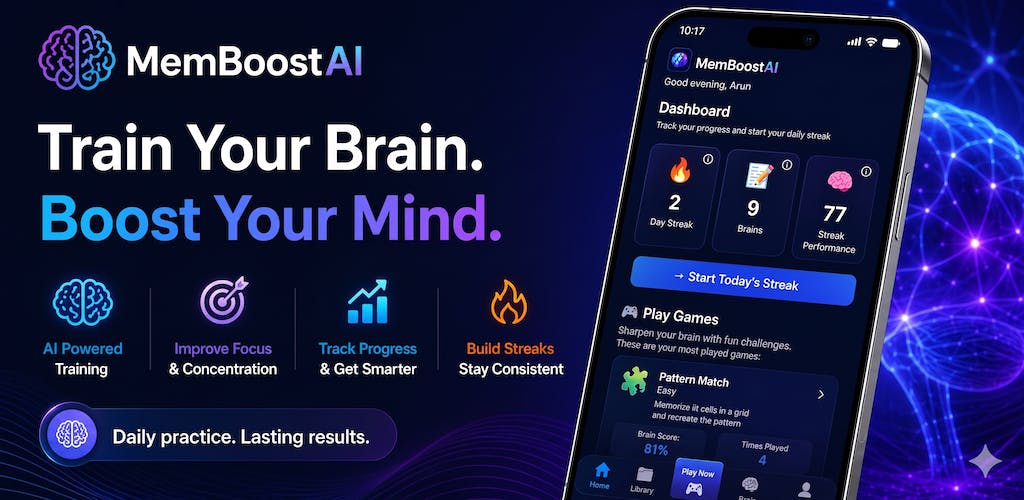
MemBoostAI's Core Philosophy: Making Memory Training Part of Daily Life
Tackling Memory Problems Through Attention
MemBoostAI's core approach hits the nail on the head: helping people pay more focused attention to what they read, watch, learn, and experience. It posits that memory decline is often not a matter of talent but rather an "attention" problem—we've grown accustomed to skimming through information without actively noticing details, making it naturally difficult to form long-term memories.
This insight is backed by solid cognitive science. Professor Gloria Mark from UC Irvine noted in her 2023 book Attention Span that modern people shift their attention focus on digital devices approximately every 47 seconds. This "shallow scanning" mode of information consumption directly impacts the quality of memory encoding. From a neuroscience perspective, memory formation requires information to move from sensory memory into working memory, and then be consolidated through the hippocampus into long-term memory. Working memory capacity is extremely limited—cognitive psychologist Nelson Cowan's research shows that human working memory can only maintain about 4 information chunks at a time. When we frequently switch attention, information in working memory gets overwritten by new inputs before deep processing can occur, leaving the hippocampus no opportunity to initiate memory consolidation.
The "Levels of Processing Theory" proposed by Fergus Craik and Robert Lockhart in 1972 long ago demonstrated that the depth at which information is processed determines how firmly it will be remembered—shallow processing (such as merely scanning headlines or noticing font appearance) almost never forms lasting memory, while deep processing (such as understanding meaning, building connections to existing knowledge, and self-referencing) significantly enhances memory encoding. In other words, it's not that we "can't remember"—we never truly "took it in." Recent fMRI studies further confirm that deep semantic processing activates broader cortical networks, forming richer neural representations that provide more memory retrieval cues.
Therefore, the product's first layer of value lies in cultivating attention, guiding users to develop a habit of "noticing details" during daily information intake.
Short Practice Sessions + Active Recall: A Scientific Approach
Methodologically, MemBoostAI employs two classic techniques repeatedly validated by cognitive science:
- Short daily exercises: Breaking training into bite-sized, low-burden daily tasks to lower the barrier to consistency. Cognitive Load Theory points out that when learning tasks exceed working memory capacity, learning efficiency drops dramatically. Keeping exercises within 5-10 minute sessions not only reduces psychological resistance but also ensures each practice session is completed while cognitive resources are abundant.
- Active recall: Unlike passive rereading, active recall requires the brain to actively "retrieve" information, making it one of the most effective ways to strengthen memory traces.
The power of active recall has been repeatedly confirmed through extensive experiments. A landmark 2006 study by Washington University psychologists Henry Roediger and Jeffrey Karpicke, published in Psychological Science, showed that actively testing yourself—compared to repeatedly reading the same material—can improve long-term memory retention by over 50% after one week. This phenomenon is known in academia as the "Testing Effect" or "Retrieval Practice Effect." The neuroscience mechanism behind it: when the brain actively retrieves information, synaptic connections between the hippocampus and prefrontal cortex are strengthened, and the neural pathways of relevant memory traces undergo Long-Term Potentiation after each successful retrieval, forming more stable memory representations. Additionally, the "desirable difficulty" generated during retrieval—that feeling of needing effort to recall something—is precisely the signal of memory strengthening.
The complementary Spaced Repetition strategy is based on German psychologist Hermann Ebbinghaus's 1885 discovery of the forgetting curve—information decays exponentially after learning, with potentially 70% of new content forgotten within 24 hours, but reviewing at specific time points can significantly slow the forgetting rate, with memory half-life extending after each review. Together, these two form the cornerstone of modern evidence-based learning methods—active recall ensures the effectiveness of each review, while spaced repetition optimizes the timing.
Additionally, the product introduces gamification through "memory challenges," using challenges and immediate feedback to make otherwise tedious memory training more engaging and sustainable. Duolingo is the most prominent success story of gamification in learning apps—with over 30 million daily active users, driven in part by streaks, XP, leaderboards, and achievement badges. Duolingo's data shows that the streak mechanism improves next-day retention by approximately 14%.
Stanford behavioral psychologist BJ Fogg's "Behavior Model" (B=MAP) states that habit formation requires Motivation, Ability, and Prompt to be simultaneously satisfied. Gamification design primarily strengthens motivation through immediate feedback that activates the brain's dopamine reward circuit—the positive feedback signal received upon completing each challenge prompts the brain to release dopamine, establishing a "behavior-reward" conditional association. However, research in Self-Determination Theory also shows that over-reliance on extrinsic rewards can undermine intrinsic motivation. Truly sustainable design needs users to feel autonomy, competence, and relatedness—in the context of memory training, this means letting users clearly see their ability growth curve and feel the intrinsic satisfaction of "I'm actually remembering more," rather than merely chasing points and badges. This is why memory training tools need carefully designed progress visualization dashboards.
How Does MemBoostAI Differ from Traditional Flashcard Tools?
From a product design logic perspective, MemBoostAI's value proposition is built on mature cognitive psychology foundations. Active recall and spaced repetition have long been the core weapons of tools like Anki, and MemBoostAI's differentiation lies in:
It doesn't just help you remember "deliberately studied" content—it extends training to everything you encounter in daily life.
To understand the significance of this differentiation, we need to review the development history of flashcard tools. The history of modern digital spaced repetition systems dates back to 1987, when Polish computer scientist Piotr Wozniak developed SuperMemo—the world's first computerized spaced repetition system, with the SM-2 algorithm at its core, which dynamically adjusts the next review time by tracking each card's review history and user self-ratings. In 2006, Australian developer Damien Elmes developed the open-source software Anki (Japanese for "memorization") based on the SM-2 algorithm, quickly building a massive user base among medical students, language learners, and various professionals thanks to its free, open-source, and highly customizable nature. Medical students use it to memorize tens of thousands of anatomy terms and pharmacology facts, making it a "secret weapon" for passing the USMLE.
However, Anki's main limitations are clear: users need to spend considerable time manually creating cards—including breaking knowledge into question-answer pairs, designing effective prompts, and organizing tags and deck structures. This "card-making" process itself constitutes a significant usage barrier, with many users abandoning the practice after just a few weeks due to the high time cost. Researchers call this phenomenon "deck fatigue." In recent years, newer tools like RemNote, Mochi, and Logseq have attempted to reduce friction through "notes and flashcards in one"—automatically generating flashcards as users take notes. AI intervention could fundamentally eliminate the "manual card-making" step, allowing systems to automatically identify key knowledge points from users' reading content and generate high-quality review materials.
Traditional flashcard tools require users to first organize knowledge points, while MemBoostAI emphasizes "ubiquitous attention training"—enabling you to consciously capture and recall details while reading news or watching videos. This "life-integrated memory training" positioning is its key differentiator from similar memory enhancement tools. From a cognitive science perspective, this approach also echoes "Situated Learning" theory: memories are more easily encoded and retrieved when associated with real-life scenarios because they're naturally embedded with rich contextual cues.
Regarding AI technology application, it's reasonable to speculate that AI may be used for automatically generating recall questions, evaluating answer quality, and dynamically scheduling review timing based on forgetting curves—precisely where large language models can bring incremental value to memory tools.
Specifically, the biggest transformation that LLMs like GPT-4 bring to EdTech lies in "automated educational content generation" and "adaptive interaction." In memory training scenarios, LLMs can automatically generate multi-level recall questions based on articles users have just read—from simple factual questions (e.g., "What year was the study mentioned in the article published?") to deep comprehension questions requiring synthesis (e.g., "Why does the author believe Strategy A is superior to Strategy B?"). This multi-level design corresponds to different cognitive levels from "remembering" to "analyzing" in Bloom's Taxonomy, promoting deeper knowledge processing.
Furthermore, LLMs can play the role of a "Socratic tutor," using follow-up questions and progressive hints to guide users toward recall rather than directly providing answers. For example, when a user can't recall a certain detail, AI can offer semantic hints ("This concept relates to XX that you learned last week") or structural hints ("It's the second of the three arguments the author made"). This "scaffolding" strategy enables users to complete retrieval under moderate challenge, maximizing learning gains. Khan Academy's AI tutor Khanmigo and Quizlet's Q-Chat are both actively exploring this direction, with the former having opened beta testing to select users in 2023.
Key technical challenges exist on several levels: First, quality consistency—LLMs may generate vague, ambiguous, or even factually incorrect questions, requiring reliable quality control mechanisms. Second, privacy protection—analyzing user reading content to generate personalized exercises means the system needs access to users' private data, and balancing local processing versus cloud-based analysis is an important architectural decision. Finally, computational cost—real-time API calls to large models generate considerable operational expenses, putting pressure on the commercial sustainability of indie developer projects.
Additionally, AI enables "personalized forgetting curve modeling." Traditional spaced repetition systems like SM-2 use a uniform mathematical model to predict forgetting time points—the same set of parameters for all users and all knowledge points. In reality, each person's forgetting rate for different types of knowledge varies significantly—visual information (like faces and charts), semantic information (like concept definitions), and procedural knowledge (like operation steps) have different decay patterns; the same person's memory performance also differs greatly between well-rested and fatigued states.
By using machine learning to analyze users' historical response data (accuracy, reaction time, error patterns, answer hesitation), the system can build independent memory strength models for each user's every knowledge point, achieving truly personalized review scheduling. Duolingo's research team demonstrated the feasibility of this direction in their 2016 ACL paper A Trainable Spaced Repetition Model for Language Learning. The proposed Half-Life Regression (HLR) model treats memory as a decay process with a computable "half-life" and uses user features (such as learning frequency, vocabulary difficulty, language similarity) as input features to predict individual half-lives. Experimental results showed that the HLR model outperformed the traditional Leitner system and SM-2 algorithm in predicting user forgetting points by approximately 9% and 5%, respectively. This means that through smarter review scheduling, users can achieve the same memory retention with fewer practice sessions—directly valuable for reducing user burden and improving retention rates.
Challenges Facing Memory Training Applications
As an early-stage product, MemBoostAI has several issues worth noting:
User Retention Is the Biggest Challenge
The hardest part of memory training apps has never been features—it's getting users to stick with daily use. "Daily practice" sounds wonderful, but user churn rates tend to be extremely high. Whether MemBoostAI can truly help users build long-term habits through gamification and AI-personalized recommendations will determine the product's success or failure.
Looking at industry data, according to reports from mobile analytics platforms like Adjust and AppsFlyer, the average 30-day retention rate for mobile apps is only about 5-10%, with health and education apps facing particularly dire situations—Day 1 retention typically falls between 25-35%, potentially dropping to just 3-8% by Day 30. Even Duolingo, with its top-tier product team, billions of data points, and mature growth system, needs to continuously invest significant resources in retention optimization—their product team has publicly shared that the streak feature alone went through hundreds of A/B test iterations.
For indie developer projects, this means the "Habit Loop" (Cue → Routine → Reward) needs to be considered as core architecture from the earliest product design stages, rather than as an afterthought. Specific strategies might include: precise notification timing (sending reminders during the user's typical learning time), progressive difficulty curves (avoiding early frustration from being too hard or boredom from being too easy), social commitment mechanisms (publicly sharing goals with friends), and anchoring to existing habits (such as attaching memory training after established behaviors like "morning coffee").
AI's Actual Effectiveness Awaits Market Validation
With AI applications blooming everywhere, a pragmatic question arises: How much substantive improvement does AI actually bring to memory training? If it simply generates questions, its competitive moat will be very limited—after all, GPT's API is open to all developers, and any competitor can quickly replicate this functionality. However, if it can precisely model personal forgetting curves, intelligently identify weak knowledge points for targeted reinforcement, or even sense users' current cognitive states to dynamically adjust training intensity, it could form truly differentiated user experiences and data moats.
Notably, AI education products face a unique validation challenge: their effects often take weeks or even months to manifest, while users struggle to perceive significant changes in the short term. This stands in stark contrast to the "instant gratification" experience of social media or entertainment apps. How to keep users believing the product works and continuing to use it before they've actually felt memory improvement is a common challenge for all cognitive training products—Lumosity (a brain training app) was fined $2 million by the U.S. Federal Trade Commission in 2016 for exaggerating cognitive enhancement claims, reminding practitioners to remain cautious and honest in efficacy marketing.
Conclusion: The Future Direction of AI Memory Training Tools
MemBoostAI represents an emerging product direction—personal growth tools that combine cognitive science, attention management, and AI technology. In an era of increasingly scarce attention, "how to remember more" is not only a rigid demand for students and knowledge workers but is also gradually becoming an ordinary person's self-improvement need to combat information overload.
From a broader perspective, such tools sit at the intersection of two major trends: "Second Brain" and "Cognitive Enhancement." The former was systematically articulated by Tiago Forte in his book Building a Second Brain, emphasizing the use of external systems to capture and organize knowledge; the latter focuses on directly improving the brain's own cognitive capabilities. MemBoostAI's unique positioning lies in the fact that it's not merely an external memory storage tool—it attempts to enhance the brain's internal memory capacity through training. As technologies like Brain-Computer Interfaces (BCI) and Neurofeedback develop, future cognitive enhancement tools may interact even more deeply with the human brain, and current AI-based memory training applications may be early forms of this long-term trend.
It's currently a fledgling indie project, but the core question it raises—whether we can reclaim our attention and memory through just a few minutes of deliberate training each day—is undoubtedly worth serious consideration for everyone living in the information age.
Related articles

Cloudflare Uses AI to Standardize Engineering Practices: From Standards Drift to Automated Enforcement
Deep dive into how Cloudflare uses LLMs to auto-enforce engineering standards, solving standards drift in large teams. Explores AI code review in CI/CD pipelines, challenges, and implications.

50 Decision Engines: Reshaping Creator Economy Operations with Quantitative Tools
Deep dive into the Sovereign Creator Calculator Suite: 50 Notion-based interactive decision engines covering pricing, churn, ad ROI, and MRR modeling for data-driven creator growth.

GLEE Competition: A Detailed Guide to the NeurIPS 2026 Official Negotiation AI Challenge
NeurIPS 2026 GLEE Competition challenges AI agents to negotiate in real-time via natural language, covering bargaining, persuasion, and game strategies. Full guide on rules, approaches, and prizes.