MEMOIR: Solving AI Agent Memory Management with Git Version Control

MEMOIR redefines AI Agent memory management using Git version control to solve context pollution and memory drift.
MEMOIR is an open-source AI Agent memory management system that brings Git version control (branching, committing, merging, rollback) to memory management, solving the pain points of context pollution, memory drift, and untraceability in traditional approaches. It replaces flat UUIDs with semantic paths for hierarchical organization, uses dual-engine (keyword exact matching + LLM semantic retrieval) parallel search, and provides multi-dimensional visualization and multi-Agent collaboration support, transforming AI memory from a black box into a traceable, debuggable white box.
The Memory Dilemma of AI Agents: Context Pollution and Memory Drift
Anyone who has worked on AI Agent development knows that memory management is one of the most frustrating aspects of the entire system. As conversation turns increase, the persistent problems of context pollution, token waste, and memory drift inevitably arise.
Context Pollution refers to the continuous accumulation of irrelevant or outdated information within the context window during multi-turn conversations, interfering with the model's understanding and reasoning about the current question. Memory Drift refers to the gradual deviation of an Agent's "memory" of earlier information from its original meaning as the conversation progresses, producing semantic distortion. The root cause of both problems lies in the attention mechanism of current large language models—the self-attention in Transformer architecture assigns weights to all tokens, and when the context grows too long, the weights of early key information get diluted, causing the model to become "attention-scattered." Current mainstream LLMs have context windows ranging from 4K to 200K tokens, but research shows that even with a 128K window, the model's recall rate for information in middle positions drops significantly—the so-called "Lost in the Middle" phenomenon.
While vector databases can store memories, they are essentially black boxes—no version control, no rollback capability, and debugging is virtually impossible. Vector databases (such as Pinecone, Weaviate, Chroma, etc.) convert text into high-dimensional vector embeddings and use cosine similarity or Euclidean distance for approximate nearest neighbor (ANN) retrieval. Although this approach enables semantic-level memory storage and retrieval, it has several structural flaws: vector embedding is lossy compression where original semantic information is inevitably lost during encoding; similarity in vector space doesn't always equate to logical relevance, easily producing "semantic hallucination"-style false recalls; most critically, vector databases lack temporal awareness and version management capabilities—they cannot answer questions like "when was this memory created" or "what changes has it undergone," making debugging and auditing nearly impossible.
Imagine this scenario: your Agent suddenly "forgets" key information from turn 3 during turn 50, or confuses two completely unrelated contexts. When you try to investigate, you find there's no way to even begin. MEMOIR's starting point is to fundamentally solve these pain points—it brings Git version control concepts into AI memory management, building a layered semantic memory system.
Core Design: Git-Style Version Control + Semantic Memory
Version Control: Making Every Memory Change Traceable and Reversible
MEMOIR's biggest highlight is the complete transplantation of Git's version control mechanism into AI memory management. It supports Branch, Commit, Merge, and Rollback operations familiar to developers, while using encryption mechanisms to ensure memory data integrity.
Git's version control is based on a Directed Acyclic Graph (DAG) data structure, where each commit is an immutable snapshot with data integrity guaranteed by SHA-1 hashes. Branches are essentially movable pointers to specific commits, and merging integrates the change histories of two branches into one. This mechanism is powerful because it simultaneously solves three problems: traceability (every change has a complete record), reversibility (any operation can be rolled back), and parallelism (multiple branches can evolve independently). MEMOIR maps these concepts to AI memory management, meaning every addition, deletion, or modification of memory generates a snapshot with a cryptographic hash, forming a complete memory evolution chain that fundamentally solves the untraceable memory changes problem in traditional approaches.
The practical benefits are very direct: when an Agent produces incorrect memory associations during a conversation, you can precisely roll back to a specific "memory snapshot" just like operating a Git repository, and systematically investigate exactly where things went wrong. For scenarios requiring reproducible testing, this capability is indispensable—you can test different strategies on different memory branches and merge the best-performing one.
Semantic Paths: Goodbye to Flat UUID Storage
Traditional approaches typically use flat UUID indexing to manage memories, with all entries piled at the same level, resulting in low search efficiency and chaotic organizational structure. UUIDs (Universally Unique Identifiers) are 128-bit random identifiers where all entries exist logically at the same level. This approach is manageable with small data volumes, but when memory entries reach tens or even hundreds of thousands, retrieval efficiency drops dramatically because the lack of hierarchical structure means each query might need to traverse large numbers of irrelevant entries.
MEMOIR replaces this with Semantic Paths, enabling hierarchical aggregation and logarithmic-time lookups. Semantic paths borrow from file system hierarchical directory structures and knowledge graph ontology concepts, organizing memories into tree-like or graph-like structures based on semantic relationships. This design reduces retrieval complexity from O(n) to O(log n), while the path itself carries rich contextual information—seeing the path immediately conveys the memory's belonging and meaning, greatly reducing cognitive load.

Put simply, memories are no longer scattered fragments but organized into tree structures by semantic relationships. For example, a path like "Project A/Requirements Discussion/Third Revision" aligns with human cognitive habits while dramatically improving retrieval efficiency. This design philosophy is especially effective for handling complex long-term memories.
Dual-Engine Retrieval: Exact Matching and Intelligent Search in Parallel
MEMOIR adopts a dual-engine architecture at the retrieval layer, a design philosophy rooted in the Hybrid Search paradigm from information retrieval, with each path serving its own purpose:
- Keyword Exact Matching Engine: Based on inverted index technology, similar to how Elasticsearch works, it achieves millisecond-level precise lookups through tokenization and building term-to-document mappings. When you know exactly what you're looking for, it provides millisecond-level precise positioning.
- LLM Intelligent Retrieval Engine: Leveraging LLM's semantic understanding capabilities to handle fuzzy queries and semantic association retrieval. For example, when a user asks "that performance issue we discussed earlier," the LLM can understand that "performance issue" might correspond to different expressions in memory like "latency optimization" or "QPS bottleneck," enabling synonym substitution and implicit semantic association identification.
These two engines complement each other, covering different use cases. Pure keyword matching can't handle semantic similarity problems, while pure LLM retrieval is both slow and expensive for exact lookups—the dual-engine design neatly avoids the shortcomings of single-approach solutions. The coordination strategy typically employs a cascading "coarse filtering then fine ranking" mode: in practice, most retrieval requests can first go through the keyword engine for quick filtering to narrow the candidate set, and the LLM is only called to semantically re-rank candidate results when semantic understanding is needed. This controls API call costs while ensuring semantic retrieval accuracy—saving tokens while maintaining retrieval quality.
Multi-Dimensional Visualization: Making Agent Memory Visible and Tangible
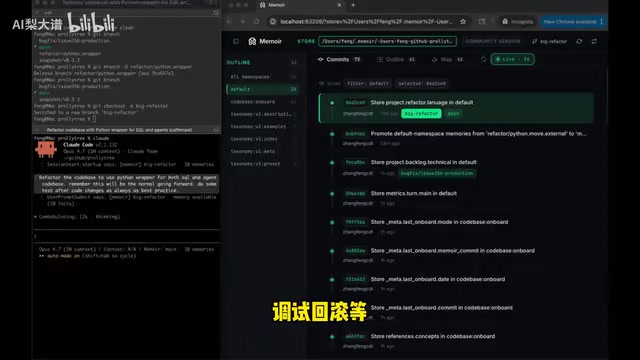
MEMOIR includes multiple built-in visualization exploration views, including tree view, graph view, and timeline view, with one-click browser opening support, allowing you to intuitively browse your Agent's entire memory structure.

This feature is enormously helpful for debugging and optimizing Agent behavior. When you can see the relationships between memories, temporal evolution, and hierarchical structure in a graphical way, the efficiency of problem identification improves by orders of magnitude. Compared to searching for a needle in a haystack within log files, the visual exploration experience is on an entirely different level. Especially when troubleshooting memory drift issues, the timeline view lets you clearly see from which node the memory started to "go off track."
Engineering Integration: Out-of-the-Box Developer Experience
CLI and Python API Dual Support
MEMOIR provides both CLI command-line and Python API access methods. The command line is suitable for quick debugging and scripted operations, while the Python API facilitates deep integration within code. In terms of model compatibility, it supports multiple mainstream LLMs with low migration costs.
Automated Hooks and Multi-Agent Collaboration
The project supports automatic hook mechanisms for Claude and Codex plugins, automatically completing context injection and memory capture, eliminating the need to manually write memory management code. Hooks are a classic design pattern in software engineering that allows predefined operations to be automatically triggered when specific events occur, without modifying core business logic. In AI Agent development, this means automatically injecting relevant historical memories at the start of a conversation (context injection) and automatically extracting and archiving newly generated key information at the end of a conversation (memory capture), achieving fully automated memory management.

In multi-Agent collaboration scenarios, MEMOIR supports offline path operations and online auto-classification. This involves the classic challenge in distributed systems—balancing data consistency and isolation. Offline path operations are similar to Git's local branches, where each Agent works independently in its own memory space; online auto-classification is similar to continuous integration (CI), where when an Agent generates new memories, the system automatically categorizes them into the correct semantic paths and synchronizes shared information with other Agents through a Git Pull-like mechanism when needed. Different Agents can maintain independent memory spaces while being able to share and synchronize key information when required. The entire tool can be installed and used with a single pip command, with a very low barrier to entry.
Use Cases and Value Analysis
MEMOIR delivers maximum value in the following development scenarios:
- Long-conversation AI Agent development: Scenarios requiring memory consistency across dozens or even hundreds of conversation turns
- Multi-Agent collaboration systems: Complex architectures where multiple Agents need to share and isolate memories
- Reproducible regression testing: Cases requiring precise control of Agent memory state for automated testing
- Agent behavior debugging: Scenarios requiring tracking and root-cause analysis of abnormal Agent behavior
From a technical architecture perspective, MEMOIR's core value lies in combining the time-tested version control concepts from software engineering with AI memory management, filling the gap in the current AI Agent development toolchain. It's not building a better vector database—it's redefining how AI memory should be organized, retrieved, tracked, and debugged.
Conclusion: Turning AI Memory from Black Box to White Box
For teams and individual developers building AI Agents, MEMOIR provides a systematic memory management solution. Git-style version control, semantic path organization, dual-engine retrieval, and multi-dimensional visualization—these capabilities combined transform AI memory from a "black box" into a "white box"—traceable, debuggable, and reversible. If you're struggling with Agent memory management issues, this open-source project is worth spending time to understand in depth and try in practice.
Related articles
New Species Discovered in New York's C…
New Species Discovered in New York's Central Park? Inside the Urban Insect Hunting Project
Scientists set up insect traps in NYC's Central Park and Prospect Park to discover unknown species. With 90% of Earth's species still unnamed, urban biodiversity research is becoming a new trend in ecology.
The Full Story of the Higgs Boson Disc…
The Full Story of the Higgs Boson Discovery: An Insider's Account of the 'God Particle'
A Fermilab physicist's insider account of the Higgs boson discovery: the transatlantic race with CERN, behind-the-scenes details of the 2012 announcement, 14 years of verification, and the true origin of the 'God Particle' name.
 Research
SciMDR: How a 7B Small Model Rivals GPT-5 in Scientific Reasoning
Yale and other institutions introduce SciMDR, a two-stage data synthesis pipeline enabling a 7B model to match GPT-5 level performance in scientific literature comprehension.