Mercury 2: How Diffusion Architecture Achieves 1000 Tokens Per Second Inference Speed

Inception Labs releases diffusion-based Mercury 2, hitting 1000+ tokens/sec with strong reasoning capabilities.
Inception Labs launched Mercury 2, replacing traditional autoregressive generation with diffusion architecture that treats language generation as a holistic optimization process rather than word-by-word output. The model exceeds 1000 tokens per second — over 10x faster than Claude 3.5 Sonnet and GPT-4o Mini — while excelling in math and science reasoning benchmarks. It's production-ready with OpenAI API compatibility, competitive pricing, and is especially suited for high-frequency agentic workflows, marking a paradigm shift in language model architecture.
Inception Labs has released Mercury 2, a language model based on diffusion architecture that breaks through 1000 tokens per second in generation speed while delivering powerful reasoning capabilities. This isn't an incremental optimization — it's a fundamental architectural challenge to traditional autoregressive models from the ground up.
From Word-by-Word Generation to Holistic Optimization: A Paradigm Shift in Architecture
Over the past few years, virtually all mainstream large language models have followed the same core logic — autoregressive generation. When you ask a question, the model predicts the next token, then the one after that, cycling repeatedly until it produces a complete answer. This approach gave rise to chatbots, code assistants, and early agentic applications, but it also led the entire industry into a speed and cost bottleneck that proved extremely difficult to break through.
Mercury 2 takes a completely different path. It applies diffusion technology — the core principle driving image and video generators like Midjourney and Sora — to the domain of language generation. Rather than outputting text word by word, Mercury 2 treats the response as a whole and optimizes it simultaneously: the system initially generates a structured "draft," then progressively refines it through parallel, iterative denoising until the answer is finalized.
Think of it as the difference between editing and typing: traditional models type one character at a time until they fill a page; Mercury 2 generates an overall draft first, then continuously polishes it until the result is accurate. This key shift fundamentally reshapes latency, cost, and model performance during inference.
Speed Dominance: Not Marginal Improvement, But an Order-of-Magnitude Leap
When we look at the actual performance numbers, the gap is staggering. Mercury 2's processing speed breaks through 1000 tokens per second, while in real benchmarks, Claude 3.5 Sonnet runs at approximately 89 tokens per second, and GPT-4o Mini hovers around 70. This isn't a 10% or 20% optimization — it's a 10x+ order-of-magnitude speed difference.

More critically, this improvement stems from the architecture itself, not from hardware tricks or aggressive engineering shortcuts. Diffusion technology allows each forward pass to simultaneously optimize multiple tokens rather than rigidly predicting them one by one, fundamentally reshaping the tradeoff between speed and quality.
The system's end-to-end response time is approximately 1.7 seconds (in benchmark environments), while comparable models take several seconds longer to complete the same tasks. This gap determines whether an AI assistant can seamlessly integrate into workflows or remains a disruptive tool that makes you pause and wait.
Reasoning Capability: Speed and Intelligence Are No Longer at Odds
For a long time, the industry believed that reasoning capability and response speed were mutually exclusive — either tolerate slow responses for better answers, or pursue speed at the expense of the model's thinking depth. Mercury 2 eliminates this tradeoff.
It performs reasoning during the diffusion refinement process, which more closely mirrors how humans solve problems: first constructing an overall framework in mind, then refining it through iterative layers. Benchmark results clearly confirm this:
- AIME test (advanced mathematical reasoning): scores exceeding 90
- GPQA test (graduate-level scientific reasoning): scores around 75
- On LiveBench, code benchmarks, and instruction-following tests, performance matches or exceeds speed-focused autoregressive models
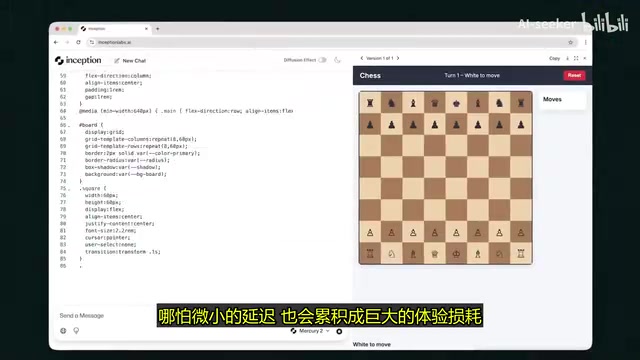
Another noteworthy detail: how Mercury 2 handles error correction. Because the model repeatedly revisits its output during generation, early deviations can be corrected in subsequent optimization steps — errors don't trigger chain reactions. This single characteristic alone fundamentally changes the reliability of multi-step reasoning, especially when handling complex, lengthy tasks.
Production-Ready: From Lab to Real Products
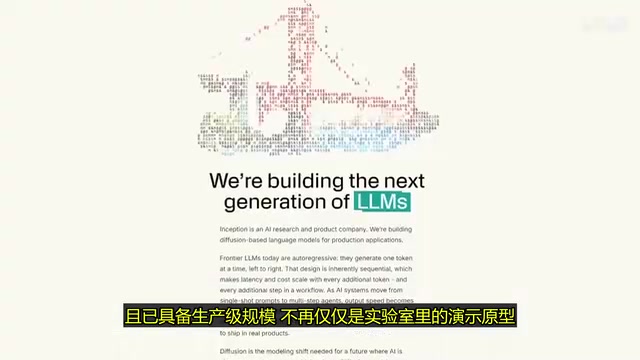
Mercury 2 isn't a lab demo prototype — it already has complete production-grade capabilities:
- Compatible with OpenAI's API interface, enabling direct integration with existing systems
- Supports tool calling, structured output, and Retrieval-Augmented Generation (RAG)
- 128K token context window
- Highly competitive pricing: $0.25 per million input tokens, $0.75 per million output tokens
Combined with the massive throughput improvement, the actual cost per completed task drops significantly. For scenarios requiring high-frequency calls — agentic workflows, real-time customer service systems, code assistants — the cost advantage is amplified even further.
The True Unlock for Agentic Workflows
The real killer use case for this model lies in agentic workflows. When agents need to continuously plan, execute, and observe, latency at each step gradually accumulates. Running agentic workflows on traditional models means every call must wait for the previous step to complete — even simple tasks exhibit noticeable lag in practice.
Mercury 2's ability to complete each reasoning step quickly means more efficient feedback loops, stronger control, and more reliable performance. This transforms agents from interesting demos into dependable systems — capable of handling production environments in IT operations, customer support, sales tools, and internal automation.
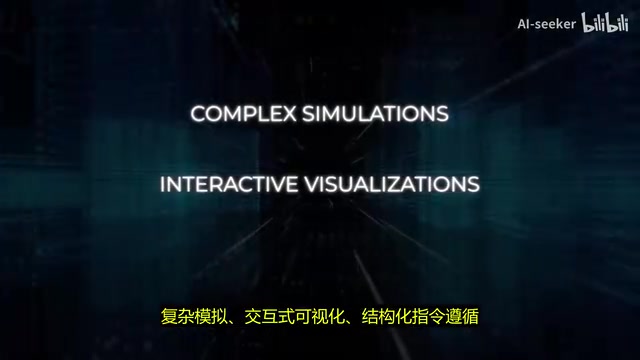
Inception encourages developers to try complex simulations, interactive visualizations, structured instruction following, and constrained generation challenges. These tasks require models to self-correct, achieving alignment at both the token level and the global level, rather than hastily finalizing early in generation and hoping subsequent content will maintain coherence.
The Team Behind It and Deeper Industry Signals
Inception Labs' founding team consists of professors from Stanford, UCLA, and Cornell University, with deep expertise in diffusion model research. They have led breakthrough work including Flash Attention, Decision Transformers, and Direct Preference Optimization (DPO). The company officially debuted in 2024, receiving investment from Microsoft's M12, NVIDIA Ventures, Snowflake Ventures, Databricks, and others, with individual investors including Andrej Karpathy and Eric Schmidt.
From a broader perspective, Mercury 2's emergence sends an important signal: the marginal returns of autoregressive scaling laws are diminishing. Simply increasing model size and data volume yields vanishingly small improvements, while diffusion architecture opens an entirely different path — one that focuses more on the mechanism of generation rather than blindly pursuing model scale.
Diffusion technology has already completely reshaped image and video generation, and now the language model domain is entering this phase. The core question is: will diffusion architecture ultimately reshape how language models are built, or will it remain a specific branch for real-time inference? Mercury 2 is already deployed at multiple Fortune 500 companies, indicating the technology has long surpassed the experimental stage. Regardless of the final answer, it has already proven one thing — when you stop obsessing over optimizing bottlenecks and instead eliminate them entirely, new possibilities emerge.
Related articles
 Tech Frontiers
A Rare Quiet Day in AI: Recursive Self-Improvement Stirs Beneath the Surface
A rare quiet day in AI sees multiple sources go silent simultaneously. Behind the calm, Recursive Self-Improvement (RSI) research continues. What this means for the industry.
 Tech Frontiers
Reve 2 vs. Ideogram 4: A Deep Dive into Layout Control in AI Image Generation
A deep comparison of Reve 2 and Ideogram 4's layout control capabilities, covering technical approaches, real-world use cases, and industry trends for designers and creators.
 Tech Frontiers
In the Weights: Check Your Influence Score in the AI World
In the Weights is an AI influence search engine that quantifies your presence in the AI world with a score. Explore how it evaluates practitioners and what it means for digital identity.