Mermail: Registration, Email, and Payment Infrastructure for AI Agents

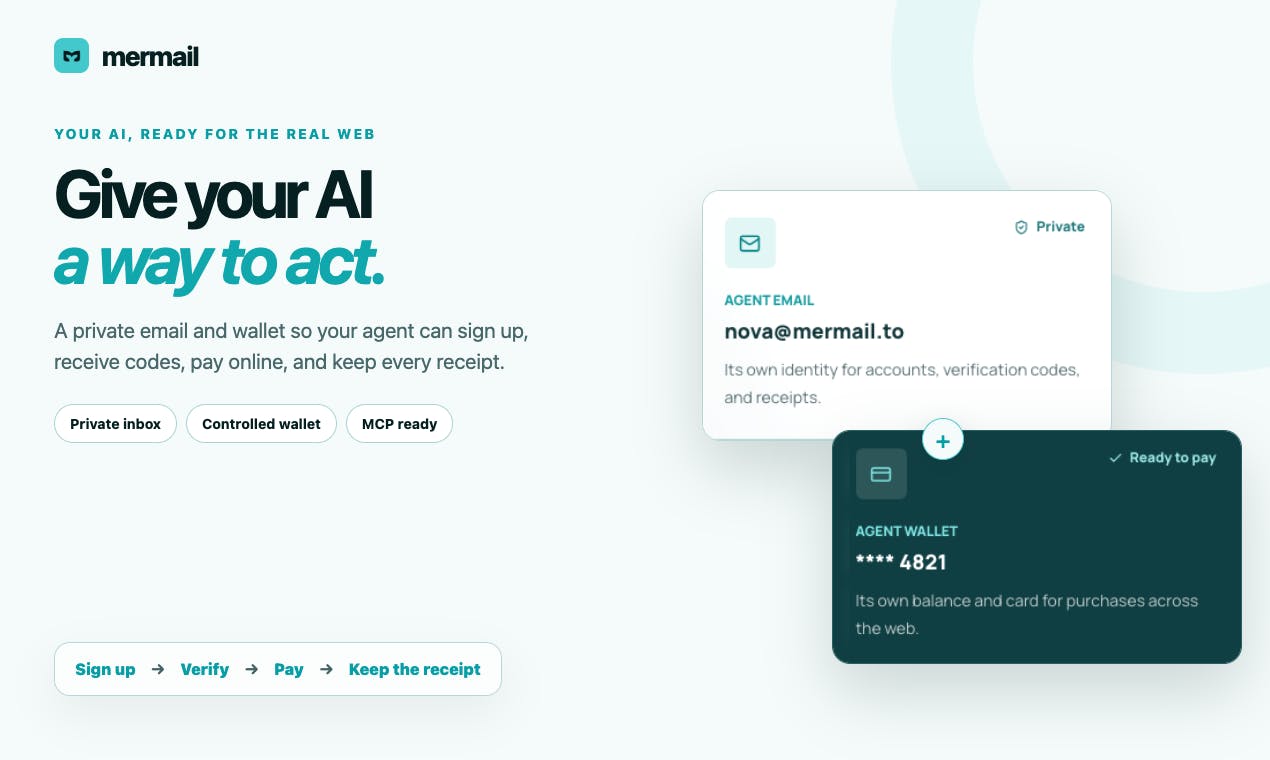
Mermail gives AI agents the ability to sign up, receive emails, and make payments autonomously.
Mermail is a new infrastructure product that enables AI agents to autonomously register accounts, receive and process verification emails, and complete payments on the internet. It offers three integration paths—MCP, Skills, and CLI—to serve different developer needs. By addressing the identity, communication, and payment gaps that prevent agents from acting independently, Mermail positions itself at the forefront of the emerging agent economy.
When AI Is More Than Just a Chat Tool
Over the past year, AI agents have moved from concept to reality, yet the vast majority remain stuck at the "conversation" level—they can answer questions, generate code, and summarize documents, but they can't truly "act." When you want AI to register a new account on your behalf, receive verification emails, complete an online payment, or manage subscriptions, they're often powerless. The reason is simple: AI lacks the identity, communication, and payment infrastructure needed to interact with real internet services.
It's worth clarifying the fundamental difference between "AI agents" and traditional AI assistants. AI agents are artificial intelligence systems capable of autonomously perceiving their environment, formulating plans, and executing actions, with emphasis on closed-loop execution from task reception to completion. Since 2024, open-source projects like AutoGPT and BabyAGI pioneered the validation of agent feasibility, followed by OpenAI's GPT-4 with tools, Anthropic's Claude with computer use, and Google's Gemini with extensions. However, these agents universally face a "last mile" problem when interacting with real internet services: they can generate code and compose email content, but they cannot actually send emails, log into accounts, or complete payments, because they lack real identity credentials and payment methods bound to external services.
A new product that recently launched on Product Hunt, Mermail, targets precisely this pain point. Its tagline is direct and impactful—"Your AI can now sign up and pay." The product received 22 upvotes and 5 comments on launch day, ranking 14th on the leaderboard. While not a blockbuster, it addresses the cutting-edge direction of agent autonomy.
What Core Problems Does Mermail Solve for AI Agents?
To understand Mermail's value, you first need to understand the three major obstacles agents face when "taking action."
Identity Verification
Virtually all real online services require account registration, which typically needs an email address and possibly phone number verification. Traditional AI agents don't have their own "identity" and cannot independently create and manage accounts. Mermail provides agents with verifiable identity infrastructure, enabling AI to establish accounts on various platforms in a legitimate manner.
Email Communication
The most common step in the registration process is email verification—receiving verification codes and clicking confirmation links. What human users accomplish effortlessly is a barrier for AI. Mermail has built-in email receiving capabilities, allowing agents to automatically receive and process emails, thus bridging the critical link in registration verification.
Autonomous Payment
Going further, many services require payment to use. Mermail provides payment infrastructure that enables agents to securely complete checkouts and manage subscriptions. This means AI can not only register for free services but also autonomously complete commercial transactions, truly becoming a digital assistant that can "get things done."
Three Integration Methods: MCP, Skills, and CLI
Mermail addresses different levels of developer needs in its integration approach, offering three access paths:
- MCP (Model Context Protocol): This is the agent context protocol launched by Anthropic that is gradually becoming an industry standard. Through MCP integration, Mermail can seamlessly fit into various AI applications that support the protocol, without cumbersome custom development.
- Skills: Extends agent capabilities in the form of skill modules, suitable for scenarios where you want to quickly add "registration + payment" capabilities to existing agents.
- CLI: The command-line interface targets developers and automation scripts, providing the most flexible and programmable control method.
It's worth diving deeper into the technical background of the MCP protocol. MCP is an open protocol released by Anthropic in late 2024, aimed at standardizing the connection between AI models and external tools and data sources. Before MCP, every AI application that needed to integrate external tools required writing customized integration code, leading to severe ecosystem fragmentation. MCP defines a unified communication format—including tool descriptions, parameter passing, result returns, and other specifications—similar to how REST APIs standardized front-end/back-end communication in web development. Currently, mainstream AI applications like Cursor, Claude Desktop, and Windsurf already support the MCP protocol. Third-party developers only need to wrap tools according to MCP specifications to be callable by all MCP-compatible AI clients. This means that once Mermail integrates via MCP, it can be directly used by a large number of existing AI applications in the ecosystem without individual adaptation.
This multi-entry design lowers the barrier to integration. Whether you're a no-code application integrator or a deeply customizing engineering team, you can find an appropriate entry point.
Industry Trend: Infrastructure for the Agent Economy Is Taking Shape
Mermail is categorized under Email, Artificial Intelligence, and Web3—an interesting combination in itself that reveals an emerging trend: building native economic infrastructure for AI agents.
As companies like OpenAI and Anthropic continue to advance agents' ability to autonomously execute tasks, a key question surfaces: when AI needs to act on behalf of users on the internet, who provides the "foundation" of identity, communication, and payment? This is precisely the core proposition of the so-called "Agentic Economy."
The Agent Economy refers to a new economic paradigm where AI agents participate in commercial activities as independent economic entities. Under this model, AI no longer serves merely as a human auxiliary tool but can autonomously procure services, enter contracts, and manage assets. The rise of this concept is related to the convergence of multiple technology trends: on one hand, the reasoning capabilities of large language models are sufficient to support complex decision-making; on the other hand, blockchain and smart contracts provide the technical foundation for trustless machine-to-machine transactions. Currently, top VCs like a16z (Andreessen Horowitz) have listed the Agent Economy as a core investment direction, Stripe has launched payment APIs for AI agents, and Coinbase has developed cryptocurrency-based agent wallets. The industry predicts that by 2027, billions of AI agents will operate autonomously on the internet, requiring identity authentication, communication channels, and payment capabilities—giving rise to an entirely new infrastructure layer market.
Recently, multiple related explorations have emerged in the industry, such as agent checkout protocols in payments and virtual identity services designed specifically for AI. Mermail's unique approach lies in its attempt to integrate identity, email, and payment capabilities into a unified infrastructure layer, rather than solving individual problems in isolation.
Application Scenarios and Potential Risk Analysis
Application Possibilities
If Mermail's capabilities mature and stabilize, its application scenarios will be extremely broad:
- Enabling research-focused agents to automatically register and invoke various SaaS tools to complete tasks;
- Allowing personal assistant AI to manage complex subscription services on behalf of users;
- Enabling automated workflows to traverse the "registration-verification-payment" sequence—traditionally requiring human intervention—in an unattended manner.
The Double-Edged Sword of Security and Compliance
However, granting AI the ability to autonomously register and pay also implies enormous responsibility. The product emphasizes that interactions are conducted "securely," but real-world challenges should not be underestimated:
- Abuse risk: If automatic registration capabilities are used to create spam accounts in bulk, it could violate platforms' terms of service;
- Payment authorization boundaries: Autonomous AI payments require clear spending limits and authorization mechanisms; otherwise, unintended financial losses may occur;
- Compliance issues: Different jurisdictions have varying requirements for identity verification and KYC. How agent identities can satisfy these regulatory requirements remains an unsolved challenge.
Regarding KYC (Know Your Customer) compliance challenges, it's worth expanding further. KYC is a core compliance requirement in the financial and internet industries, aimed at preventing money laundering, terrorist financing, and fraud. Traditional KYC processes require verifying the identity of real natural persons or legal entities, including government-issued identification documents and proof of address. When AI agents need to autonomously register and pay, how their "identity" is defined and verified within existing KYC frameworks becomes an entirely new legal and technical challenge. Current exploration directions include: binding agents to their owner's verified identity (proxy model), creating new digital identity standards for agents (such as the W3C Verifiable Credentials framework), and implementing on-chain identity verification through smart contracts. Regulatory attitudes vary enormously across countries—the EU's AI Act and eIDAS 2.0, US FinCEN regulations, and others may all constrain agent identity. This will be an ongoing compliance challenge that Mermail and similar products must continuously address.
Conclusion
Mermail represents a pragmatic attempt to move AI agents from "being able to talk" to "being able to act." Rather than chasing more powerful large models, it focuses on the infrastructure that existing agents need to truly take action—identity, communication, and payment.
For developers, integrating through MCP, Skills, or CLI means adding "get-things-done" capabilities to their agents at relatively low cost. From a broader perspective, the emergence of such products signals that the "agent economy" is moving from vision to engineering implementation. Of course, with greater capability comes greater importance of boundaries and security—how to maintain security and compliance baselines while empowering AI to act autonomously will be the key factor determining whether Mermail and the entire sector can go the distance.
Related articles

Poison-Resistant Concept Anchoring: A New Approach to Defending Against AI Data Poisoning
Deep dive into Poison-Resistant Concept Anchoring, defending against data poisoning via signed anchors and bounded updates. Experiments show 62% poison isolation with 0% false rejection rate.

Hungarian Algorithm Explained: Principles, Complexity, and Engineering Implementation Guide
In-depth explanation of the Hungarian Algorithm: core principles, O(N³) time complexity advantages, and engineering implementation. Covers assignment problem definition, step-by-step algorithm walkthrough, Python/C++ libraries, and applications in multi-object tracking and resource scheduling.
OpenAI's First Enterprise AI Report: H…
OpenAI's First Enterprise AI Report: How ChatGPT Is Changing the Way Organizations Work
OpenAI's first enterprise AI report reveals three key traits of ChatGPT Enterprise adoption: the shift from novelty to necessity, writing and coding as top use cases, and data governance as a core prerequisite.