Meta Admits Muse Was Clearly Inspired by OpenClaw — And It's No Coincidence
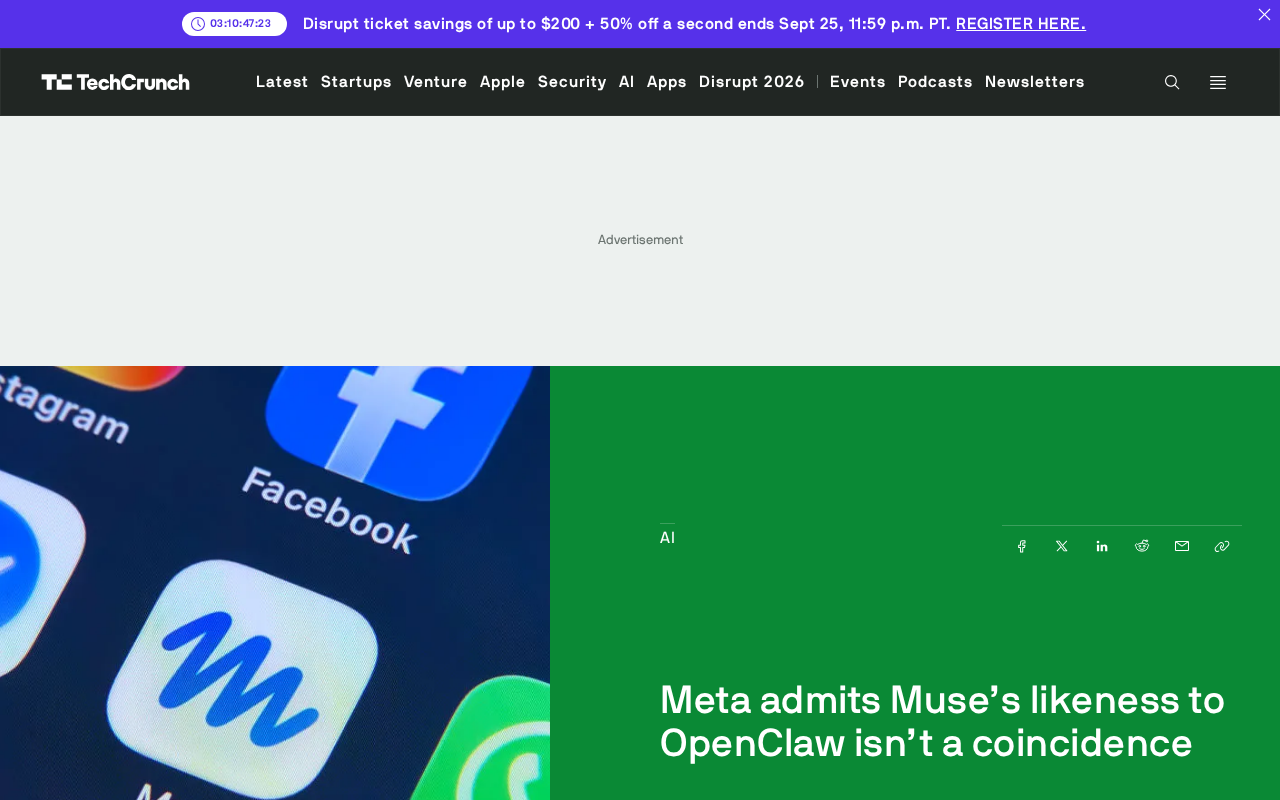
Meta admits Muse was heavily inspired by OpenClaw, with similarities down to workspace file names.
Meta has publicly acknowledged that its AI assistant Muse bears a deliberate resemblance to OpenClaw. While insisting the code was built from scratch, the company admits Muse was "heavily inspired" by OpenClaw — similarities that extend to workspace file naming and content details. This carefully worded admission reflects a calculated balance between legal compliance and PR management, and raises broader questions about the ethics of inspiration-driven borrowing in a fast-moving AI industry.
Meta's Admission: Muse Didn't Come Out of Nowhere
Meta recently acknowledged publicly that its AI assistant Muse bears a striking resemblance to OpenClawAd — and that the similarity is "no coincidence." While Meta insists that Muse was "built from scratch," the company also admitted that the product was "heavily inspired" by OpenClaw during development — a resemblance that extends down to workspace file naming and certain content elements.
The statement has sparked discussion across the AI industry. On one hand, Meta is drawing a clear line in legal and PR terms, maintaining that Muse's underlying code was built independently. On the other hand, the company is having to confront criticism that its product "borrowed too heavily" from a competitor.
The Fine Line Between "Built from Scratch" and "Heavily Inspired"
Meta's choice of words is telling. "Built from scratch" typically implies that the code and architecture are entirely original; "heavily inspired" suggests that the product drew from a competitor's interaction design, feature layout, and even naming logic. These two claims may seem contradictory, but they reflect a common strategy among today's tech giants — build the technical foundation in-house, while borrowing user experience patterns and product forms that have already been validated in the market.
Most notably, the similarities reportedly extend to workspace filenames. This level of detail is far harder to dismiss as coincidence than general UI resemblance, since file naming typically reflects a development team's internal organizational logic and design philosophy.
Why This Kind of Similarity Raises Eyebrows
In the current fiercely competitive AI assistant market, product convergence is nothing new. Mainstream products like ChatGPT, Claude, and Gemini all show signs of mutual influence in their interaction paradigms. But when the similarities get as specific as file naming and content details, they start to brush up against sensitive territory around intellectual property and competitive ethics.
For a company of Meta's scale, proactively acknowledging the "inspiration" is both an act of transparency and a form of risk management — rather than being caught off guard by external exposure, it's better to get ahead of the narrative and frame the issue as "reasonable reference" rather than "copying."
From a legal standpoint, intellectual property protection in software typically operates on several levels: source code is protected by copyright, specific technical solutions can be patented, and UI design and interaction patterns occupy relatively gray territory. The sensitivity around "file naming" lies in the fact that it's a non-functional design choice — developers can use entirely different naming conventions to achieve the same functionality, making identical file names difficult to explain away as coincidence. In U.S. copyright law practice, courts have sometimes applied a "look and feel test" to determine whether software similarity constitutes infringement, but this standard is itself contested and difficult to apply consistently. If OpenClaw were to seek legal remedies, the burden of proof and litigation costs would be substantial.
Implications for AI Product Development
This episode reflects a broader phenomenon in AI product development: under intense pressure to iterate quickly, "inspiration-driven borrowing" has become an industry norm. Successful interaction patterns tend to be rapidly studied and replicated, which simultaneously accelerates industry-wide progress and blurs the line between original and imitation.
For developers and companies, the key is finding the right balance — the independence of technical implementation, the incremental value of functional innovation, and the respect owed to original creators when drawing inspiration all need to be weighed carefully. In some ways, Meta's public statement offers the industry a reference point for how to handle these situations.
It's worth noting that publicly available information remains limited. The specific details of where exactly Muse and OpenClaw overlap, and whether this will lead to any legal disputes, remain to be seen.
Notably, OpenClaw has far less public visibility than Meta's products, and this power imbalance between a tech giant and a smaller developer is an important part of why this story has resonated. In the AI tools ecosystem, independent developers and small teams often pioneer novel interaction paradigms or product forms — but once those ideas are "borrowed" by a well-resourced tech giant, they typically lack the legal and financial firepower to defend themselves. This structural inequality is a dimension of competitive ethics in the AI industry that cannot be ignored, and it has prompted parts of the developer community to call for clearer norms around "acknowledgment" or "attribution" — proactively crediting sources of inspiration even beyond any legal obligation.
Related articles

A Single Prompt Triggers a Global PHP Security Storm: Is AI a Savior or a Hidden Risk?
A single AI prompt triggered a global PHP security crisis affecting Wikipedia and the Internet Archive. This article reviews the incident, analyzes the OpenAI-Amazon controversy, and explores the security paradox of lowered vulnerability discovery barriers in the AI era and developer response strategies.

When AI Is Taken Away: How Reliance on Shortcuts Undermines Your Problem-Solving Resilience
A study of 1,222 people found that after using AI to answer questions, once AI was removed, people gave up on more problems than a control group that never used AI. The article analyzes the impact of AI reliance on learning resilience and metacognition, and explores design implications for AI learning tools.

Carta and NewView Partner to Let Startup Employees Cash Out Equity Early
Carta and NewView Capital partner to simplify startup tender offers, helping employees sell equity early. Analysis of the mechanism, liquidity pain points, and impact.