Meta Brings AI Agent Muse to Small Business Owners: Your Partner for Operations and Customer Acquisition

Meta expands AI agent Muse to small businesses, automating marketing and customer acquisition through its social ad ecosystem.
Meta has announced it is extending its AI agent Muse to small businesses, positioning it as a tool to help owners handle daily operations and acquire new customers. For merchants without dedicated marketing teams, Muse could significantly lower the barrier to Meta's ad ecosystem by automating ad placement, audience targeting, and content creation. Backed by data and users across Facebook, Instagram, and WhatsApp, Meta's "AI tools + ad platform" combination offers a competitive edge over standalone AI vendors — though Muse's pricing, feature scope, privacy safeguards, and real-world effectiveness remain to be seen.
Meta Brings AI Agents into Small Business Operations
Meta recently announced it is expanding its AI agent product, Muse, to small businesses. According to the company, this AI assistant can help business owners manage day-to-day operations and find new customers. The move signals that Meta is pushing generative AI beyond consumer-facing social experiences and into the business operations of small and medium-sized enterprises.
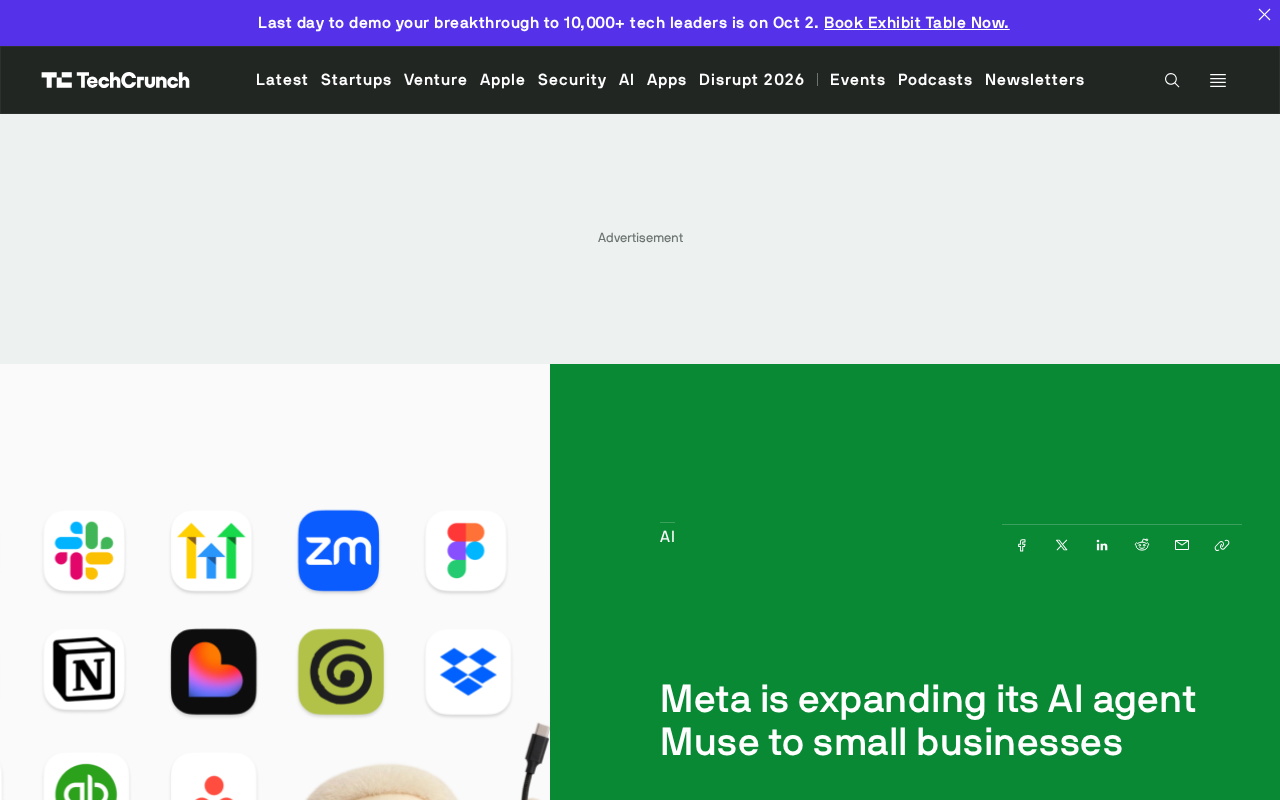
For small merchants who rely on Facebook, Instagram, and other Meta platforms for marketing and customer acquisition, an AI agent capable of understanding business needs and automating marketing and customer interactions offers clear practical value. This initiative also continues the broader trend of major tech companies embedding AI capabilities into specific business workflows.
Muse's Positioning: A Business Assistant for Small Business Owners
Based on Meta's description, Muse is positioned as a tool to "help business owners run their businesses and find new customers." This points to two high-frequency needs: first, improving operational efficiency through content creation, customer communication, and ad management; and second, driving growth by leveraging Meta's massive social platform traffic and advertising system to help merchants reach potential customers.
Small businesses typically lack dedicated marketing teams and technical staff — a gap that AI agents are well-suited to fill. If Muse can automate tasks like ad placement, audience targeting, and content generation that previously required specialized expertise, it would significantly lower the barrier for small merchants to participate in Meta's advertising ecosystem.
The key difference between an AI Agent and a standard AI chat tool lies in autonomy: an agent can independently plan and execute multi-step tasks, rather than simply answering one-off questions. A typical AI agent can receive a goal like "Help me promote this week's new product on Instagram," then autonomously break it down into subtasks — writing copy, selecting audience tags, setting bids, and publishing the ad — completing each step without manual intervention. This "goal-driven + autonomous execution" model is precisely what makes AI agents most appealing to small business owners who lack dedicated teams. It's closer to a digital employee that can work independently than a Q&A system that requires constant prompting.
The Race to Commercialize AI Among Tech Giants
Pushing AI agents into the small business market reflects the broader competition among leading tech companies to capture enterprise-level AI adoption. Small and medium-sized businesses are numerous, increasingly willing to pay for software, and highly sensitive to ease of use — making them an important proving ground for AI agents' real-world productivity value.
Meta owns platforms like Facebook, Instagram, and WhatsApp that reach billions of users, and its advertising business is heavily dependent on small and medium-sized merchants. Embedding Muse into this ecosystem can both improve advertiser performance and retention, while feeding back into Meta's own advertising revenue loop. This combination of "AI tools + ad platform" gives Meta a distinct advantage over standalone AI vendors.
Meta's advertising ecosystem currently serves more than 10 million active advertisers, the vast majority of which are small and medium-sized businesses. This foundation gives Muse a natural distribution advantage — merchants are already using Meta's Business Manager and Ads Manager, meaning Muse can directly tap into existing audience data, historical campaign records, and account permissions without building data connections from scratch. By contrast, standalone AI tools would require merchants to manually authorize and import data, creating higher friction. This approach of "deeply integrating AI capabilities with existing platforms" mirrors the logic behind Google embedding AI into Google Ads and Microsoft embedding Copilot into Microsoft 365: enabling users to upgrade seamlessly within existing workflows, rather than switching to an entirely new tool.
Key Questions and Considerations
Publicly available information remains limited. Muse's specific feature boundaries, pricing model, supported regions, and integration with existing Meta business tools are still unclear. For small business owners, several critical questions remain unanswered: How reliable are the AI agent's recommendations and automated actions? How are data privacy and account security protected? And can AI-generated marketing content actually deliver measurable results in customer acquisition?
As Meta gradually expands Muse's reach, these details will determine whether it becomes a genuinely useful business tool or just another marketing concept. For small and medium-sized merchants looking to cut costs and improve efficiency, staying informed while evaluating cautiously is the most prudent approach.
Related articles

A Single Prompt Triggers a Global PHP Security Storm: Is AI a Savior or a Hidden Risk?
A single AI prompt triggered a global PHP security crisis affecting Wikipedia and the Internet Archive. This article reviews the incident, analyzes the OpenAI-Amazon controversy, and explores the security paradox of lowered vulnerability discovery barriers in the AI era and developer response strategies.

When AI Is Taken Away: How Reliance on Shortcuts Undermines Your Problem-Solving Resilience
A study of 1,222 people found that after using AI to answer questions, once AI was removed, people gave up on more problems than a control group that never used AI. The article analyzes the impact of AI reliance on learning resilience and metacognition, and explores design implications for AI learning tools.

Carta and NewView Partner to Let Startup Employees Cash Out Equity Early
Carta and NewView Capital partner to simplify startup tender offers, helping employees sell equity early. Analysis of the mechanism, liquidity pain points, and impact.