Meta Connect Puts Smart Glasses Center Stage: Wearables Become the New Battleground

Meta bets on smart glasses to bypass Apple and Google ecosystems and claim the next human-computer interaction platform.
At Meta Connect, smart glasses were positioned at the core of the company's hardware strategy. Facing a saturated smartphone market and tight Apple/Google control over mobile ecosystems, Meta is building a matrix of Ray-Ban-branded smart glasses to compete for the next computing platform. The product lineup strategy serves three goals: lowering user barriers, accumulating usage data, and creating ecosystem lock-in. Smart glasses are also deeply integrated with Meta AI, making them a key vehicle for bringing multimodal AI to consumer hardware — though privacy concerns, battery life, display technology, and pricing remain critical variables.
Meta's Next Big Bet: Using Glasses to Bridge the Digital World
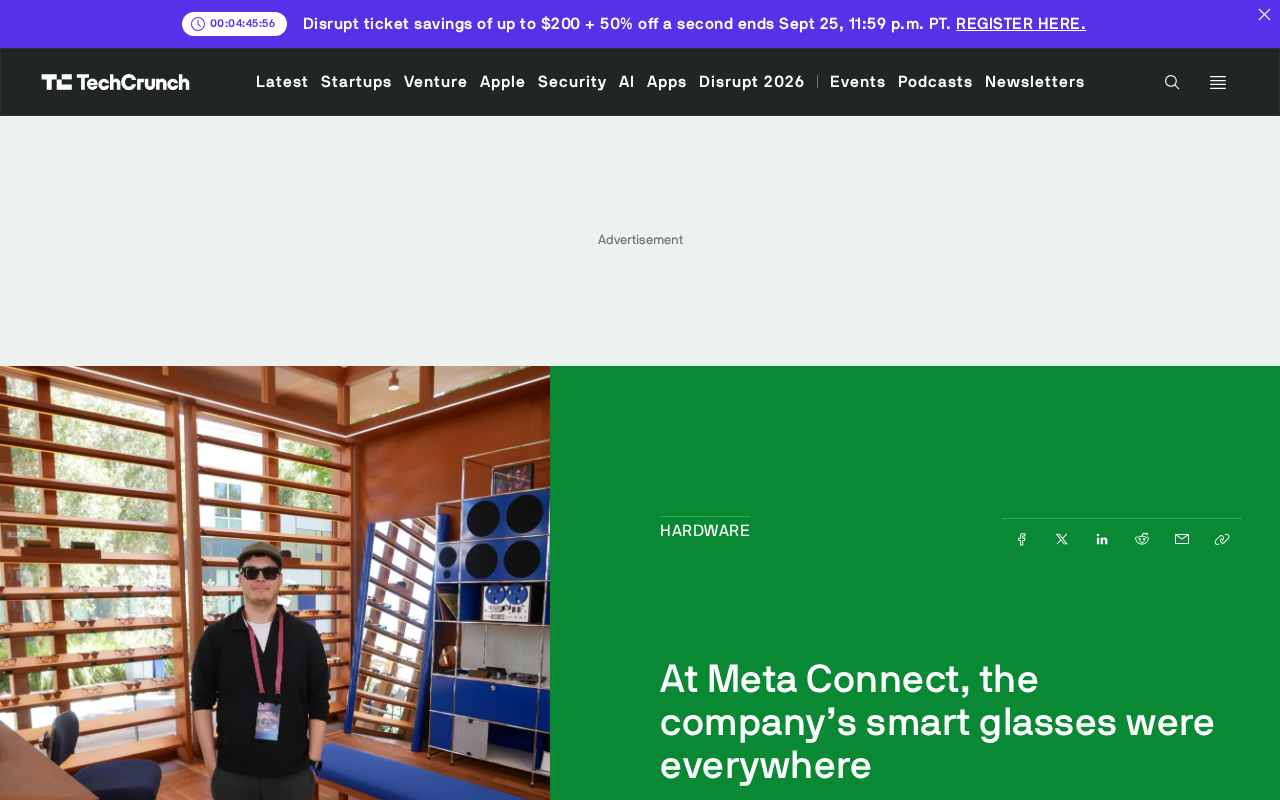
At the latest Meta Connect developer conference, smart glasses were everywhere. The parent company of Facebook and Instagram is aggressively expanding its smart glasses product line in an effort to give consumers a more natural, everyday way to stay connected to the digital world.
Meta's strategic intent is unmistakable: smart glasses are no longer an experimental accessory — they've been placed at the center of the company's future consumer hardware roadmap. The all-in showcase was itself a signal: Meta wants smart glasses to become the next generation of human-computer interaction.
Why Meta Is Betting on Smart Glasses
The smartphone market has largely plateaued, and the industry widely believes the next computing platform will emerge in wearables and augmented reality. For Meta, whose core revenue depends on social media and advertising, owning a new hardware entry point means bypassing the mobile OS ecosystems dominated by Apple and Google to reach users directly.
The appeal of smart glasses lies in their natural form factor. Compared to the bulk and social isolation of head-mounted VR devices, glasses are closer to what people already wear every day — making them far easier for mainstream consumers to adopt. Meta's decision to make smart glasses the centerpiece of its conference reflects the company's desire to capitalize on this form-factor advantage and get to market first.
Meta's journey into hardware traces back to its 2014 acquisition of VR headset maker Oculus for roughly $2 billion. In the years since, the company has poured tens of billions of dollars into VR/AR hardware, with its Reality Labs division posting sustained losses. The smart glasses line is the fruit of a partnership with Luxottica, the parent company of Ray-Ban — the Ray-Ban Meta series leads with a fashionable design and focuses on camera, voice calling, and AI assistant features, starting at around $299. Compared to the Apple Vision Pro (which costs thousands of dollars) or the feature-limited early Google Glass, this pricing strategy gives it far stronger market penetration potential. Apple and Google control mobile app distribution, payments, and data pipelines through iOS and Android, leaving Meta's social and advertising businesses subject to "platform taxes" and vulnerable to privacy policy changes. A proprietary hardware entry point is therefore seen as Meta's strategic escape from platform dependency.
What the Expanding Product Line Reveals About Meta's Ambitions
The original briefings specifically highlighted Meta's "growing lineup of smart glasses." This signals that Meta isn't launching a single flagship product — it's building a matrix of products spanning different price points and feature sets.
This portfolio approach carries several strategic implications:
- Lowering the barrier to entry: A tiered product range lets more consumers step into the smart glasses ecosystem at a lower cost.
- Accumulating data and use cases: More devices mean more real-world usage data to fuel future AI feature development.
- Ecosystem lock-in: Once users get used to taking photos, making calls, and accessing information through their glasses, switching to a competitor's platform becomes much harder.
Smart Glasses and AI: A Deep Integration
Notably, today's smart glasses are tightly coupled with AI capabilities. Voice assistants, real-time translation, and visual recognition are becoming the core differentiators that separate smart glasses from ordinary accessories. Meta's sweeping showcase of smart glasses at the conference was, in a sense, also a demonstration of how its AI capabilities can land in consumer hardware.
For Meta, glasses offer an ideal AI platform — they have a camera, microphone, and display capability, and can continuously perceive the user's environment from a first-person perspective, laying the hardware foundation for a far smarter personal assistant.
The AI engine at the heart of Meta's smart glasses is the company's own Meta AI assistant, built on the Llama family of large language models. Unlike AI assistants on smartphones, glasses-based AI can "see" the user's environment in real time through the built-in camera, enabling vision-contextualized Q&A — for example, pointing at a menu to ask about calories or scanning a street sign for real-time translation. This mode of "eyes-as-input" interaction is known in the industry as multimodal perception, and it represents the evolution of AI assistants from text/voice interaction toward environment-aware interaction. For Meta, the continuous first-person-perspective data collected by the glasses is also a long-term asset for training more personalized AI models, giving smart glasses a dual identity: consumer hardware product and AI data collection node.
Challenges and Uncertainties
Despite widespread optimism about the potential, smart glasses still face significant hurdles to mass adoption. Privacy is an unavoidable issue — the potential intrusion on bystanders' privacy posed by an always-present camera has historically been a flashpoint for criticism of such devices. Battery life, weight, display quality, and price will all determine whether the product can truly go mainstream.
For Meta, saturating its Connect conference with smart glasses was a clear strategic statement — but there's still a considerable distance between a showcase and scaled commercial adoption. The market will ultimately validate or invalidate this bet through sales figures and user retention.
The privacy controversy has historical precedent in the smart glasses space. When Google Glass launched around 2013, its discreet recording capability triggered a fierce public backlash, with wearers dubbed "Glassholes" — and the consumer version was pulled from the market in 2015. The Ray-Ban Meta series has faced similar incidents: in 2023, researchers demonstrated real-time facial recognition and address lookup via the glasses, sparking widespread discussion on social media. Meta's current countermeasure is an indicator light that activates during recording, but critics argue the notification is far too subtle. AR display technology remains a bottleneck as well — the existing Ray-Ban Meta series does not actually feature optical overlay display; it relies solely on audio and phone tethering to deliver information. True optical see-through AR displays (using waveguide or birdbath approaches) continue to face technical challenges around weight, field of view, and mass-production costs, putting consumer-grade availability still years away.
Conclusion
The high-density appearance of smart glasses at Meta Connect signals that the company is elevating wearables to a core strategic priority. In a landscape where smartphone growth has peaked and the AI wave is crashing through hardware, whoever defines the next interaction paradigm first stands to hold the initiative. Meta clearly intends to be that defining force.
Related articles

S³-PnP: Self-Supervised Score Priors for Plug-and-Play Denoising in Scientific Imaging
S³-PnP introduces a self-supervised plug-and-play image restoration framework that learns score priors directly from ADMM observation intermediate states, requiring no clean training labels or external pretrained weights, and achieving consistent gains in hyperspectral imaging and MRI denoising.

EmoGenie: The First AI-Generated Image Emotion Benchmark — Can MLLMs Truly Read the Feelings in a Picture?
EmoGenie is the first emotion benchmark for AI-generated images, covering expressed and evoked emotions, with 6,400 images, 90K QA pairs, 13,175 human MOS ratings, and the EmoProbe evaluation model.

MFVSR: A New Benchmark Brings Fine-Grained Evaluation to Video Subtitle Removal
MFVSR is a large-scale, multi-style fine-grained benchmark for video subtitle removal (VSR), with 3,000 paired videos and 953 real videos across 16 languages, and a spatially decoupled evaluation protocol that measures restoration, preservation, temporal fidelity, and reliability.