Meta Fined $25 Billion for Privacy Deception: A Wake-Up Call for Tech Giant Regulation
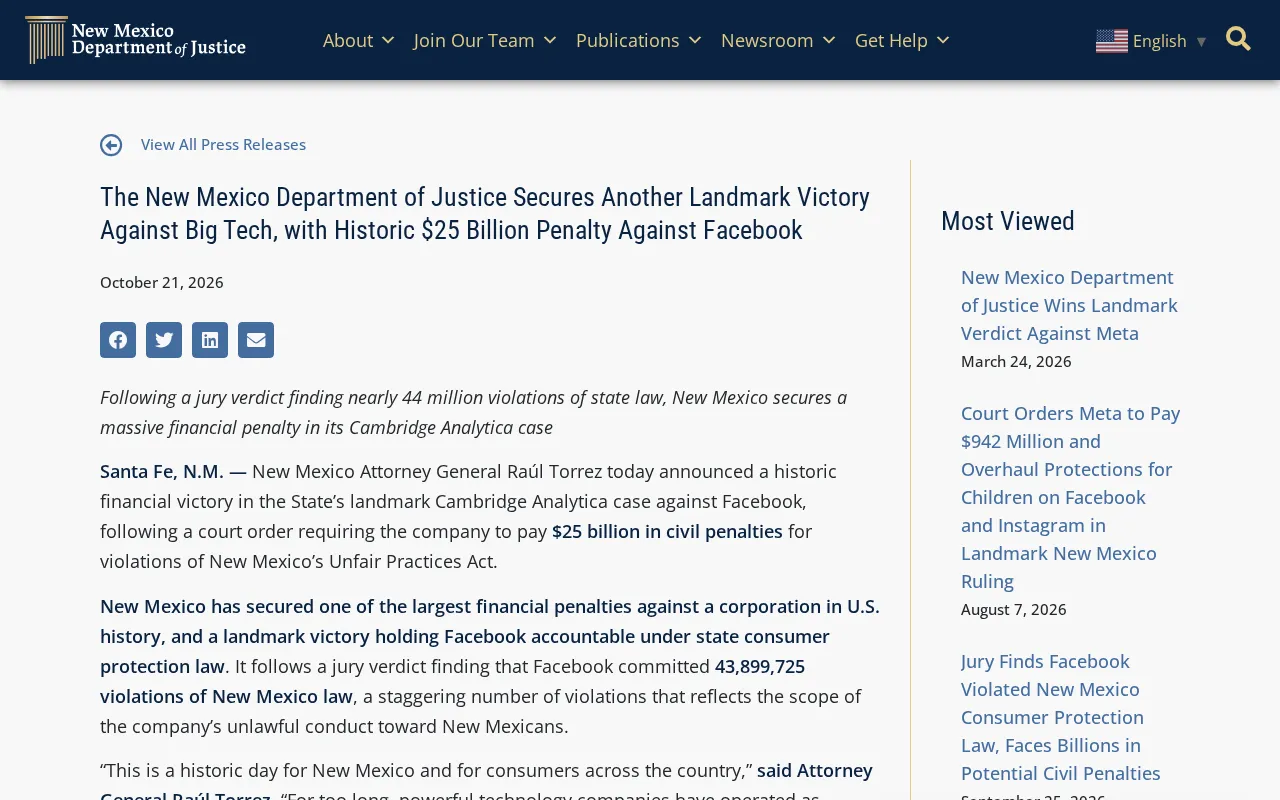
Meta fined $25 billion for deceiving users on privacy, as regulation shifts toward accountability and privacy by design.
The article centers on Meta's $25 billion fine for deceiving users over Facebook privacy, noting that the penalty targets systematic misleading rather than a mere data breach and carries precedent-setting significance. The massive fine will force Meta to rebalance ad targeting capabilities against compliance costs and may expose it to ongoing oversight and mandatory privacy audits. For the industry, platforms monetizing user data must ensure privacy statements are accurate and readable; privacy by design will become the trend, and rising compliance costs for smaller platforms may intensify market concentration. Repairing user trust is harder than paying a fine, regulatory logic is shifting from self-regulation to accountability, and privacy reviews need to be moved forward into product design.
Event Overview: A Sky-High Fine Lands
According to a trending topic on Hacker News, Meta has been fined $25 billion for deceiving users over Facebook privacy practices. This figure sets a new record for penalties imposed on tech companies for privacy violations and signals that regulators' tolerance for the "data-for-services" model in the platform economy is plummeting sharply. Although the original discussion provided only a title and limited comments, the event itself is enough to provoke deep reflection on privacy compliance, platform responsibility, and user trust.
Core fact: Meta is accused of misleading users about Facebook privacy practices, with a fine amounting to $25 billion.
Judging from the discussion's popularity on Hacker News (109 points) and its 17 comments, the community's attention centered on whether the fine is enough to change platform behavior, the boundaries of privacy policy transparency, and whether regulators are engaging in "after-the-fact accountability" rather than "ex-ante prevention."
The Logic Behind the Fine: Deceptive Privacy Practices
Why "Deception" Rather Than "Negligence"?
The $25 billion fine is not simply for a data breach or security vulnerability, but for the act of "deceiving users." This means regulators determined that Meta engaged in systematic misleading in its privacy policy statements and disclosure of data usage scope. For a social platform with billions of users, vague handling of privacy terms has long been regarded as an industry open secret—using lengthy legal text to conceal the true nature of data commercialization. This penalty characterizes such "legalized packaging" as fraud, which carries precedent-setting significance.
In privacy enforcement, "deceptive conduct" and "negligence" correspond to different legal elements. Take the enforcement practice of the U.S. Federal Trade Commission (FTC) as an example: under Section 5 of the FTC Act, which prohibits "unfair or deceptive acts or practices," establishing deception typically requires proving that the platform made a material statement or omission, and that the statement was sufficient to mislead a reasonable consumer. By contrast, negligence points more to breaches caused by inadequate security safeguards. The burden of proof in deception allegations focuses on "inconsistency between disclosure and substance," so the wording of privacy terms, pop-up design, and default toggle states can all become evidence. This is why the fine focuses on "misleading" rather than "breach"—it challenges the contractual foundation between platform and user under information asymmetry.
What the Magnitude of the Amount Means
$25 billion equals a share of Meta's net profit over several years, far exceeding the amounts previously imposed on multiple tech companies for privacy issues. A penalty of this magnitude sends a clear signal: regulators are no longer satisfied with "symbolic fines" but are attempting to force platforms to restructure their privacy design through economic means. For companies reliant on advertising revenue, privacy compliance costs will rise from "legal expense" to "strategic variable."
When assessing the magnitude of a fine, two dimensions are often referenced: first, the proportion of revenue or net profit; second, comparison with historical enforcement cases. The EU's GDPR provides for fines of up to 4% of global annual revenue, while U.S. privacy enforcement has long centered on settlements and remediation commitments, with relatively modest amounts. If the $25 billion figure is accurate, it would significantly exceed the scale of most previous privacy settlements, approaching a "structural penalty" rather than a "compliance cost." However, whether the fine can be realized still depends on legal proceedings, appeals, and the final ruling, and companies may also dilute the actual impact through installment payments or tax deductions, so its deterrent effect must be judged in conjunction with the certainty of enforcement.
Industry Impact: Privacy Compliance Enters Deep Waters
Chain Reactions for Meta Itself
Beyond the fine, Meta may face stricter ongoing oversight and mandatory privacy audits. Tightening of ad targeting capabilities will directly affect its core business model—precision delivery based on user profiles. If regulators require changes to its data collection and sharing mechanisms, Meta will need to find a new balance among user experience, advertising efficiency, and compliance costs. Some Hacker News commenters noted that Meta may treat the fine as a "cost of doing business," but continuous compliance constraints are the real source of pressure.
A Warning to Other Tech Platforms
Any platform that monetizes user data should re-examine the accuracy and readability of its privacy statements. The EU's GDPR, U.S. state privacy laws, and FTC enforcement actions are creating a compounding effect. This penalty may accelerate the industry's shift toward "privacy by design"—for example, disabling unnecessary data collection by default and providing clearer data usage dashboards. For small and medium-sized platforms, rising compliance costs may intensify market concentration, because only giants can afford in-depth compliance systems.
"Privacy by Design" is a methodology that embeds privacy protection into product architecture and processes from the outset. Its core principles include collecting minimal data by default, purpose limitation, end-to-end transparency, and user control. Article 25 of the GDPR explicitly requires data controllers to take technical and organizational measures to implement data protection by design. For platforms, this means privacy reviews must be conducted in parallel with product requirement reviews, and data maps, field-level permissions, and third-party SDK inventories should all be incorporated into design documents. Compared with remediating after launch, designing in advance has lower marginal costs and makes it easier to provide verifiable compliance evidence during regulatory inquiries.
User Trust: Harder to Repair Than a Fine
$25 billion can be quantified, but the loss of user trust is difficult to price. Exposure of privacy deception will reinforce public distrust of social platforms, thereby affecting engagement and advertising value. If Meta treats the fine merely as a one-time event without making perceptible changes in transparency, long-term user stickiness will still suffer. True repair requires structural adjustments in the language of privacy policies, the ownership of data control, and the transparency of third-party sharing.
Regulatory Trends: From Leniency to Accountability
This fine is a microcosm of global regulators' continued pressure on tech giants over privacy issues in recent years. From the Facebook-Cambridge Analytica incident to a series of subsequent investigations, the regulatory logic has shifted from "self-regulation first" to "accountability first." In the future, the burden of proof for privacy violations may fall more on platforms, requiring them to demonstrate that data practices are consistent with user disclosures. For product teams, this means privacy reviews must be moved forward to the design stage rather than patched in after launch.
"Accountability" is one of the core principles of the GDPR, requiring data controllers not only to comply with the rules but also to be able to demonstrate their compliance. In practice, this is reflected in Data Protection Impact Assessments (DPIAs), records of processing activities, version trails of privacy policies, and regular audits. The burden of proof shifting toward platforms means regulators can require companies to submit internal decision records and risk assessment reports during investigations. For product teams, front-loading privacy reviews, documenting decisions, and describing traceable data flows are changing from "best practice" to "necessary evidence."
Conclusion: After the Sky-High Fine
The $25 billion fine is a milestone, but not the end. For Meta, the real test is whether it can turn compliance pressure into privacy-friendly product innovation; for the industry, this is a collective reflection on data ethics and business models. What users expect is not longer privacy terms, but a more honest data contract.
Related articles

Microsoft Fabric Database Agent in Action: From Reactive Firefighting to Intelligent Detective
A deep dive into the Microsoft Fabric Database Agent: how to enable it, supported monitoring scenarios, a blocking-issue demo, and the roadmap from reactive to autonomous operations.

Zendesk Uses ChatGPT Enterprise to Build a Sales Agent with 1,000 Daily Active Users
Zendesk opened ChatGPT Enterprise to all employees, who built about 600 apps themselves, including a sales expansion agent with about 1,000 daily active users. This article analyzes how it turns internal data into sales opportunities and its "don't wait" implementation strategy.

Google Releases Gemini 4 Carbon: Its Strongest Model Yet, Debuting with a Cybersecurity Focus
Google releases Gemini 4 Carbon, calling it its strongest model, with a cybersecurity focus. It tops the third-party composite ranking at 59 points but leads by only one or two. This article analyzes its security test results, staged rollout, token pricing, and the divergence between self-reported and third-party tests on hallucinations.