Meta Goes All-In on AI App Muse: The Strategy Behind Its Rise to the Top of the Charts

Meta leverages its social ecosystem to rocket Muse to the top of app charts, but retention and privacy risks remain.
Meta's personal AI agent app Muse has rapidly topped app store charts by riding traffic from Facebook, Instagram, and WhatsApp. The article argues that Meta's core edge — low-cost embedded distribution that rivals can't replicate — mirrors the same playbook used for Reels and Threads. Yet short-term chart success differs fundamentally from long-term product health, where retention and active usage are the real moat. Meanwhile, Meta's persistent data privacy trust deficit, combined with the deep personal data access that AI agents require, represents the critical variable that will determine whether Muse can truly go the distance.
Muse Tops the App Charts as Meta Pours Resources Into Promotion
Meta's personal AI assistant app Muse is gaining momentum fast. According to reports, Muse has climbed to the top of app store charts, with user numbers growing at a remarkable pace. Meanwhile, Meta is aggressively promoting this personal AI agent product across and beyond its own app ecosystem — a clear signal of how seriously the company is taking this space.
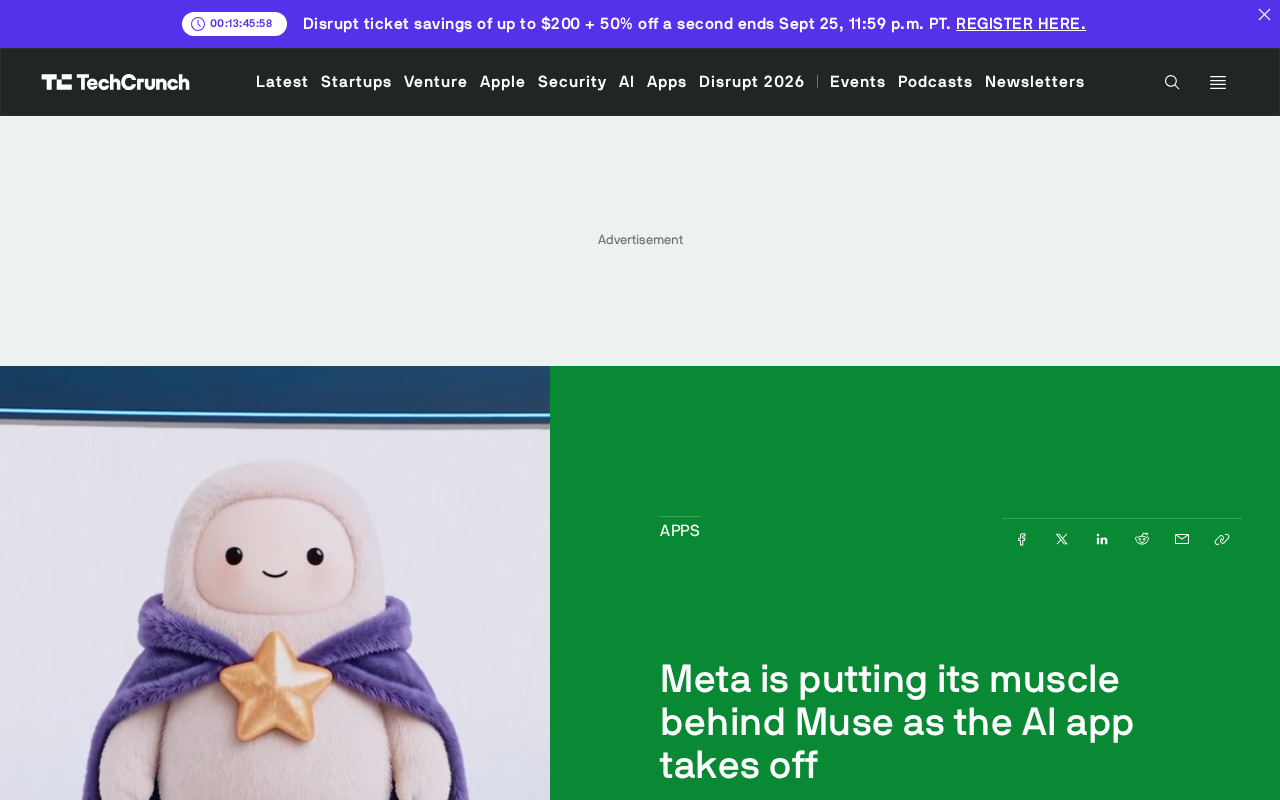
In terms of positioning, Muse is defined as a "personal AI agent" — a distinction that sets it apart from simple chatbots, emphasizing its role as an everyday personal assistant. In today's fiercely competitive AI assistant market, the fact that Meta is channeling its own platform traffic so heavily toward Muse is itself a telling sign.
Why Meta Is Putting Its Muscle Behind Muse
Meta owns a massive portfolio of social apps — Facebook, Instagram, WhatsApp, and Messenger — with billions of monthly active users. Embedding Muse's promotion into these apps means it can reach enormous numbers of potential users at minimal marginal cost, a distribution advantage that few independent AI startups can hope to match.
Topping the app charts rarely happens through organic growth alone; it typically requires strong exposure and promotional support. The phrase "putting its muscle behind" Muse signals that Meta is deliberately redirecting platform-level traffic resources toward this product. This playbook is nothing new for Meta — from Reels taking on TikTok to Threads going after Twitter, the company has consistently used its ecosystem's distribution power to rapidly scale new products.
This approach of embedding new products within an existing app ecosystem is known in product growth circles as "embedded distribution." Specific tactics include inserting promotional cards into Facebook or Instagram feeds, adding AI shortcut buttons within WhatsApp conversations, and pushing in-app notifications to existing users. What all these methods have in common is that they bypass the app store's organic search rankings, delivering promotional content directly to an already highly active user base. With Meta's combined platforms exceeding 3 billion monthly active users, even a tiny conversion rate is enough to engineer a chart-topping explosion in a short period. This is why a number-one ranking doesn't necessarily reflect product quality — it more often reflects the scale of the promotional resources behind it.
The Competitive Landscape for Personal AI Agents
Personal AI agents are becoming the next major battleground for tech giants. OpenAI's ChatGPT, Google's Gemini, and Anthropic's Claude are all fighting for mindshare, while Meta hopes to leverage its distribution advantages in consumer apps to catch up and pull ahead.
Muse's rapid rise to the top and its high-speed user growth reflect strong market demand for lightweight, personalized AI assistants. For Meta, controlling a high-frequency AI entry point matters not just for the commercial success of its AI business, but for its position in the next generation of human-computer interaction. When users habitually rely on AI agents to access information and handle tasks, whoever owns that entry point controls the flow of traffic in the future.
The core difference between a "personal AI agent" and an ordinary AI chatbot lies in autonomous action. Chatbots primarily work in a Q&A format — the user inputs a command, the AI outputs a text response, and the interaction ends with the conversation itself. AI agents go further: they can call external tools on the user's behalf, access calendars or email, execute multi-step tasks, and complete a series of operations without requiring user confirmation at every step. OpenAI's GPT-4o Actions, Google's Project Astra, and Anthropic's Computer Use feature are all representative explorations in this direction. The commercial value of the agent paradigm far exceeds that of a chat interface — when AI can complete real tasks on behalf of users, it evolves from an information tool into a productivity tool, significantly increasing usage frequency and user dependency. This is the fundamental reason why major tech companies are all betting heavily on this direction.
The Hidden Risks Behind Rapid Growth
Worth noting is that download growth driven by heavy promotion through proprietary channels has yet-uncertain sustainability. Chart rankings and user acquisition speed are short-term metrics. What ultimately determines a product's success is retention and long-term active usage. If Muse cannot genuinely meet users' high-frequency needs at the experience level, traffic injection alone is unlikely to build a durable moat.
Additionally, personal AI agents involve processing large amounts of sensitive user data. Meta has long faced regulatory scrutiny and public trust challenges around data privacy. As an assistant deeply embedded in users' personal lives, how Muse balances personalized experience with privacy protection will be a critical variable in determining whether it can go the distance.
Meta's track record on data privacy is essential context for understanding this concern. The Cambridge Analytica scandal of 2018 exposed the large-scale misuse of Facebook user data for political ad targeting, after which Meta reached a $5 billion settlement with the Federal Trade Commission (FTC) — at the time the largest privacy fine in history. Since then, Meta has faced multiple heavy penalties under the EU's General Data Protection Regulation (GDPR), with Ireland's Data Protection Commission alone issuing fines totaling over one billion euros. Because personal AI agents must continuously read users' schedules, messages, preferences, and behavioral habits to deliver personalized service, the depth of data collection far exceeds that of traditional social apps — making regulators and privacy researchers highly watchful of Muse's data practices.
Conclusion
Muse's rise is an important venture by Meta into consumer-facing AI applications, and it confirms the enormous value of platform distribution in the AI era. Whether it can convert short-term chart success into long-term user loyalty will be the true test of this product — and of Meta's broader AI strategy. Given the limited public information available at this stage, the specifics of Muse's features and its path to monetization still await further disclosure.
Related articles

Claude Code + Codex Multi-Agent System Tested: The Real Problem Behind a 98% Cache Rate
Developer shares 7-day test of a Claude Code + Codex multi-agent system: 98% cache rate, 354:1 input/output ratio, but stuck on orchestration and output share.

Cursor SDK New Feature: Real-Time Steering of Running AI Agents
Cursor SDK adds run.steer(), letting developers inject messages in real time while an AI agent runs to adjust its direction. Subagents move to the background on steer.

AI Tools Are "Invading" Retro Games: A Game of Creativity vs. Copyright
AI tools are dramatically lowering the barrier to retro game porting—browser-based Halo, iPhone Wind Waker, and MR Smash Bros. are going viral, but sparking copyright disputes and regulatory concerns.