Meta Issues New Stock to Fund AI Infrastructure: Can Its Capital Structure Support the Massive Investment?

Meta plans a new stock class to fund large-scale AI investment via equity financing, signaling the AI race has entered a capital structure competition stage.
Meta plans to raise funds for broad AI model and service investment by creating a new stock class. The article argues this tool may combine financing and governance functions; choosing equity over debt avoids fixed interest burdens but dilutes existing shareholders. Meta's AI spending covers model development, data centers, and GPU procurement—massive and with uncertain payback. Terms and voting rights are undisclosed and will affect market acceptance and governance debate. The move shows the AI race extending into capital structure competition.
Meta is trying an unusual financing approach to fund its broad investments in AI models and services. According to RSS sources, the social media giant plans to raise funds by creating a new class of stock—a move seen as a key step in its capital strategy for the AI arms race.
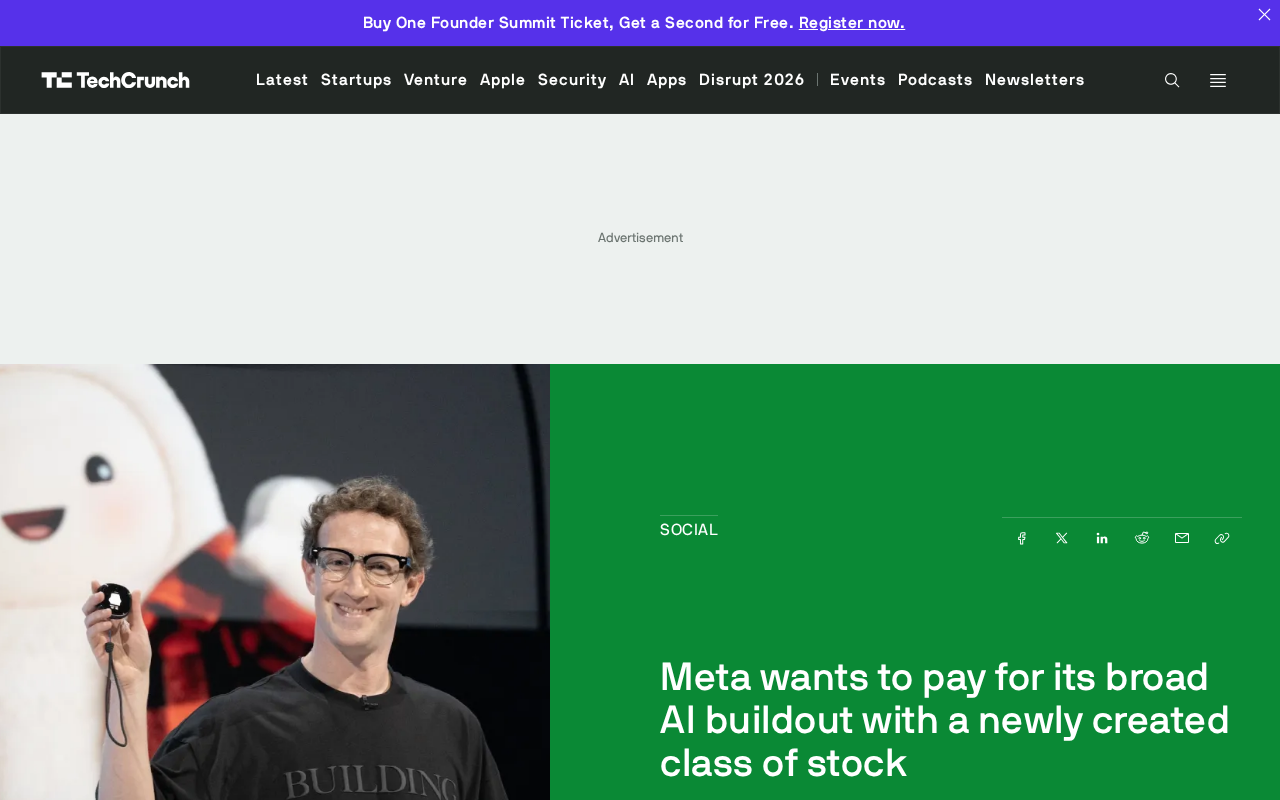
New Stock Class: A Financing Tool or a Control Mechanism?
Meta has not disclosed the specific terms of the new stock, but the phrase "new stock class" suggests it is likely an instrument that combines financing and governance functions. Tech companies issue new shares for two main purposes: to raise cash directly, and to cement founders' control through share structures with different voting rights. Meta's move is most likely both.
What is interesting is that Meta chose equity rather than debt to support its AI investment. With interest rates relatively high, equity financing dilutes existing shareholders' interests but does not add a fixed interest burden. For AI infrastructure that requires long-term, large-scale investment with an uncertain payback period, this choice is reasonable.
Dual-Class Share Structure refers to a company issuing two or more classes of common stock, with different classes carrying different voting rights. A common design is Class A shares with one vote per share, offered to public investors, and Class B shares with multiple votes per share (such as 10 or even 20 votes), held by founders or management. The core purpose of this structure is to allow the founding team to retain control of the company even as their ownership stake is diluted. Google (Alphabet), Facebook (Meta's predecessor), Snap, and other tech companies have all used similar arrangements.
However, dual-class structures have long been controversial. Supporters argue that they allow management to focus on long-term strategy and resist short-term market pressure, which is especially important for AI businesses with long investment cycles and uncertain returns. Opponents point out that super-voting shares weaken ordinary shareholders' voice, reduce corporate governance transparency, and may leave management without effective accountability. Institutional investors and proxy advisory firms (such as ISS and Glass Lewis) generally take a cautious view of such structures. If Meta introduces special voting rights into the new stock, it will likely reignite this governance debate; if the new stock is purely a financing instrument without special voting rights, the market's focus will fall more on the dilution ratio and use of proceeds.
The Capital Pressure of AI Investment
The scale of Meta's AI investment is no secret. From large model development to data center construction to the integration of AI features across its entire product line, each requires continuous capital injection. The computing costs of training frontier models, the operating expenses of inference services, and the procurement of hardware such as GPUs together form a massive spending structure.
Raising funds by issuing new stock means Meta hopes to shift part of the cost of AI investment to investors willing to share in long-term growth dividends. Behind this is an implicit judgment: management believes that the long-term returns on AI investment will be sufficient to cover the cost of equity dilution.
The training costs of frontier AI models are rising exponentially. For a GPT-4-class model, for example, the compute cost of a single training run can reach tens of millions to hundreds of millions of dollars, and as model parameter scale expands, the size of the GPU clusters required for training, power consumption, and cooling costs all climb in tandem. The inference stage is also costly: after a model goes live, every response to a user request consumes compute, and the larger the user base and the more frequent the calls, the higher the operating expenses.
Data center construction is another heavy-asset investment. Building a large AI data center often costs billions of dollars, covering land, buildings, power systems, liquid cooling facilities, and the procurement of tens of thousands of GPUs. GPUs (such as NVIDIA H100/H200) cost tens of thousands of dollars each, face tight supply and rapid iteration, and have short hardware depreciation cycles, further increasing capital expenditure pressure. What these investments have in common is that they require huge upfront spending, have long payback periods, and involve uncertainty in technology roadmaps—which is precisely the fundamental reason why Meta and other companies need long-term, flexible financing channels.
The core difference between equity financing and debt financing lies in the cost of capital structure and risk allocation. Debt financing requires scheduled interest payments and repayment of principal at maturity, creating fixed cash outflow obligations, but interest expenses are usually tax-deductible and do not dilute existing shareholders' ownership. Equity financing requires no principal repayment and creates no fixed interest burden, but it dilutes existing shareholders' ownership and earnings per share, effectively transferring part of future growth dividends to new investors.
In a higher-interest-rate environment, the cost of debt financing rises, and both companies' willingness to issue bonds and the market's capacity to absorb them are affected. For investments like AI with long payback periods and uncertain cash flow recovery, a fixed interest burden may put sustained pressure on financial statements. Choosing equity financing therefore means Meta's management judges that trading some shareholder equity dilution for financial flexibility is the better path to support large-scale AI investment at present. This trade-off also reflects management's confidence in the long-term returns of AI.
Will the Market Buy It?
For investors, the key question is whether Meta's AI investment can translate into substantial revenue growth. The AI-ification of the advertising business has already brought efficiency gains, but investment in model development and infrastructure continues to expand. The specific design of the new stock class—including issue size, pricing method, and voting rights arrangements—will directly affect the market's acceptance.
If the new stock carries special voting rights arrangements, it may trigger discussion at the corporate governance level. If it is merely a financing tool, the market's focus will return to the payback period of AI investment. In either case, Meta's move provides a new sample for observing how large tech companies finance the AI race.
Industry Signal: The AI Race Enters the Capital Structure Competition Stage
Meta's move reflects a broader trend: the AI race is extending from pure technological competition to a contest of capital structures. When AI infrastructure investment reaches the scale of tens of billions of dollars, how to obtain funds at the optimal cost becomes part of competitiveness in itself.
Other tech giants are also exploring different financing paths—some rely on strong free cash flow, while others raise funds through debt markets. How Meta's choice of equity financing works out will provide an important reference for those who follow.
It should be noted that information about this new stock class is still limited, and the specific terms and timing of the issuance have not yet been clarified. Further developments are worth continued attention.
One-line Summary
Meta plans to create a new stock class to support large-scale AI investment through equity financing, reflecting the AI race's shift into a capital structure competition stage.
Paragraph Summary
Meta plans to raise funds for broad investment in AI models and services by creating a new class of stock. The article argues that this instrument may combine financing and governance functions; choosing equity rather than debt financing avoids a fixed interest burden but dilutes existing shareholders' interests. Meta's AI investment covers large model development, data center construction, and hardware procurement such as GPUs—massive in scale with an uncertain payback period. The specific terms and voting rights arrangements of the new stock have not been disclosed and will directly affect market acceptance and corporate governance discussions. The move also reflects that the AI race is extending from technological competition to a contest of capital structures, providing a new sample for observing how large tech companies finance AI.
Related articles

OpenAI Partners with Shield: How the Astra Agent Revolutionizes IT Troubleshooting
OpenAI and Shield launch the Astra agent, which autonomously logs into computers and legacy systems to fix IT issues in real time, 35-40% faster than traditional models, with humans involved only when judgment is needed.

iPhone Duo Battery Life Tested: One Charge a Day Is Unavoidable, and the Large Screen Is the Culprit
iPhone Duo battery test: heavy use needs at least one charge a day, and about 30% remains after 6.5 hours of screen-on time. How often the large screen is unfolded is key; a MagSafe battery pack helps, and long-term degradation is also worth watching.

Kimi K3.1 Pro Open-Sourced: 2.8 Trillion Parameters Close In on Opus
Moonshot releases the open-source MoE model Kimi K3.1 Pro, with 2.8T total parameters and 104B activated, trailing Opus 5.5 by under 1 point on Terminal Bench 4.0.