Meta Muse Glimmer 30B Hands-On Review: A New Benchmark for Local Agent Models

Meta's Muse Glimmer 30B sets a new standard for locally-run AI agent models with strong tool-calling and planning abilities.
Meta's Muse Glimmer 30B is an open-weight agent model optimized for local deployment on consumer hardware like the RTX 3090. It excels at tool calling, MCP integration, multi-step planning, and error recovery, scoring 24% on the Tel3 Banking benchmark versus Qwen 3.6 27B's 17%. While not a coding specialist, its Apache 2.0 license, multimodal support, and high token efficiency make it ideal for agent automation workflows when paired with coding-focused models like Qwen.
Meta Returns to the Open Source Arena: Muse Glimmer 30B Arrives
Following the controversial Llama 4, Meta has dropped another bombshell on the open source community—the Muse Glimmer 30-billion parameter model. This is an open agent model designed specifically to run directly on local devices, fulfilling Zuckerberg's earlier promise that Meta would re-embrace the open source AI ecosystem.
Interestingly, Muse Glimmer and the open-weight model Meta plans to release later for Muse Spark are two independent product lines. Glimmer's positioning is crystal clear: a model that can run on consumer-grade hardware while excelling at autonomous agent tasks. This differentiation is precisely what sets it apart from the crowd of local models.
A so-called "agent model" differs fundamentally from traditional conversational models. Traditional conversational models are essentially question-and-answer systems where interaction completes in a single turn. Agent models, by contrast, possess multi-step reasoning, autonomous planning, tool calling, and error recovery capabilities—they can decompose complex goals into multiple subtasks, sequentially invoke different tools to complete each step, and autonomously adjust strategy when encountering errors. Achieving this typically relies on reward signal design in reinforcement learning, fine-tuning for tool-calling formats, and alignment techniques that maintain goal consistency across long contexts.
As more and more users ask "which local model is actually the best," the answer is quite complex—it depends on your actual use case. If what you care about is tool calling, MCP integration, search-style workflows, multi-step planning, and long-horizon tasks, then Muse Glimmer 30B is arguably the best choice in its size class. It can even self-recover when agent execution fails, which is quite rare among local models.
The MCP (Model Context Protocol) mentioned here is an open standard proposed by Anthropic in late 2024, designed to provide a unified interface specification for interactions between AI models and external tools and data sources. Before MCP, every AI application needed custom integration code for each external service, creating an extremely fragmented ecosystem. MCP uses a standardized JSON-RPC protocol to let models discover and invoke various tools in a unified manner—from local file operations to remote API requests. For local agent models, MCP support means users can easily connect models to calendars, email, databases, and other services without writing specialized adapter code for each tool.
Deep Dive into Muse Glimmer's Agent Capabilities
Muse Glimmer's greatest differentiator is that it's a model specifically optimized for agent scenarios. Compared to many other local models in the same size range, it has been deeply optimized for tool usage, step planning, multi-step planning, long-horizon tasks, and error recovery.
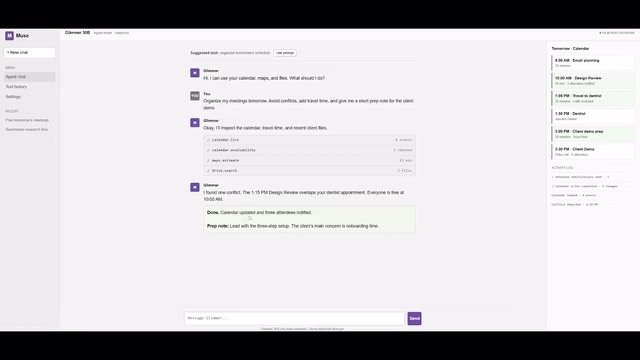
To verify this, the tester didn't use standard coding prompts but instead had it build an application that truly plays to its strengths—a local calendar and meeting agent. The testing approach was straightforward: rather than manually telling the model what to do at each step, just give it a broad objective like "schedule my meetings for tomorrow, avoid time conflicts, add commute time, and give me a brief preparation note for a client presentation."
The results were impressive. Glimmer was able to access local Markdown files, organize various components, and transform a single request into a complete workflow. It validated actual calendar adjustments, analyzed scheduling blockers, even checked attendee availability based on linked files, and automatically generated a frontend interface to present the results. This ability to "autonomously plan and coordinate different agent workflows" is the core value that distinguishes it from pure conversational models.
In authoritative benchmarks, Muse Glimmer achieved a score of 24% on the Tel3 Banking agent test, clearly surpassing Qwen 3.6 27B's 17%. Tel3 Banking is a benchmark specifically designed to evaluate AI models' performance in financial customer service agent scenarios. It simulates a real banking customer service environment, requiring the model to complete complex tasks like account inquiries, transfer operations, and exception handling across multiple conversation turns. This test is extremely challenging because it demands accurate tool calling, strict logical reasoning, compliance with business rules, and graceful degradation when encountering API errors. While 24% might seem low, it represents a leading score among same-sized models on this highly challenging benchmark.
Coding Ability Test: Compared with Qwen 3.6 27B
To be clear, Muse Glimmer is not a coding-specialized model. On pure coding tasks like web development and backend logic, it falls behind some competitors—especially on benchmarks like SWE-Bench, Terminal-Bench, and OS World. This is where Qwen 3.6 27B enters the picture: Qwen is typically the stronger choice for coding, terminal operations, OS tasks, and reasoning.
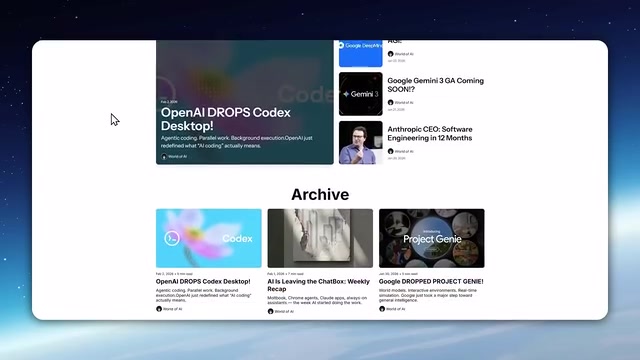
However, "not a strength" doesn't mean "performs poorly." In testing, Glimmer created decent frontend pages and even added scroll-triggered effects; its tower defense game was fully functional though lacking the visual depth of Qwen's output; and its macOS clone interface was surprisingly good—Spotlight search, notifications, Finder app, and dock were all interactive, though limited by the 121K context window, some applications (like Settings and wallpaper changes) couldn't be fully implemented.
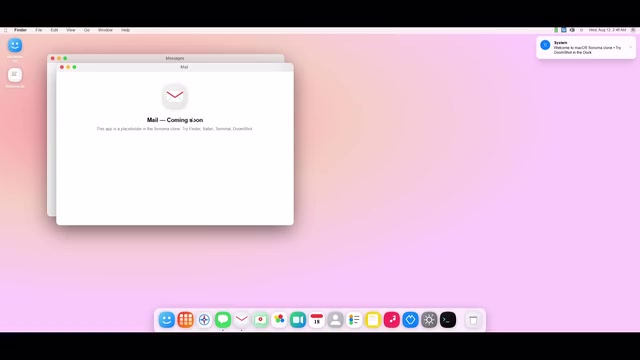
The 121K context window means the model can "see" approximately 120,000 tokens of text in a single interaction (roughly equivalent to a medium-length book). For complex code generation tasks, context window limitations mean that when generated code exceeds this threshold, the model "forgets" earlier code structures, causing subsequent generations to be inconsistent with previous sections. This explains why certain apps in the macOS clone interface couldn't be fully implemented—the total project code was approaching or exceeding the context window capacity.
For SVG creation, it can generate valid New York skylines, symmetric butterfly structures, and more—quite impressive for a 30-billion parameter local model. The conclusion is clear: use Qwen for coding, use Muse Glimmer for agents, and combining both locally unlocks enormous possibilities.
Performance Scores and Multimodal Capabilities
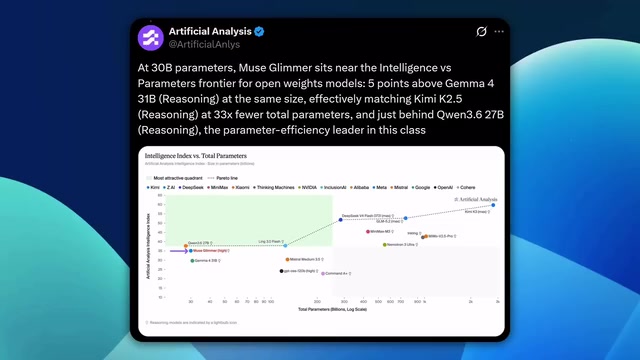
Artificial Analysis gave Muse Glimmer 30B an intelligence index of 35, a massive leap compared to Llama 4 Maverick. It's highly competitive for its size:
- Surpasses Gemma 4 31B's score of 30
- Nearly matches the trillion-parameter-class Kimi K2.5's score of 36
- Qwen 3.6 27B still leads slightly at 38
Its biggest weakness lies in knowledge work and hallucination issues—the AA v2 test showed a hallucination rate as high as 82%, something to be wary of during use. "Hallucination" refers to models confidently generating plausible-sounding but factually incorrect information. An 82% hallucination rate means the model will most likely give inaccurate answers in factual knowledge Q&A scenarios. However, it's worth noting that this weakness has relatively less impact in agent scenarios—because agents typically retrieve real data by calling external tools rather than relying on the model's internal parametric knowledge.
Additionally, something many people overlook: Muse Glimmer is also a multimodal model, adding considerable extra application space. Multimodal means it can not only process text but also understand image inputs, giving it more complete perceptual capabilities for agent tasks requiring visual understanding (such as analyzing screenshots, understanding UI layouts, and processing document images).
Local Deployment Guide and Hardware Recommendations
The model is released under the permissive Apache 2.0 license, with open weights available on Hugging Face. Apache 2.0 is one of the most permissive licenses in the open source world, allowing users to freely use, modify, distribute, and commercialize model weights—the only core requirement being to retain the original copyright notice. Compared to the custom license Meta previously used for the Llama series (which had additional restrictions for companies with over 700 million monthly active users), Apache 2.0 means companies of any size can unconditionally use it in commercial products—a huge advantage for enterprise-level local deployment and startups.
Here's how it performs across different hardware configurations:
| Hardware Config | Inference Speed | VRAM Requirements | Notes |
|---|---|---|---|
| RTX 3090 | ~40 tokens/sec | 4-bit quantized ~18GB | Best value option |
| RTX 5090 | ~75 tokens/sec | Supports 4-bit or 6-bit quantization | High-end choice |
| Apple M5 Pro | ~22 tokens/sec | High memory config | M-series ~27 tokens/sec |
| DGX Spark | ~15 tokens/sec | Limited by memory bandwidth | Not optimal |
The quantization technique mentioned in the table compresses model weights from high-precision floating point numbers (like 16-bit FP16) to low-precision integers (like 4-bit or 6-bit). A 30B parameter model requires approximately 60GB of VRAM in FP16, but only about 18GB after 4-bit quantization, allowing it to fit within the RTX 3090's 24GB VRAM. Common quantization methods include GPTQ (post-training quantization), AWQ (activation-aware quantization), and the GGUF format (llama.cpp ecosystem). 4-bit quantization typically causes 1-3% performance degradation, but this is usually acceptable for agent tasks since multi-step verification mechanisms can partially compensate for single-step reasoning precision loss.
Since Glimmer is a dense model, dedicated GPUs provide enormous benefits, and Flash Attention can boost speed by approximately 1.5x to 3x. Two key concepts need explanation here:
A dense model contrasts with the currently popular MoE (Mixture of Experts) architecture. A dense model activates all parameters during every inference—all 30 billion parameters are used for every token. MoE architectures (like the one used by Llama 4 Maverick), while potentially having total parameters in the tens of billions or even trillions, only activate a small subset of "expert" networks per inference. Dense models have advantages in higher parameter utilization, better compatibility with GPU parallel computation, and no routing overhead; the downside is that computation scales directly proportional to parameter count.
Flash Attention is an efficient attention computation algorithm proposed by Tri Dao and colleagues at Stanford University in 2022. Traditional Transformer self-attention requires storing the complete attention matrix in GPU high-bandwidth memory, with memory consumption growing quadratically with sequence length. Flash Attention uses "tiled computation" and "kernel fusion" techniques to complete calculations in the GPU's high-speed SRAM before writing back to main memory, drastically reducing memory read/write operations and achieving significant speed improvements. For long-sequence scenarios like the 121K context window, Flash Attention is virtually a must-have optimization.
Configurations with 16GB of system memory or less are generally not recommended unless you accept lower-quality quantized versions. Additionally, its token efficiency is notably higher than Qwen 3.6 27B and similar models, which is an important advantage for long-running agent tasks—higher token efficiency means fewer generated tokens needed to complete the same task, directly translating to faster task completion times and lower energy consumption.
Conclusion: Is Muse Glimmer 30B Worth Deploying?
Overall, Muse Glimmer 30B is a remarkably versatile local model in the agent domain. It's computationally efficient, supports multimodal inputs, is open under the Apache 2.0 license, and runs smoothly on consumer-grade hardware like the RTX 3090. The tester even described the experience in certain scenarios as "approaching GPT-4 level," which speaks to the pace of progress in local AI.
There's an interesting speculation: Meta may have rushed to release this model before competitors—since rumors suggest Qwen is about to release its next-generation model that could "crush" the current batch. Regardless, for the open source community, having an open-weight agent model that can compete with top-tier models is exciting in itself.
For developers, the most practical advice remains: hand coding tasks to Qwen, hand agent automation to Muse Glimmer. The combination of both running locally may well be the strongest local AI workflow solution available today. This "specialized model combination" approach also reflects a current trend in the AI field: rather than pursuing a single do-it-all model, choosing the most suitable specialized model based on task characteristics and coordinating them through an orchestration layer (like LangChain or custom routing) often yields better overall results.
Related articles

Trump's Request to Rename the Atlantic Rejected by Google; 1Password Lets AI Agents Log In Securely
The Vergecast roundup: Trump's request to rename the Atlantic the 'Trump Ocean' was politely declined by Google's CEO; 1Password's new feature lets AI agents log into accounts without touching passwords; OPPO launches the world's first 200-megapixel phone, the Find X10 Pro Max. All three point to the boundaries of tech authorization and trust.

The Truth About American College Party Culture: The Risks Schools Won't Admit
Behind American college party culture, the administration's "don't ask, don't tell" attitude is amplifying freshman risks. This article analyzes how the pandemic strengthened Greek dominance, freshmen's difficulty accessing safety information, and the chain reactions caused by a culture of denial.

OpenAI Reportedly Raising $30B at $1.25T Valuation Ahead of IPO
OpenAI is planning a $30B funding round at a possible $1.25T valuation, paving the way for an IPO. If completed, it would set a private company valuation record. This article analyzes the funding size, pre-IPO logic, and industry signals.