Meta Muse Wonder: MSL Joins the Frontier Lab Ranks

Meta MSL releases Claude 5.5-tier frontier model Muse Wonder, marking its rise into the first tier.
This issue of AINews focuses on Meta MSL's release of Muse Wonder and Wonder Full, directly positioned as a Claude 5.5-tier frontier model. This marks the formal completion of MSL's emergence as a frontier lab, moving Meta from long being half a step behind to standing on equal footing with top closed-source models. The benchmarking uses capability anchoring, which is more intuitive than specific scores. However, sources are relatively concentrated, mainly from AINews pushes and screenshots, lacking independent evaluation cross-verification. If the judgment holds, the list of frontier model suppliers will expand, developers will have more choices, competitors will face pressure, and if the open-weights route continues, the distance between frontier capability and open source will be further compressed. The final ranking still needs developer testing and long-term iteration to confirm.
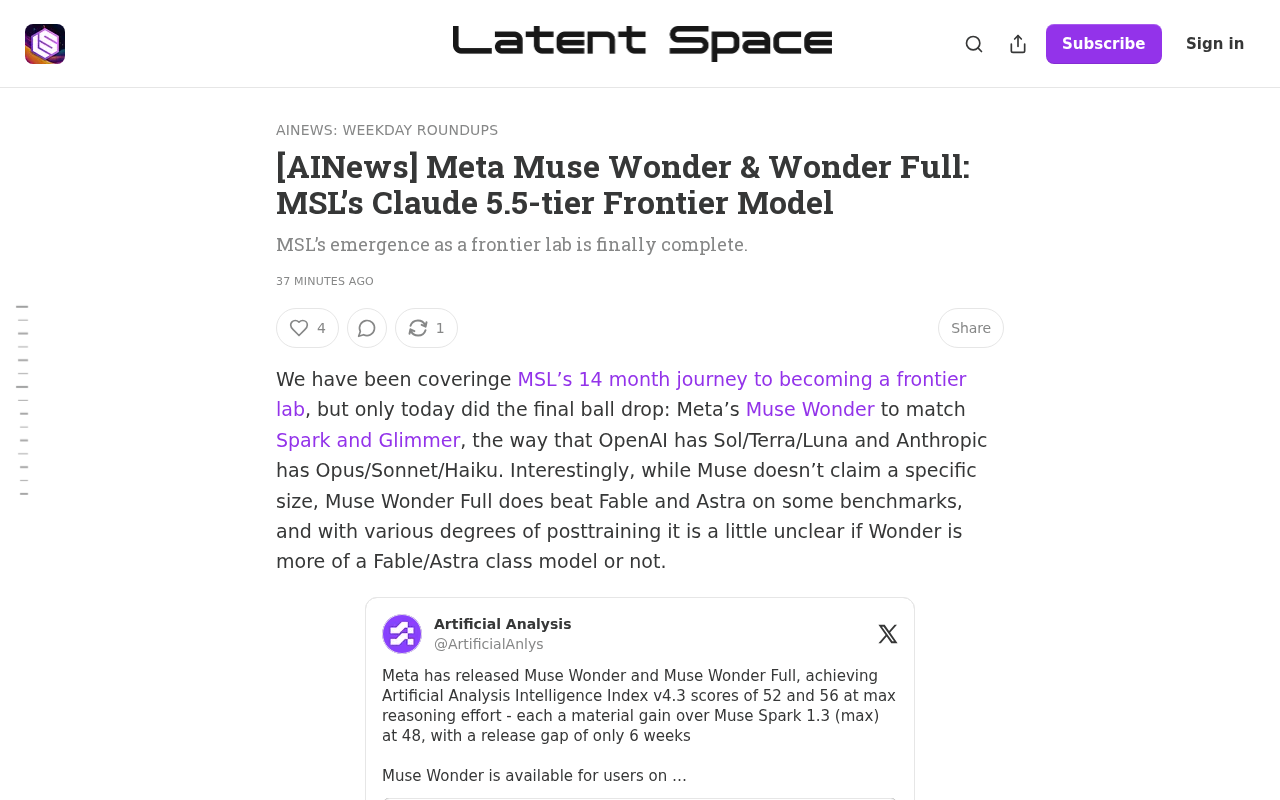
Meta's MSL (Meta Superintelligence Labs) has finally delivered a result worthy of being counted among the "frontier labs." The core topic of this issue of AINews is Meta Muse Wonder and Wonder Full—a frontier model directly benchmarked against the Claude 5.5 tier.
From Chaser to Peer
For quite a long time, Meta's position in the frontier large-model race was awkward: it had enormous compute and a loud voice in the open-source community, but in comparisons of top-tier closed-source capabilities, it was always half a step to a full step behind.
The founding of MSL was itself a signal—bringing research, product, and compute resources more tightly together, with the goal no longer being "release a pretty good model" but entering the first tier. The release of Muse Wonder and Wonder Full is seen as the marker of that goal being achieved.
The original wording is blunt: MSL's "emergence" as a frontier lab is finally complete. The significance of this statement lies in the fact that it is no longer a debate about some benchmark score, but a redivision of "seats."
Meta Superintelligence Labs (MSL) is Meta's core AI research organization reorganized in 2025, and its very name conveys the ambition to upgrade its goal from "general assistant" to "superintelligence." Compared with the former Meta AI (FAIR), MSL's positioning is closer to "frontier labs" like OpenAI and Anthropic: it is not only responsible for basic research, but also centrally coordinates training compute, data pipelines, and product deployment, thereby shortening the cycle from paper to model. The industry typically judges whether an organization belongs to the "frontier lab" category by whether it has a ten-thousand-GPU-scale training cluster, whether it continuously produces SOTA models, and whether it is included in external independent evaluation comparisons. The founding of MSL is precisely Meta's key move in trying to rise from "leader of the open-source ecosystem" into this list.
What Claude 5.5-Tier Means
Putting Muse Wonder and Claude 5.5 in the same sentence is a form of capability anchoring. The Claude series has long been regarded as one of the benchmarks in reasoning, long context, and instruction following. Using "Claude 5.5-tier" to describe it is equivalent to saying: this is not catching up, but standing on equal footing.
This way of benchmarking is becoming increasingly common in frontier model circles because it is more intuitive than specific scores. Readers can locate it at a glance: oh, it's that tier.
Capability anchoring is an expression that has become popular in the frontier model community in recent years: instead of directly reporting scores, it places a new model in the same tier as a widely recognized model. This can bypass issues such as benchmark saturation, leaderboard contamination, and inconsistent evaluation standards. The reason the Claude series is often used as an anchor is that it has long performed in a balanced way in long context (such as above 200K tokens), complex reasoning (multi-step math, code, agent tasks), and stability of instruction following, and is regarded as one of the representatives of the "upper limit of comprehensive capability." Saying that a certain model is "Claude X-tier" actually means: on most everyday tasks, the gap between it and the anchor model has already fallen within the user-perceptible threshold, rather than surpassing it on a single metric.
Multi-Source Cross-Verification
It should be noted that the sources for this issue are relatively concentrated, mainly from AINews RSS pushes and related screenshots, and in-depth cross-verification from multiple independent evaluations has not yet been seen.
From the available information, the point of consensus is that MSL already has the ability to produce frontier-level models, and Muse Wonder / Wonder Full are its representative works. As for exactly which tasks it has caught up on and which tasks still lag behind, the currently public materials are not yet sufficient to give detailed conclusions.
Impact on the Industry Landscape
If this judgment holds, the most direct change is the expansion of the list of frontier model suppliers. In the past, when discussing top models, the available names were limited; now Meta is back at the table, which means one more choice for developers and pressure for competitors.
More noteworthy is the tension between open source and closed source. Meta has long competed from an open-source posture. If the Muse Wonder series continues this line, then the distance between "frontier capability" and "open weights" will be further compressed.
Open weights and open source are not completely equivalent in the model context. Open weights mean that model parameters can be downloaded, fine-tuned, and deployed locally, but the training data, training code, and recipe are not necessarily public; open source usually requires more complete reproducible materials. Meta's Llama series has long followed the "open weights" route, and is therefore often discussed as a representative of the "open ecosystem." If the Muse Wonder series continues this strategy, it means that top-tier capability will no longer be monopolized by a few closed-source APIs, and developers can deploy models close to frontier level in private environments. This has an especially large impact on scenarios that are cost-sensitive and have high data compliance requirements. Conversely, if Meta chooses closed source or restrictive licensing, the narrative of "the distance between frontier capability and open weights" would need to be reassessed.
Wait-and-See and Verification
Whether a model truly reaches a certain tier must ultimately be confirmed through independent evaluations, developer testing, and long-term use. Claims of instant ranking upon release often need weeks or even months to settle into consensus.
For MSL, the real test is not the buzz on release day, but the subsequent iteration pace, ecosystem building, and stability. Joining the frontier labs is a ticket to entry; holding the position is the long-term homework.
One-line Summary
Meta MSL releases Claude 5.5-tier frontier model Muse Wonder, marking its entry into the first tier.
Paragraph Summary
This issue of AINews focuses on Meta MSL's release of Muse Wonder and Wonder Full, directly positioned as a Claude 5.5-tier frontier model. The article argues that this marks the formal completion of MSL's "emergence" as a frontier lab, with Meta moving from being half a step behind for a long time to standing on equal footing with top closed-source models. The benchmarking approach uses capability anchoring, which is more intuitive than specific scores. However, the sources are relatively concentrated, mainly from AINews pushes and screenshots, and independent evaluation cross-verification is still lacking. If the judgment holds, the list of frontier model suppliers will expand, developers will have more choices, and competitors will face pressure; at the same time, if the open-weights route continues, the distance between frontier capability and open source will be further compressed. The final ranking still needs developer testing and long-term iteration to confirm.
Related articles

Why Does the Tesla Roadster Need to Fly? A Deep Dive into Musk's Wild Demo
Tesla's Roadster launch showed wall-climbing, upside-down driving, and flying stunts—but The Vergecast notes the demo car may lack a battery, the Rocket version is invite-only and not street-legal, and the website terms don't guarantee delivery. After nine years of delays, why does this car still need to exist?

AI Is Not a Replacement: Human-AI Collaboration Through the Lens of Factory Root Cause Analysis
Starting from factory root cause analysis, this article explains how AI accelerates evidence chain construction rather than replacing human experts, exploring the pragmatic implementation logic and business value of 'AI supporting people rather than replacing them.'

AI Agent Decision Auditing: Building an Evidence Chain in Regulated Workflows
Starting from a Reddit discussion, this article analyzes three core issues in AI agent decision auditing within regulated workflows: what fields audit records should contain, how to handle feedback latency for erroneous decisions, and how to continuously calibrate LLM judge consistency with human judgment.