Meta Quest Launches 3D Movie Store: 150+ Titles as VR Viewing Enters the Paid Era

Meta launches 150+ 3D movies on Quest 3/3S with purchase or rental, filling the paid film gap.
Meta has officially launched a 3D movie purchase and rental service in the TV app on Quest 3 and Quest 3S headsets, with a library of over 150 titles including blockbusters like Avatar, Spider-Man: Far From Home, and Wicked: Part Two, plus music content. Users can pay to watch directly in the app without sideloading or third-party tools. The move aims to monetize the headset's big-screen viewing selling point, build paid habits in the TV app, and pave the way for immersive video and other future content. Unlike Apple Vision Pro's studio partnerships and spatial video emphasis, Meta follows a broad-content, low-barrier digital store logic. However, Meta hasn't disclosed key details like pricing, rental duration, resolution specs, offline download, or family sharing — factors that will determine whether the service is a novelty or a long-term cinema alternative.
Meta has officially launched a 3D movie purchase and rental service on its Quest 3 and Quest 3S headsets, with a library of over 150 titles including popular films such as Avatar, Spider-Man: Far From Home, Jurassic World Rebirth, and Wicked: Part Two. Users can pay to watch directly within Meta's TV app, marking another step in the VR headset's evolution from a gaming device toward the home theater space.
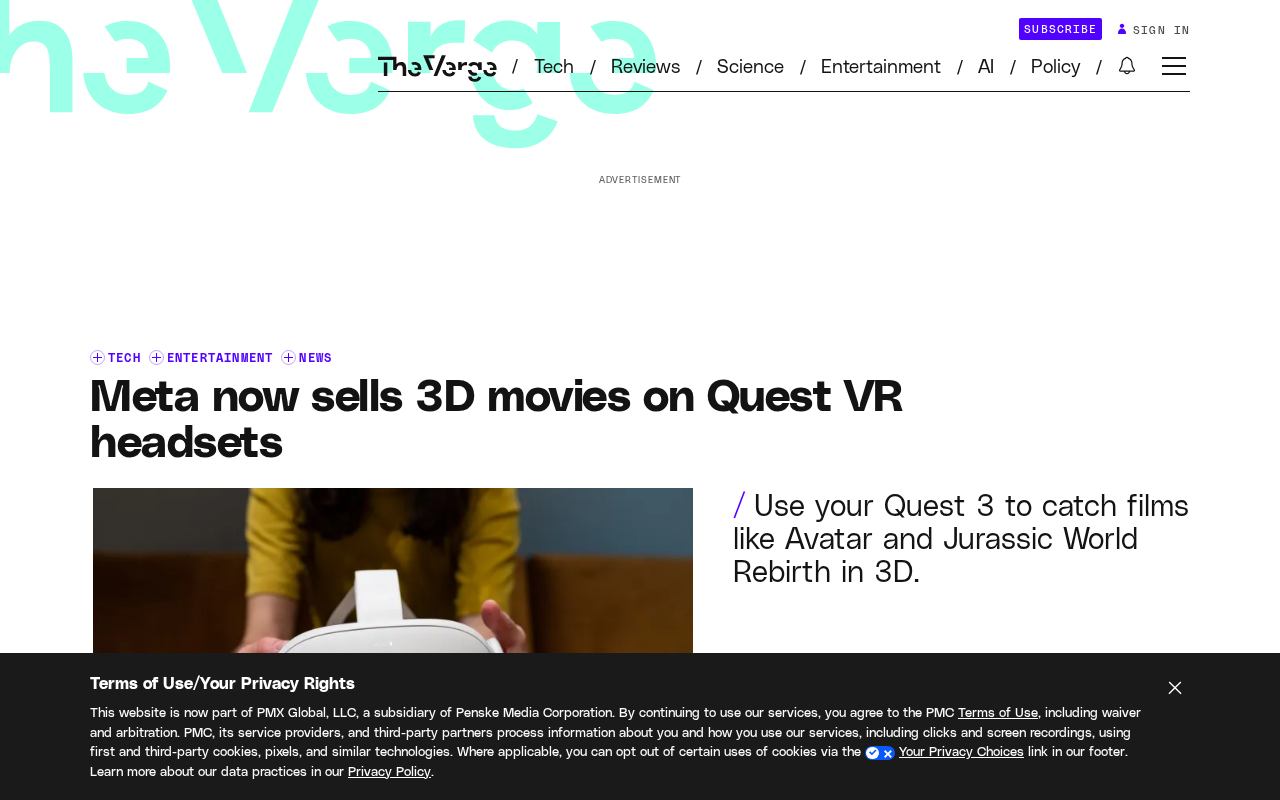
3D Movies Arrive on Quest: The Lineup and How to Watch
According to Meta's official announcement, these 3D films are offered for purchase or rental and are fully integrated into the TV app built into Quest. The lineup includes 3D benchmark titles like Avatar, commercial blockbusters such as Spider-Man: Far From Home, Jurassic World Rebirth, and Wicked: Part Two, plus Billie Eilish-related music content.
Users don't need to switch to a third-party app — after paying within the TV app, they can watch in 3D on Quest 3 or Quest 3S. Meta didn't disclose specific pricing, rental duration, or resolution specs in the announcement, but the dual "purchase or rental" model means it's closer to a traditional digital store than subscription streaming.
The digital rights model behind rental and purchase: The "purchase or rental" mentioned here corresponds to two forms of copyright licensing in digital content distribution. Purchase (often called "buyout") means the user pays to gain long-term viewing rights to the film under their platform account, but it's generally still subject to DRM (digital rights management) restrictions and the file can't be freely exported. Rental, by contrast, allows repeated viewing within a limited time window (commonly 48 hours or 30 days, with the countdown shortened once playback begins). This model differs from subscription streaming (like Netflix) — users don't pay for an entire content library but for individual titles, with the platform and studios splitting revenue according to agreed proportions. Because 3D films have higher production and conversion costs, pricing is typically higher than 2D versions, and studios are more sensitive about windowing and exclusivity terms — which may explain why Meta didn't disclose pricing or revenue-share details in the announcement.
How 3D movies play in a VR headset: Quest 3 and Quest 3S use a binocular display system to present slightly parallaxed images to the left and right eyes, creating a sense of stereoscopic depth. This is the same principle as polarized 3D or active-shutter 3D in cinemas, but without the glasses. 3D film sources are typically stored in frame packing or top-and-bottom / side-by-side formats, and the TV app decodes them during playback and outputs them separately to the two displays. Quest 3's per-eye resolution is 2064×2208, higher than the equivalent clarity of most cinema projections, but the actual experience also depends on source bitrate, lens distortion correction, and virtual screen distance settings. That's why the question raised at the end of this article — whether image quality reaches full HD or above per eye — is key to judging the experience: if the source is encoded at only 720p per eye, it will appear noticeably blurry when enlarged onto a virtual giant screen.
Why Meta Is Selling 3D Movies
Quest's ecosystem has long relied on games and fitness apps as its main revenue drivers, with film and TV content mostly supported by free or partner apps. Introducing paid 3D movies is essentially about monetizing the headset's "big-screen viewing" selling point — 3D is Quest's differentiation advantage over TVs and projectors, and the number of available titles has always been a limiting factor.
A library of over 150 titles is already substantial in the VR space. For Meta, this business isn't just about selling films — it's about establishing paid habits for the TV app and paving the way for more content formats (such as immersive video and live sports) down the line.
How the Approach Differs from Apple Vision Pro
Apple's Vision Pro also focuses on viewing, but takes a route of partnering with studios like Disney and emphasizing spatial video and high-spec image quality. Meta's move leans more toward "digital store" logic: broad content, low barriers, cheap hardware. The two take different approaches to paid content, but both are betting on the same judgment — that film and TV is the high-frequency scenario for VR headsets second only to gaming.
You may not have noticed that Meta's announcement is relatively restrained — it didn't publish sales targets or studio revenue-share details, suggesting this is more of an ecosystem catch-up than a major bet.
The difference between spatial video and 3D movies: The "spatial video" Apple emphasizes with Vision Pro is not the same concept as the 3D movies discussed here. 3D movies are a traditional stereoscopic film format, generated by two synchronized cameras or post-production conversion, with a fixed viewpoint — viewers can only watch the camera positions the director预设. Spatial video, by contrast, uses a capture format with depth information (such as Apple's spatial video format) that allows users to change their viewpoint within a limited range, creating a sense of presence similar to a "window." The former has a mature library and large content volume; the latter has high production barriers and little native content. Meta chose to start with 3D movies to quickly establish a paid scenario using mature content; Apple is trying to build a differentiated experience with spatial video, but in the short term its content scale will struggle to match. The divergence in content strategy is essentially a trade-off between "breadth first" and "experience first."
What Users Get — and What's Still Missing
For existing Quest 3/3S users, the 3D movie store fills an obvious gap: no more fiddling with sideloading or third-party apps to find 3D content. For potential buyers, it's also a more concrete reason to buy.
What remains unclear: whether 3D movies support offline download, whether they integrate with Meta account family sharing, and whether image quality reaches full HD or above per eye. These details will determine whether it's a "novelty feature" or a genuinely viable long-term cinema replacement.
Related articles

Jensen Huang Returns to Nvidia: The Power Game Behind an "Aggro Reset"
Nvidia's board reappointed Jensen Huang as CEO less than two weeks after his scandal-driven resignation. This analysis explores the board's decision-making, Trump's political intervention, media power failure, and market reaction behind the dramatic return.

Why Voice AI Can't Understand Kenyans' Everyday Conversations
Swahili speech recognition hits 3.24% error on read text, but everyday Kenyan speech mixes English, Sheng slang, and accents—leaving mainstream voice AI struggling.

Data Centers Build Their Own Natural Gas Plants: AI Compute's Breakout Around a Decade-Long Grid Wait
Grid interconnection approvals can take a decade, so xAI and others are building off-grid natural gas plants to power AI clusters. This article analyzes the drivers, costs, and impact of behind-the-meter generation on AI infrastructure.