Meta's Free Cash Flow Plunges 91%: Where Is the Tipping Point for Its AI Infrastructure Gamble?

Meta's free cash flow drops 91% as AI infrastructure spending consumes nearly half its revenue.
Meta's latest earnings reveal a stark financial reality: free cash flow collapsed 91% to $784M while AI infrastructure spending hit $31B per quarter. With CapEx projected to reach 50% of revenue by 2026 and long-term debt surging to $83.7B, Meta faces a critical question—will this unprecedented AI gamble deliver outsized returns or force a costly retreat?
A Set of Alarming Financial Figures
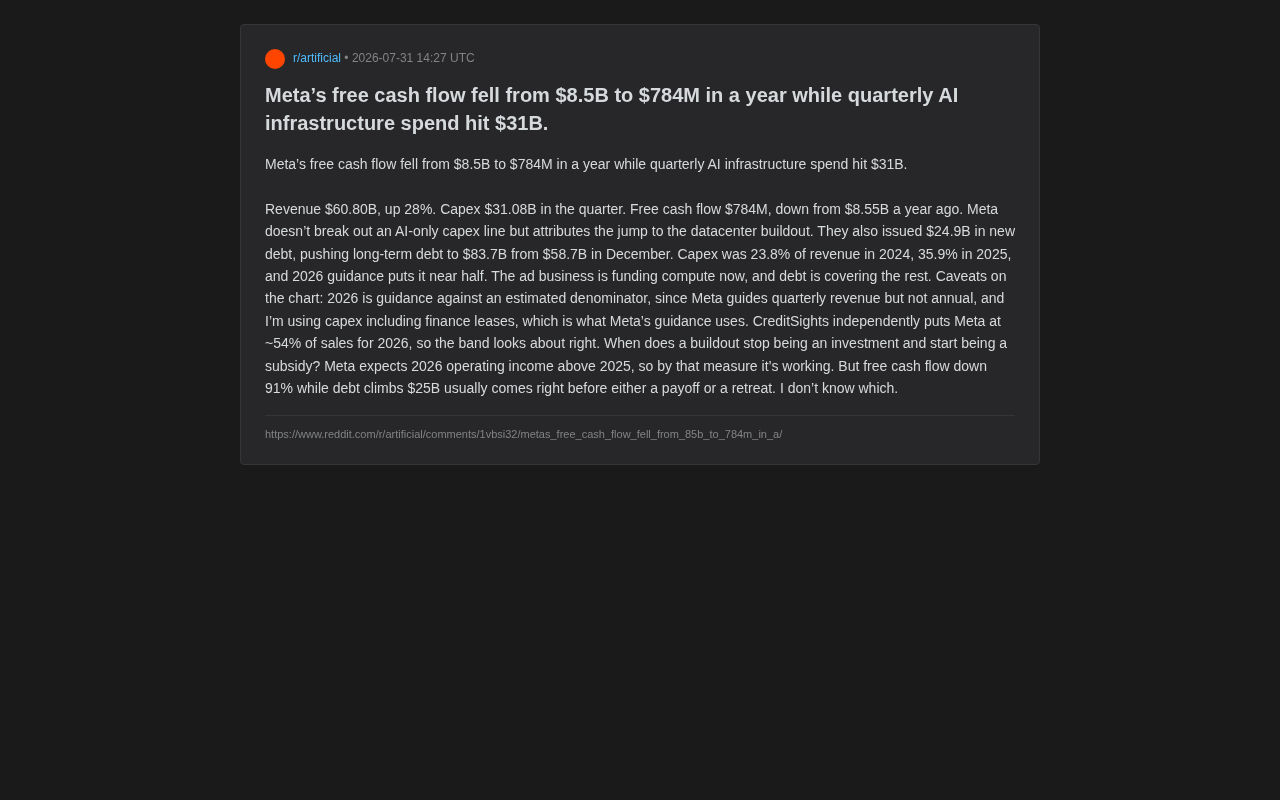
Meta's latest earnings report reveals a deeply unsettling trend: the company's free cash flow plummeted from $8.55 billion to $784 million in a single year—a staggering 91% decline. Meanwhile, AI infrastructure spending surged to $31 billion in a single quarter. The stark contrast between these two figures paints a vivid picture of the high-stakes gamble this social media giant is undertaking.
Free Cash Flow (FCF) is a core metric for assessing a company's financial health. It represents the cash generated from operations minus capital expenditures—the actual disposable cash available for debt repayment, share buybacks, or dividends after maintaining and expanding the asset base. Unlike net income, free cash flow strips out the noise from non-cash items and more accurately reflects a company's true "cash-generating ability." When a company's free cash flow collapses, its actual financial flexibility and resilience against risk deteriorate significantly—even if reported profits appear healthy on the surface.
On the surface, Meta's business remains robust—revenue reached $60.8 billion this quarter, up 28% year-over-year. But when we dig deeper into the cash flow structure, a far more complex picture emerges: the enormous profits generated by the advertising business are being rapidly consumed by unprecedented capital expenditures.
The Runaway Rise of Meta's CapEx-to-Revenue Ratio
What truly warrants alarm is the trajectory of Meta's capital expenditure as a percentage of revenue. According to data analysis:
- 2024: CapEx accounted for 23.8% of revenue
- 2025: This ratio leaped to 35.9%
- 2026 guidance: Expected to approach nearly half of revenue (~50%)
This trend has been independently corroborated by third-party institutions. Credit research firm CreditSights estimates Meta's 2026 capital expenditure will constitute approximately 54% of sales—broadly aligned with the above projections. This means that for every two dollars Meta earns, nearly one dollar is being poured into data center construction.
Historically, tech companies typically maintain capital expenditure at 10%-20% of revenue. Even the telecom industry, known for its asset-heavy operations, rarely exceeds 25%-30%. Meta's plan to push this ratio toward 50% is virtually unprecedented in tech industry history. The only comparable case is the aggressive investment cycle when telecom companies laid fiber optic networks in the early 2000s—an investment boom that ultimately led to multiple telecom giants filing for bankruptcy and writing down assets. Of course, the environment then differs fundamentally from today: Meta has a high-margin advertising business to support cash flow, whereas the telecom companies of that era lacked a similarly stable revenue source.
It should be noted that the 2026 figures are estimates based on guidance extrapolation—Meta only provides quarterly revenue guidance, not annual guidance, and the CapEx figures used here include finance leases (which is the standard Meta's official guidance uses). Finance leases are long-term lease arrangements where the lessee essentially assumes most of the risks and rewards of the asset, treated as purchases in accounting terms. For Meta, a significant portion of data centers and GPU servers are acquired through finance leases; excluding them would severely understate the company's actual capital commitments. Even accounting for these technical factors, the sustained upward trend in the ratio remains unmistakable.
Debt Expansion: Filling the AI Investment Cash Flow Gap
When advertising cash flow cannot cover such massive investments, Meta has turned to borrowing. This quarter, the company issued $24.9 billion in new debt, pushing long-term debt from $58.7 billion in December last year to $83.7 billion.
This reveals the financing logic behind Meta's current AI strategy: the advertising business supports compute investment, while debt fills the remaining funding gap. This model appears workable during periods of sustained business growth, but it also carries significant financial risk. Should revenue growth decelerate or AI investments fail to generate timely returns, the elevated debt burden will become a heavy millstone.
Notably, Meta was essentially a zero-debt company before 2022. Its large-scale borrowing began during the transition period after the metaverse strategy faltered, and the AI arms race further accelerated this trajectory. Vaulting from near-zero debt to $83.7 billion in long-term obligations in just over two years—this pace of leverage is exceptionally rare among tech giants. While Meta's debt-to-EBITDA ratio remains within manageable bounds, the speed of expansion itself constitutes a risk signal.
One detail worth mentioning: Meta does not separately disclose AI-specific capital expenditure breakdowns, instead attributing the surge to overall data center construction. This opaque disclosure approach makes it difficult for outside investors to precisely assess the true scale and return timeline of AI investments.
Investment or Subsidy? The Tipping Point Question for AI Infrastructure
The original post raises a thought-provoking question: At what point does an infrastructure buildout transition from "investment" to "subsidy"?
In economic terms, the core distinction between "investment" and "subsidy" lies in the certainty of expected returns. Investment is capital allocation based on reasonable expectations, with clear return pathways and timeframes; subsidy is a sustained resource transfer with no clear expectation of recoupment. When AI infrastructure spending continues to balloon while monetization models remain limited to "improving ad efficiency" and "potential future products," outside observers have legitimate grounds to ask: have these outlays transformed from commercial investments with expected returns into a "unilateral subsidy" for AI technology development—where Meta creates value for the entire AI ecosystem but fails to capture that value proportionally.
From Meta's own perspective, the gamble is still paying off. The company projects 2026 operating profit will exceed 2025 levels. By this measure, the massive investment is generating positive returns. Meta's AI spending currently serves three monetization vectors: first, improving the precision and efficiency of ad systems (AI recommendation systems have reportedly increased user engagement time on Facebook and Instagram by 8%-10%); second, capturing the AI application gateway through the Meta AI assistant; and third, building ecosystem influence through the open-source Llama model. However, only the first of these three pathways has produced clearly quantifiable commercial returns.
But from a cash flow perspective, the warning signs are equally apparent. Historical experience shows that when a company's free cash flow drops 91% while simultaneously adding $25 billion in debt, it typically foreshadows one of two outcomes:
- Payoff: The massive investment ultimately translates into overwhelming market advantages and cash flow returns
- Retreat: The investment fails to generate expected returns, forcing the company to scale back
Currently, no one can determine which path Meta will take.
A Panoramic View of the Tech Giants' AI Arms Race
Meta's situation is not an isolated case—it's a microcosm of the entire tech industry's AI infrastructure arms race. From Microsoft and Google to Amazon, leading companies are all expanding data centers and compute reserves at breathtaking speed. The wager in this race is clear: whoever can first build sufficiently powerful AI infrastructure will dominate the next computing paradigm.
Meta's so-called AI infrastructure investment primarily encompasses the construction of hyperscale data centers, procurement of high-performance GPU clusters (mainly NVIDIA's H100/B200 chips), high-speed network interconnects, cooling systems, and supporting power infrastructure. A single hyperscale data center can cost tens of billions of dollars, and the GPU clusters required to train large language models carry astronomical price tags—for a GPT-4-class model, single training run compute costs are estimated at $60 million to $100 million, while next-generation models may break through the $1 billion mark. Additionally, AI training is extremely energy-intensive; a large training cluster's annual electricity consumption can equal that of a small city, making power supply and cooling systems significant investment items.
By some estimates, total AI-related capital expenditure by U.S. hyperscalers in 2025 is expected to exceed $300 billion—more than double the 2023 figure. This arms race exhibits classic "prisoner's dilemma" characteristics: every company fears that if they don't invest, competitors will gain irreversible first-mover advantages; but if everyone invests massively, it could ultimately lead to severe compute overcapacity and collectively declining returns on investment.
However, this "build first, monetize later" logic is pushing capital markets' patience to the limit. Investors must weigh two perspectives:
- Optimistic view: This is a one-time, necessary infrastructure investment, and short-term cash flow pressure is the price for long-term structural advantage. Supporting arguments include: AI is substantively improving ad efficiency, Meta possesses a data flywheel advantage with over 3 billion daily active users, and the open-source strategy may help Llama become an industry standard.
- Cautious view: Concerns that CapEx approaching half of revenue is unsustainable, and AI monetization pathways remain unclear. Historically, excessive technology infrastructure buildouts often end in overcapacity and asset write-downs—from the fiber optic bubble of 2000 to the cryptocurrency mining farms of 2022, similar stories have played out repeatedly.
Conclusion: The Ultimate Test of Time and Conviction
Meta's earnings report is fundamentally a test of time and conviction. A 28% revenue increase proves the core business remains healthy, and projected growth in operating profit supports management's optimistic narrative. But the 91% cliff-drop in free cash flow and rapid debt expansion constitute a risk exposure that cannot be ignored.
Whether this AI infrastructure gamble will deliver rich returns or ultimately force Meta into retreat cannot be determined in the short term. What is certain is that cash flow performance and actual AI monetization progress over the coming quarters will serve as critical signals for judging the success or failure of this gamble. For the broader tech industry, Meta's trajectory will also become an important bellwether for assessing whether an AI investment bubble exists.
From a more macro perspective, Meta's story reflects a fundamental tension facing the tech industry today: during this window period when AI capabilities are advancing rapidly but business models have not fully matured, companies must make difficult choices between "over-investing and potentially wasting resources" and "under-investing and potentially missing the era." This is not just Meta's challenge—it's the central question that the entire tech industry and capital markets must answer in 2025.
Related articles

After Being Laid Off by AI, a Programmer Open-Sourced an AI CEO: Who Should the Automation Axe Really Fall On?
A CEO used AI as a reason to fire developers. They responded by open-sourcing an AI CEO, exposing the power bias in automation narratives and who really should be replaced.

A 4-Year Engineering Study Plan: The Path from Zero to Landing Your First Offer
A systematic 4-year engineering study plan covering foundation building, specialization, interview prep, and job hunting to help students build an actionable technical growth path.

Roc 0.1.0 Preview: A Fast, Friendly, and Functional New Programming Language
Roc language nears its first numbered release 0.1.0, transitioning from experimental to usable. Explore its platform architecture, core features, and toolchain.