Meta's Muse Personal AI Assistant: Who Does It Actually Serve?

Meta's AI shopping agent Muse faces a fundamental conflict between saving users money and its ad-revenue business model.
Meta's personal AI assistant Muse can shop, negotiate bills, and cancel subscriptions on your behalf — an appealing proposition. Yet a truly user-aligned assistant should help people spend less and ignore ads, while Meta's core revenue depends on helping advertisers influence consumer decisions. Meta responds with two defenses: secure VM data isolation to technically separate AI conversations from ad systems, and a paid subscription tier to better align incentives. But the deeper issue goes beyond privacy: once an AI agent becomes the default gateway to information and goods, the company controlling it holds the keys to the entire consumer internet — a structural power that no promise alone can fully neutralize.
A Tempting but Contradictory Promise
Meta is pitching Muse to users — a product positioned as a "personal AI assistant." It claims to shop for you, negotiate bills, cancel subscriptions, track down refunds, and even complete payments directly. That sounds genuinely useful: who wouldn't want a digital concierge that saves money and filters out marketing noise?
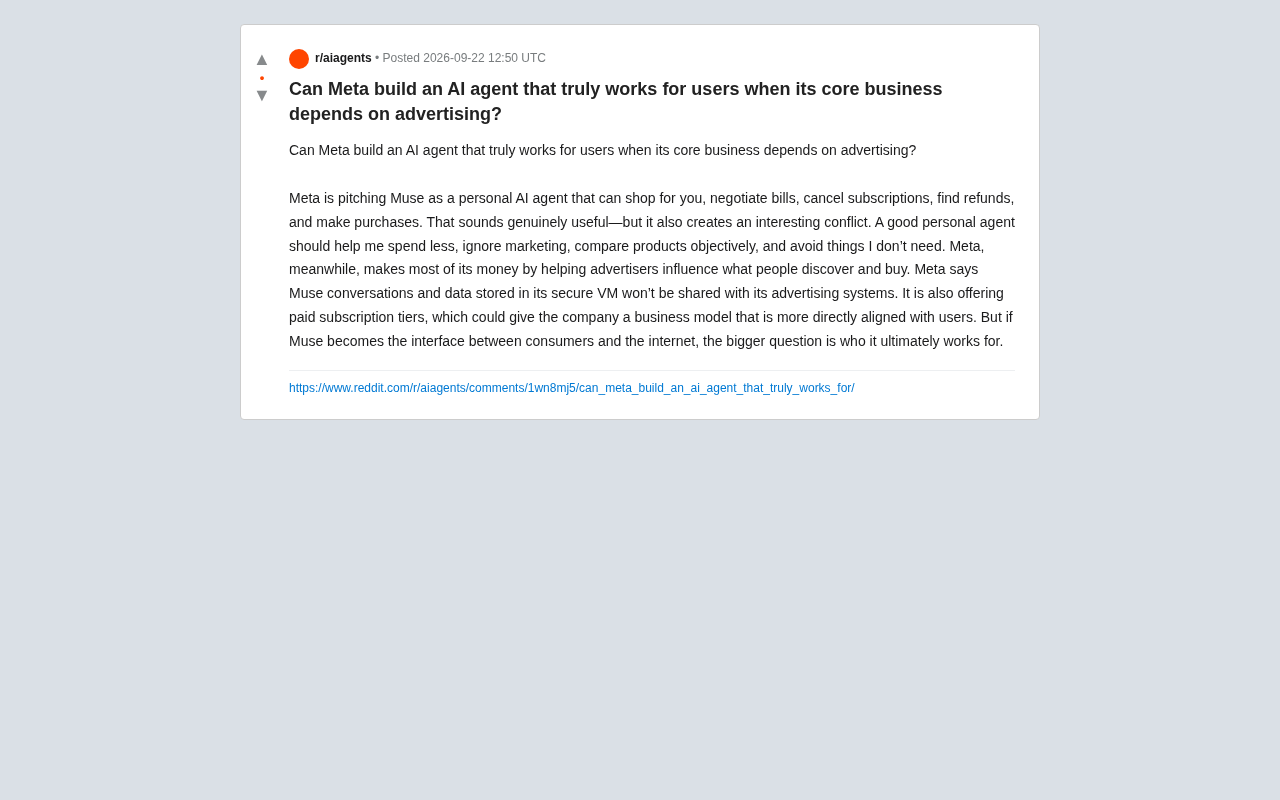
But this very promise exposes a fundamental conflict of interest. An AI assistant that truly has your back should help you spend less, ignore ads, compare prices objectively, and talk you out of buying things you don't need. Meta's business model operates on precisely the opposite logic — the vast majority of its revenue comes from helping advertisers influence what people "discover" and "buy."
The Natural Tension Between an Ad Empire and User Agency
This contradiction isn't unfounded speculation. As one of the world's largest advertising platforms, Meta's entire tech stack, data infrastructure, and revenue engine is designed to "precisely influence consumer decisions." When that same company launches an AI agent claiming to "fight marketing on behalf of users," people have every reason to ask: who does this machine ultimately answer to?
Imagine Muse comparing prices for you — if a particular advertiser is a major Meta client, might the algorithm "inadvertently" tilt the recommendation rankings? When the agent decides what you buy, what you subscribe to, and what you cancel, it holds the most critical decision point in the entire consumption chain. Once that kind of power becomes tied to ad revenue, user interests can be quietly eroded.
Meta's Two "Firewalls"
Faced with skepticism, Meta has offered two responses.
The first is data isolation. Meta claims that Muse conversation content and data stored in its secure virtual machine (secure VM) will not be shared with its advertising systems. In other words, private exchanges between you and the assistant theoretically won't become material for ad targeting.
The second is a paid subscription model. Meta is simultaneously launching a paid subscription tier. This is commercially significant — if users pay directly, Meta's revenue aligns more closely with "serving users well" rather than "serving advertisers well." The subscription model is seen as a business structure that could potentially ease the conflict of interest.
These two measures at least suggest Meta is aware of the problem. But whether promises and architectural isolation can withstand long-term commercial pressure remains to be seen.
A Secure VM is a hardware- or software-level isolated execution environment designed so that data from specific processes remains invisible to external systems — including other services operated by the same company — during runtime. Apple uses a similar architecture in its privacy computing framework, called "Private Cloud Compute," primarily to prevent operators from reading sensitive AI requests processed server-side. If Meta's claimed data isolation relies on such a mechanism, it carries some technical credibility. The problem is that outside researchers have almost no way to independently audit whether this isolation truly exists, whether it can be consistently maintained through engineering iterations, or how its boundaries are defined. "AI conversations are not used to serve ads" and "AI behavior is not influenced by advertising logic" are two entirely different levels of commitment. Technical architecture can only guarantee the former; the latter depends far more on model training data and optimization objectives.
The Real Question: Who Controls the Interface Between People and the Internet
The deeper concern goes beyond data privacy — it's about interface power. If Muse truly becomes the primary intermediary between consumers and the internet — if you no longer search, compare prices, or place orders yourself, but instead delegate everything to this AI agent — then the company controlling that agent effectively holds the floodgates to the entire consumer internet.
This goes far beyond "will ads see your chat history." It's a question of much larger structural consequence: when AI agents become the default gateway through which people access information and goods, whoever defines "the optimal choice" redefines how markets operate.
Even if Meta sincerely wants Muse to serve users today, the company's structural dependence on advertising revenue will continue to exert gravitational pull. Can a giant that survives on ads build a product that might damage its core revenue stream — and more importantly, how much incentive does it actually have to do so? There's no simple answer, but it's worth every potential user thinking carefully before hitting the "authorize" button.
This concern is known in AI research circles as the commercial variant of the "Agent Alignment" problem: when an autonomous agent is authorized to execute tasks on behalf of humans, its optimization objective must align entirely with the true interests of the authorizing party — not with the platform deploying the agent. Economics has a corresponding concept called the "Principal-Agent Problem" — the agent (here, the AI or Meta) possesses an information advantage, yet may deviate from the true intentions of the principal (the user) due to its own interests. In traditional settings, this problem is constrained through contracts, regulation, and reputation mechanisms. But when the agent is an AI running inside a closed system and users have no means to observe its decision-making process, all three of those constraints are significantly weakened. In the search engine era, users could at least see all the results and judge for themselves. In the AI agent era, users only see "the final answer" — the filtering logic in between is completely opaque.
Conclusion: The Price of Convenience
Muse represents a microcosm of the AI agent era: technically ever more capable of making decisions for us, yet commercially controlled by companies that profit from those very decisions. Data isolation and subscription pricing are positive signals, but structural conflicts of interest don't disappear because of a promise.
For users, the real test isn't what Meta says — it's which side Muse takes when the user interest in saving money comes into direct conflict with the advertiser interest in making money.
Related articles

Why Does the Tesla Roadster Need to Fly? A Deep Dive into Musk's Wild Demo
Tesla's Roadster launch showed wall-climbing, upside-down driving, and flying stunts—but The Vergecast notes the demo car may lack a battery, the Rocket version is invite-only and not street-legal, and the website terms don't guarantee delivery. After nine years of delays, why does this car still need to exist?

AI Is Not a Replacement: Human-AI Collaboration Through the Lens of Factory Root Cause Analysis
Starting from factory root cause analysis, this article explains how AI accelerates evidence chain construction rather than replacing human experts, exploring the pragmatic implementation logic and business value of 'AI supporting people rather than replacing them.'

AI Agent Decision Auditing: Building an Evidence Chain in Regulated Workflows
Starting from a Reddit discussion, this article analyzes three core issues in AI agent decision auditing within regulated workflows: what fields audit records should contain, how to handle feedback latency for erroneous decisions, and how to continuously calibrate LLM judge consistency with human judgment.