Meta Used 5 Million Medical Records + an AI Coding Assistant to Produce Ten Papers in Two Weeks

Meta used 5 million EHRs and an AI coding scaffold to let medical experts produce ten research manuscripts in two weeks.
Meta's health workflow team disclosed an experiment: licensing 5 million electronic health records and building a coding scaffold called Muse Wonder, letting medical experts pose research questions in natural language while AI executes data analysis. In two weeks, the expert team produced ten research manuscripts, with one person completing three independently. Experts reviewed each other's manuscripts and wrote skill files, enabling the scaffold to continuously improve. The project stresses human researchers' irreplaceability, and is framed under AI for Science: AI accelerates the path from raw data to understanding, potentially boosting productivity 10–100x.
Meta Used 5 Million Medical Records + an AI Coding Assistant to Produce Ten Papers in Two Weeks
Meta's health workflow team recently disclosed a rather thought-provoking experiment: what happens when you put a group of medical experts, a powerful coding model, and 5 million electronic health records together? The answer — ten research manuscripts produced within two weeks, with one researcher completing three of them single-handedly.
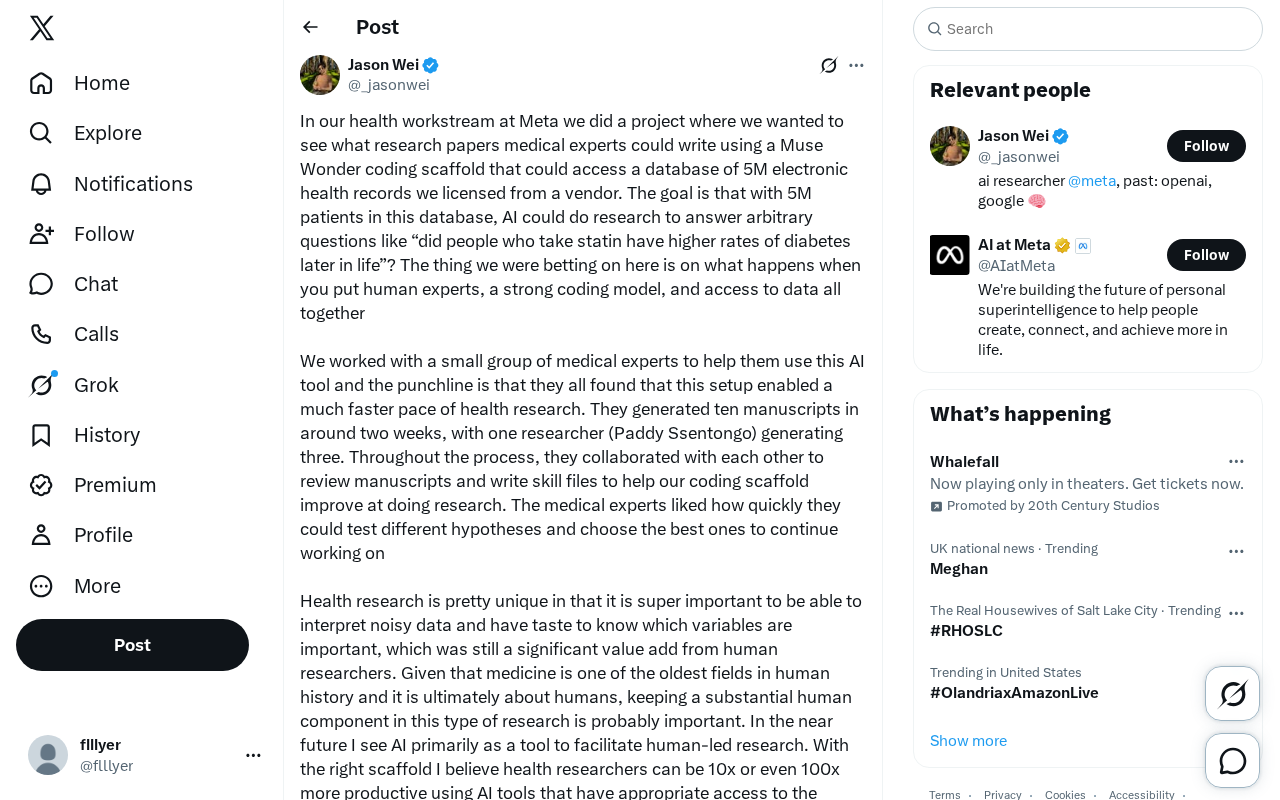
Experiment Design: 5 Million Patient Records + AI Coding Scaffold
According to shares from Meta team members on social media, the project is part of their health workflow efforts. The team licensed 5 million electronic health records from a vendor and built a coding scaffold called Muse Wonder, enabling medical experts to pose research questions in natural language while AI assists with data analysis.
For example, a researcher can directly ask: "Do people who take statins later have a higher rate of diabetes?" The AI will run the analysis across the massive database and quickly return statistical results.
The core bet of this project is not whether AI can replace doctors, but rather how far research efficiency can be pushed when human experts, a strong coding model, and data access are combined.
Electronic Health Records (EHR) are digitalized patient files generated by medical institutions during diagnosis and treatment, typically containing structured fields such as diagnostic codes, medication records, lab results, vital signs, and surgical history, often mixed with unstructured text like clinical notes. The scale advantage of EHR makes it an important data source for observational research, such as adverse drug reaction signal detection in pharmacoepidemiology. But EHR is not designed for research: missing data, inconsistent coding, and interrupted follow-up are common problems, so researchers often need extensive cleaning and causal inference methods to control for confounding bias. Meta's licensed access to 5 million EHRs this time means its AI scaffold faces a real-world evidence (RWE)-level data environment, not an idealized clinical trial dataset — which also explains why "human judgment" is repeatedly emphasized in the process.
Ten Manuscripts in Two Weeks: The Collaboration Model Behind the Speed
Medical experts involved in the experiment generally reported that this setup markedly accelerated the pace of health research. They generated ten research manuscripts in roughly two weeks, with researcher Paddy Ssentongo contributing three on his own.
More importantly, the mode of collaboration changed. Experts reviewed each other's manuscripts and wrote "skill files" to help the coding scaffold continuously improve on research tasks. In other words, the AI tool itself was being optimized through use.
One point the medical experts specifically highlighted: they could rapidly test different hypotheses, then pick the most valuable directions to pursue further. This rhythm of "rapid trial-and-error, advance the best" often takes months to complete a single round in traditional research workflows.
Skill files in this context can be understood as a kind of "reusable instruction set" or "fine-tuning prompt package" for an AI coding scaffold: researchers write recurring research operations — such as standardized extraction of specific variables, missing value handling rules, statistical model selection preferences — into structured documents for the scaffold to invoke in subsequent tasks. Unlike traditional "prompt engineering," skill files are closer to the team's internal methodology accumulation, shareable across researchers, version-controlled, and iteratively improved. When experts write skill files, they are essentially externalizing tacit research experience into AI-executable rules, making the scaffold increasingly "handy" within a specific domain. This mechanism also partly explains how ten manuscripts could be produced in two weeks: repetitive analytical steps are packaged upfront, letting researchers focus only on hypothesis design and result interpretation.
Human Researchers Remain Irreplaceable
Despite AI's impressive performance, the project also explicitly points to the core value of human experts. What makes health research unique is that, faced with noisy data, researchers need judgment to identify which variables truly matter — this kind of "taste" remains an important contribution of human researchers.
The Meta team maintained a cautious attitude: medicine is one of humanity's oldest fields, and the ultimate subject of research is people, so retaining a considerable proportion of human involvement in such research may be necessary.
In the foreseeable future, AI is more of a tool that facilitates human-led research. But with the right scaffold and appropriate data access for AI, health researchers' productivity could increase 10x or even 100x.
AI for Science: Accelerating from Data to Understanding
This project can be understood within the larger framework of "AI for Science." Scientific activity can be split into two parts: first, collecting raw data about the world; second, synthesizing raw data into understanding.
The premise of this project is that the data already exists, and the goal is to use AI to accelerate the second part. The Meta team envisions a long-term future: when AI tools are powerful enough, the time to transform raw data into understanding approaches zero. In such a world, scientific progress would accelerate dramatically, with most work focused on collecting the right raw data through physical experiments.
This experiment was completed in a very short time, which was itself deliberate — it wanted to validate speed. And the conclusion is: the future of scientific research may be faster and more exciting than it is now.
AI for Science is a research paradigm that has emerged in recent years, with the core proposition of embedding machine learning, large models, and automated experimentation platforms into the entire process of scientific discovery, rather than serving only as an after-the-fact data analysis tool. Typical examples include AlphaFold's breakthrough in protein structure prediction, GNoME's application in materials discovery, and various laboratory automation loops. The key distinction of this paradigm is that AI can accelerate both the inductive step of "data to hypothesis" and optimize the experimental design step of "hypothesis to validation." The Meta health workflow project explicitly positions itself in the former — it assumes raw data already exists and focuses on compressing the time from data to understanding. The limitations of this route are equally obvious: if the raw data itself has measurement bias or insufficient coverage, AI only accelerates interpretation of existing data, not new observations of the world. Therefore, the long-term value of AI for Science depends on whether data collection and AI reasoning can evolve in tandem.
One-line Summary
Meta used 5 million electronic health records and an AI coding scaffold to let medical experts produce ten research manuscripts in two weeks.
Paragraph Summary
Meta's health workflow team disclosed an experiment: licensing 5 million electronic health records, building a coding scaffold called Muse Wonder, and letting medical experts pose research questions in natural language with AI executing data analysis. Within two weeks, the expert team produced ten research manuscripts, with one person completing three independently. In terms of collaboration, experts reviewed each other's manuscripts and wrote skill files, enabling the AI scaffold to continuously improve through use. The project emphasizes the irreplaceability of human researchers — the "taste" for identifying key variables and interpreting noisy data remains a core contribution. The experiment is placed within the AI for Science framework: AI accelerates the process from raw data to understanding, and the future focus of research may shift to collecting data through physical experiments, with health researcher productivity potentially increasing 10 to 100 times.
Related articles

A Single Prompt Triggers a Global PHP Security Storm: Is AI a Savior or a Hidden Risk?
A single AI prompt triggered a global PHP security crisis affecting Wikipedia and the Internet Archive. This article reviews the incident, analyzes the OpenAI-Amazon controversy, and explores the security paradox of lowered vulnerability discovery barriers in the AI era and developer response strategies.

When AI Is Taken Away: How Reliance on Shortcuts Undermines Your Problem-Solving Resilience
A study of 1,222 people found that after using AI to answer questions, once AI was removed, people gave up on more problems than a control group that never used AI. The article analyzes the impact of AI reliance on learning resilience and metacognition, and explores design implications for AI learning tools.

Carta and NewView Partner to Let Startup Employees Cash Out Equity Early
Carta and NewView Capital partner to simplify startup tender offers, helping employees sell equity early. Analysis of the mechanism, liquidity pain points, and impact.