Michael Nielsen Pulls Neural Network Book: A Reflection on AI Promises

Michael Nielsen pulls his neural network book, sparking discussion on AI knowledge timeliness and writing ethics.
Quantum computing pioneer and science writer Michael Nielsen has removed his widely followed neural network book from public channels, with the Hacker News discussion post receiving 59 points and 35 comments. Community reactions are divided: some readers regret losing a high-quality introductory resource, while others understand that prematurely solidified tutorials may mislead readers amid rapid technological iteration. The article argues that this move may reflect Nielsen's high standards for accuracy and the reality of shrinking knowledge half-life in AI. Lessons for AI content creators include establishing revision mechanisms, labeling content timeliness, and valuing diverse community discussion; for readers, it reminds us not to rely on a single tutorial but to maintain critical thinking and keep up with primary research.
Event Recap: The Exit of an Unfinished Work
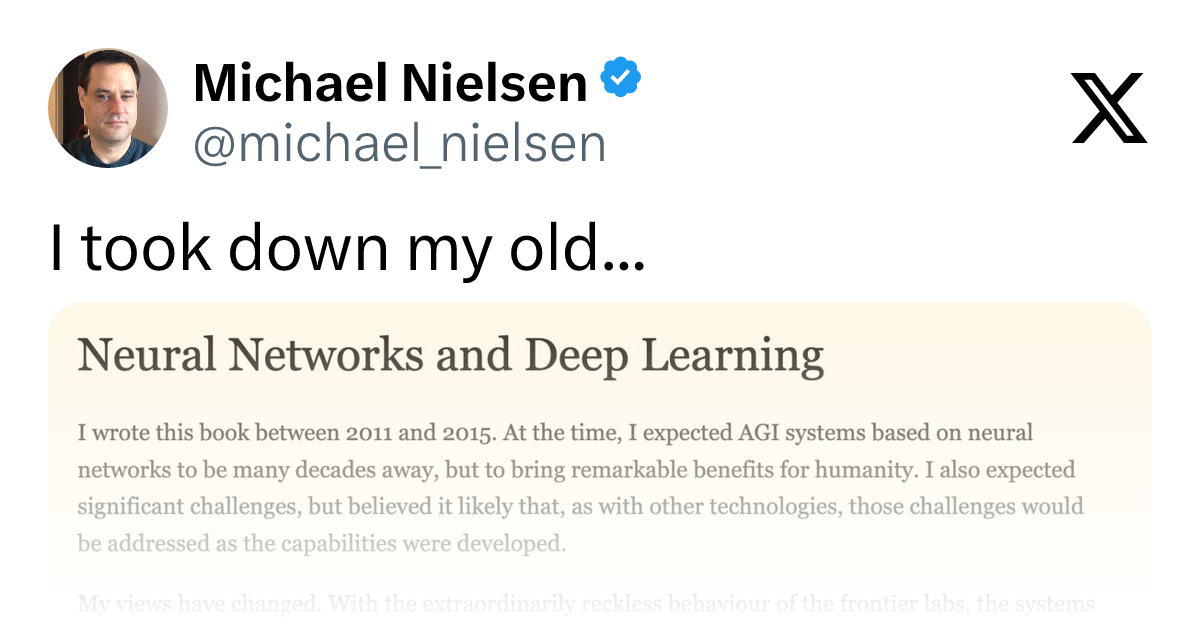
According to a Hacker News discussion thread, Michael Nielsen has removed his book on neural networks from the web. The post received 59 points and 35 comments, placing its discussion热度 in the moderately high range for the technical community. Nielsen had previously earned acclaim in the AI science communication space for works such as Neural Networks and Deep Learning, known for their rigor and clarity. This removal is not an isolated case—he has also made substantial revisions to or withdrawn published content in the past, consistent with his high standards for accuracy.
Interestingly, the original post did not disclose the specific reason for the removal, nor whether the book would return in a revised form. This information vacuum has precisely sparked multi-angle interpretations from the community.
What Michael Nielsen calls his "neural network book" most likely refers to the online open manuscript Neural Networks and Deep Learning, which he has long maintained with collaborators. The book is known for self-contained case studies such as "deriving backpropagation from scratch" and "handwritten digit recognition," and is published online under a CC license, allowing readers to read and translate it for free. This type of open manuscript differs from traditional printed books: it has no fixed "publication" milestone, authors can modify, take down, or rewrite it at any time, and readers find it difficult to distinguish a "stable version" from a "work-in-progress version." Therefore, Nielsen's takedown action is closer in传播 effect to "closing a long-public writing repository" rather than "recalling a printed textbook." Understanding this publishing format helps explain why the community reaction focused on "losing access" rather than "buying a wrong version."
Community Reaction: From Regret to Understanding
In the Hacker News comment section, opinions roughly split into two camps. Some readers expressed regret, arguing that Nielsen's writing served as an entry guide for many entering the neural network field, and that the takedown means latecomers lose a high-quality learning resource. Another group expressed understanding, believing that in the context of rapid AI iteration, prematurely solidified tutorials may mislead readers, especially when the book's content involves old paradigms that have been superseded by new methods.
This divergence itself reflects a deeper issue: in the AI field, the half-life of knowledge is shrinking. For a book on neural networks, the cycle from writing to publication to being surpassed by new technology may be shorter than in traditional disciplines. Nielsen's choice may well be a response to this reality.
The "knowledge half-life" was originally a concept in information science, referring to the time required for half of the knowledge in a field to be replaced or falsified by new discoveries. In the deep learning field, this cycle has been significantly compressed: after AlexNet in 2012, paradigms such as convolutional networks, attention mechanisms, Transformers, and large-scale pretraining succeeded one another, and many standard practices from five years ago (such as specific regularization techniques and classic recurrent network structures) are no longer default choices. But a short half-life does not mean all content quickly becomes obsolete—mathematical derivations, optimization intuition, and experimental design principles are relatively durable, while tool APIs, benchmark leaderboards, and "current best practices" are extremely prone to becoming outdated. To judge whether a neural network book needs to be taken down, the key is to see what type of knowledge it carries, and whether it clearly labels its scope of applicability and the time of writing.
Why Removal May Be a Responsible Approach
From a content creator's perspective, retracting published work requires considerable courage. For an author like Nielsen, whose reputation is built on accuracy, the neural network field has undergone dramatic changes in architecture, training methods, and application scenarios in recent years. If certain chapters of the book are based on outdated assumptions or case studies, continued public distribution may mislead readers.
On the other hand, Nielsen's writing tends to be pedagogical, emphasizing conceptual understanding over tool operation. Although such content is relatively durable, when the underlying technological paradigm shifts, the teaching framework itself may also need reconstruction. The takedown may be to buy space for revision rather than permanent abandonment.
In open publishing practice, author retraction or rewriting of content typically involves version control and licensing issues. If the manuscript was published under a license such as CC BY-NC, third-party translations, mirrors, and derivative versions may have already spread; a unilateral takedown by the original author cannot make these copies disappear, and may instead create a fragmented situation where "the official version is missing while unofficial versions continue to circulate." This is also a side effect that open textbook authors need to consider when deciding to withdraw: a takedown may not prevent old content from spreading, but it may weaken readers' channels to obtain the authoritative revised version. A safer approach is often to retain the old version and mark it as "outdated," while providing a new version or errata notes, allowing readers to judge for themselves under transparency.
Implications for AI Content Creators
This event offers several reminders for those currently active in AI writing and education. First, public writing requires a revision mechanism, rather than being published once and shelved. Second, in rapidly evolving technical fields, authors should clearly label the timeliness and scope of applicability of their content to help readers judge whether it still applies. Third, the value of community discussion lies in providing diverse perspectives; the discussion sparked by Nielsen's takedown is itself a public dialogue about the ethics of AI knowledge dissemination.
For readers, this event also reminds us: no technical book can replace continuous practice and reading of primary sources. In the AI field, maintaining critical thinking and keeping up with the latest research is more important than relying on a single tutorial.
Conclusion
The specific reason for Michael Nielsen's takedown of his neural network book remains unclear, but the community's reaction already shows that the authority of technical writing comes not only from the content itself but also from the author's cautious attitude toward the boundaries of that content. In the AI boom, creators who dare to admit that "this part needs rewriting" may be more trustworthy than those eager to publish.
Related articles

Nothing CMF Buds 2A Drops to $17.89 on Black Friday: A New Low for ANC Earbuds
Nothing CMF Buds 2A wireless earbuds Black Friday deal: just $17.89 on Amazon, about $11 off retail and a record low. ANC earbuds at an entry-level price.

When AI Creation Gets Accused of "Spitting": Hacker News Heats Up Over the Glaude Controversy
A Hacker News post, "Spitting in the Face of Glaude," sparks debate on AI creation transparency and attribution ethics. This analysis examines the blurred creator identity behind the controversy and offers practical advice for AI content production.

Akai Embraces Custom Firmware: MPC Sample 1.4 Lets Users AI-Program Their Sampler
Akai embraces the modding community with MPC Sample 1.4 firmware, supporting vibe-coded custom firmware and effects. We analyze the impact of this open strategy on music hardware and AI-assisted programming.