Michael Nielsen Takes Down His Classic Neural Network Textbook, Sparking Community Discussion

Michael Nielsen's classic free deep learning online book goes offline, prompting community regret and discussion on knowledge preservation.
The page for Michael Nielsen's free online book Neural Networks and Deep Learning is no longer accessible, sparking heated discussion on Hacker News with nearly 300 points and over 180 comments. Known for first-principles derivations, intuitive diagrams, and runnable code, the book is a landmark resource for deep learning beginners, and many developers say it was through this book that they truly understood backpropagation and gradient descent. Nielsen has not explained the reason for the takedown, and community speculation includes content aging, adjustments to publishing plans, or the author deliberately retiring an old work. The discussion extends to the sustainability of free technical education resources and knowledge archiving, and compiles alternatives such as Deep Learning, fast.ai, and PyTorch tutorials.
Event Retrospective: A Classic Textbook Quietly Goes Offline
Recently, news spread quickly through the tech community: the online book page for Neural Networks and Deep Learning by Michael Nielsen is no longer accessible. According to a discussion thread on Hacker News (which received 296 points and 187 comments), the book's original address neuralnetworksanddeeplearning.com currently shows as unavailable. Since its release, this book has been a landmark free resource in the field of deep learning introductions, known for its clear derivations, intuitive diagrams, and runnable code examples.
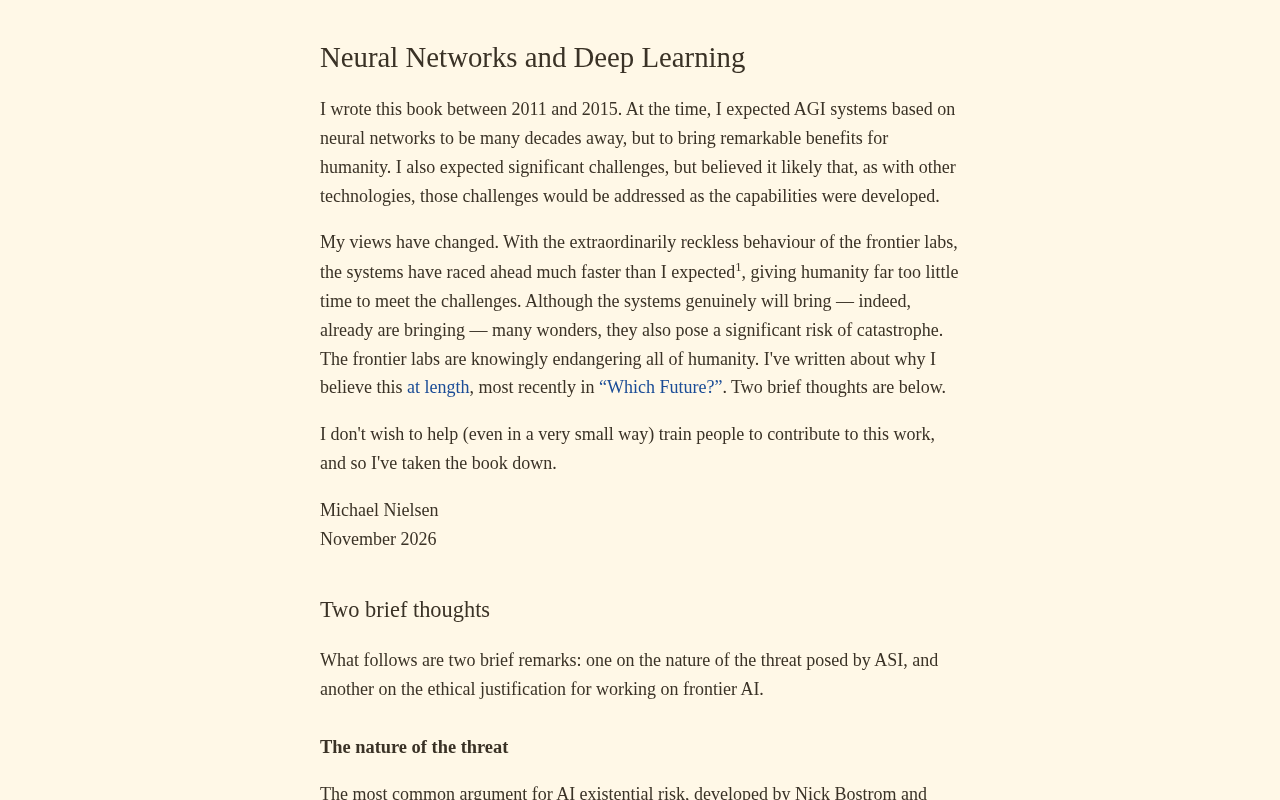
Nielsen himself has not yet publicly explained the reason for taking it down in detail, but various speculations have appeared in community discussions. Some comments suggest the author may want to integrate the content into a new publishing plan, while others believe this is a deliberate "retirement" of an early work. Regardless of the reason, the move has left many developers who benefited from the book feeling regretful.
Michael Nielsen is a well-known researcher in the fields of quantum computing and open science. He co-authored Quantum Computation and Quantum Information with Isaac Chuang and has systematically explored how to use online media to restructure scientific communication in his writing. He began serializing Neural Networks and Deep Learning around 2014, adopting an online "book + executable code" format, with each chapter paired with interactive Python examples (based on early frameworks such as Theano/CuPy). This approach of placing mathematical derivations, visualizations, and runnable code side by side had a clear influence on later online courses and interactive textbooks.
Community Reaction: Regret and Understanding Coexist
In the Hacker News discussion, many users shared their stories with the book. Some mentioned that it was through Nielsen's explanations that they truly understood the mathematical details of backpropagation and gradient descent; others said that the book's chapters on "how neural networks learn" remain their top recommendation for beginners to this day.
At the same time, some commenters expressed understanding of the author's decision. One user wrote: "The author has the right to decide where their work goes, especially when they believe the content needs updating or no longer meets current standards." This view represents the community's respect for creators' autonomy. The discussion also extended to the sustainability of free technical education resources—when an author chooses to withdraw their work, how should the community preserve and pass on that knowledge?
Impact on Learners and Alternative Paths
For readers currently learning deep learning, the disappearance of this book is undoubtedly a loss. Nielsen's writing style is known for "starting from first principles"; he excels at breaking down complex concepts clearly with simple mathematics and code, a style that is rare among comparable textbooks.
However, the community quickly compiled alternative resources. Comments recommended Deep Learning by Goodfellow et al., fast.ai's courses, and the official PyTorch tutorials, among others. You may not have noticed that Nielsen's other works (such as Reinventing Discovery) and his popular science content on quantum computing remain online, suggesting that this takedown may target only this one neural network textbook.
Backpropagation is the core algorithm for training multilayer neural networks. It is essentially an efficient implementation of the chain rule on a computational graph: it first performs a forward pass to obtain the loss, then works backward from the output layer to compute the partial derivatives of the loss with respect to each parameter layer by layer, thereby keeping the computational complexity of gradients on the same order as the forward pass. Gradient descent then updates weights according to these gradients at the learning rate, and its variants (stochastic gradient descent, momentum, Adam, etc.) are the default choices in practical training. Understanding the mathematical details of these two is precisely the part many readers consider most valuable in Nielsen's book, and it is also why its content remains relevant even though the tool stack is outdated.
Author's Intent and the Boundaries of Open Education
Michael Nielsen has long been an advocate of open science and open-source knowledge, and he has written multiple times about how to make scientific knowledge more accessible. Therefore, his removal of his own free book is particularly noteworthy. Some analysts believe this may be related to the aging of the book's content—the book is mainly based on early neural network technology stacks, and although the core principles remain valid, the tools and frameworks have changed dramatically.
Another speculation is that Nielsen may plan to republish it in a revised edition or move the content to a new platform. In either case, this event touches on a deeper question: in the rapidly iterating field of AI, how can classic textbooks stay vital? And how should authors balance the responsibility of free sharing with content maintenance?
Open Science advocates that research data, methods, code, and publications should be as openly accessible as possible to lower the barrier to knowledge acquisition and promote reproducibility; but an open license is not the same as giving up the author's control over the work. For online books released under Creative Commons licenses, authors usually retain the right to withdraw or revise them, though distributed copies are difficult to recover. This tension is precisely the focus of this discussion: free sharing lowers the cost of distribution but does not solve the problems of long-term hosting, version maintenance, and content aging, and it has also given rise to community practices such as spontaneous mirrors, archiving (e.g., the Wayback Machine), and local backups.
Conclusion: The Value of a Classic Does Not Fade When a Link Breaks
Although the online version is temporarily inaccessible, the influence of Neural Networks and Deep Learning on countless learners has settled into the community's memory. This event also reminds us that free knowledge on the internet is not permanent, and building local backups and diversified learning paths is especially important. For Nielsen, his writing and thinking will continue to influence later generations; and for learners, understanding the principles is far more important than relying on any single textbook.
Related articles

Inside the AI Training Data Market: The Trade-off Between Exclusivity and Discounts
G2i founder Gabe Greenberg reveals the dual-track pricing of the AI training data market: labs pay a premium for exclusive data or accept discounts that allow others to buy it.

SessionGraph: Unifying All Coding Agent Sessions in One Interactive Graph
SessionGraph aggregates coding agent sessions into an interactive graph, helping developers review, debug, and manage AI coding workflows across sessions. This article examines its positioning, value, and open questions.

iPad Mini Black Friday First Discount: $699 Starting Price Finally Sees Movement
Apple's 2026 iPad Mini sees its first major Black Friday discount, with Amazon and Walmart running simultaneous promotions. This article analyzes the product positioning, pricing pain points, and buying timing advice for this $699 compact tablet.