Micro Center Requires No-Export Declaration for RTX 5090 Purchases, Targeting GPU Smuggling to China

Micro Center now requires a No-Export Declaration for RTX 5090 purchases to curb GPU smuggling to China.
U.S. retailer Micro Center is reportedly requiring customers to sign a No-Export Declaration when purchasing the RTX 5090, marking a new front in geopolitical compute controls reaching the consumer market. According to Reddit users, the policy stems from Chinese buyers exploiting Micro Center's cash payment acceptance to purchase GPUs in bulk for smuggling — repeatedly clearing store inventory after restocks. Smuggling occurs both through scattered retail purchases and large-scale container shipments. For ordinary consumers, signing the declaration adds little burden, but signals a growing compliance trend for high-end GPU purchases.
Overview
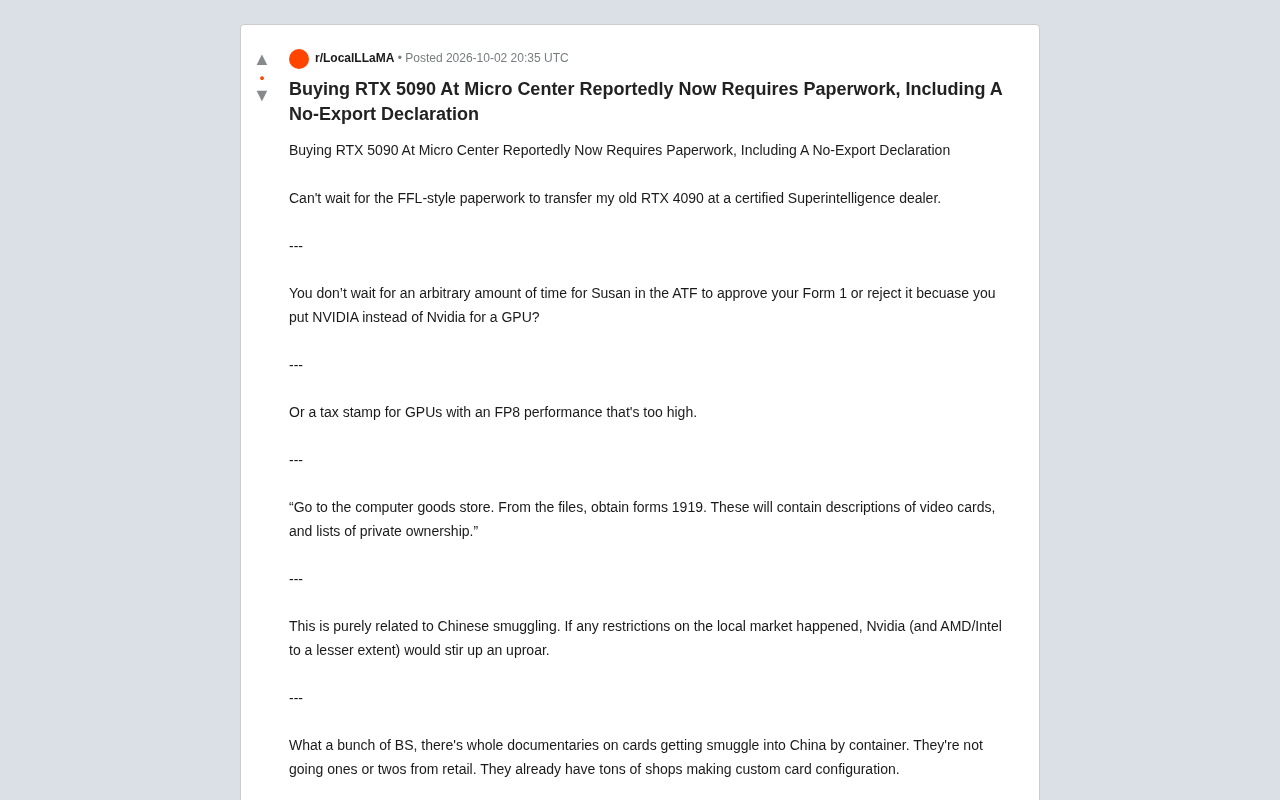
According to heated discussions in the Reddit community, major U.S. computer retailer Micro Center is now requiring customers who purchase RTX 5090 graphics cards to fill out additional paperwork, including a "No-Export Declaration." This means consumers buying this high-end GPU must sign a pledge that they will not export the card to restricted regions.
The change has sparked widespread debate among gamers and hardware enthusiast communities. While Micro Center has not yet issued an official comprehensive confirmation of this policy, multiple community users have verified the existence of this process through their own firsthand experiences.
Why the RTX 5090?
As NVIDIA's current flagship consumer GPU, the RTX 5090 stands out not only for its gaming performance but also for its powerful AI compute capabilities — placing it squarely in a "gray zone" when it comes to export controls targeting China. Against a backdrop of strict export restrictions on high-end AI training chips, consumer graphics cards have become an alternative route to circumvent those controls.
Some community members half-jokingly suggested that buying a GPU in the future might require "FFL-style" paperwork similar to purchasing a firearm in the U.S., with one user quipping that "GPUs with too much FP8 performance should require a tax stamp." Behind the humor lies a genuine concern among hardware enthusiasts about the gradual tightening of compute controls.
The Blackwell architecture GPU inside the RTX 5090 offers extremely high FP8/FP16 floating-point throughput, which in theory can be used for large-scale AI model training and inference — overlapping significantly in technical profile with regulated datacenter-class chips like the NVIDIA A100 and H100. The U.S. Department of Commerce's Bureau of Industry and Security (BIS) uses a "compute threshold" to determine export control eligibility: once a chip's aggregate compute metrics exceed a certain threshold, an export license is required to sell it to restricted countries. Consumer GPUs have long operated below this threshold, but as flagship card performance has grown exponentially each generation, the RTX 5090 has prompted fresh scrutiny from regulators. Meanwhile, the Export Control Reform Act (ECRA) and the "Entity List" system applied to China have nearly cut off access to datacenter-class chips, pushing some demand toward the consumer market and amplifying the RTX 5090's strategic sensitivity.
Retail Channels as a Key Link in Smuggling
Regarding the true motivation behind this policy, the community has reached a fairly consistent consensus: this is primarily aimed at countering GPU smuggling flowing into China.
One user who claimed to have spoken with managers at multiple retail stores provided fairly specific details. According to their account, Micro Center is especially popular with Chinese buyers because it accepts cash payments — minimizing paper trails. During past RTX 5090 restocks, it was common to see Chinese buyers lining up and purchasing repeatedly until store inventory was completely wiped out.
This user also noted that they had predicted more than a month ago that this type of smuggling would become unsustainable: "This smuggling pattern has caused serious headaches for retailers, and the government was bound to step in eventually."
U.S. export control enforcement has traditionally focused on large traders and direct exporters, while "ant-moving" retail-level purchasing has long remained a blind spot for regulators. Cash transactions leave no credit card or bank transfer records, and the difficulty of sharing retailers' inventory data with regulators in real time means that continuous large-volume purchases at a single store are very hard to retroactively identify as organized export activity. It is for this reason that Micro Center's proactive requirement of a No-Export Declaration is being interpreted by the industry as the retailer building a legal firewall for itself before formal regulations are in place — should an investigation arise later, the retained declaration documents would demonstrate that the retailer had fulfilled its duty to inform buyers, thereby avoiding joint liability.
Smuggling Scale: Piecemeal vs. Container Shipments
On the specific forms smuggling takes, the community is somewhat divided.
One camp argues that GPUs are primarily smuggled into China in bulk via shipping containers — "there are entire documentaries covering this process" — and points out that stores in China offering custom GPU configurations are unlikely to rely on buying one or two cards at a time from retail outlets.
The other camp cites investigations by well-known hardware outlet Gamers Nexus, noting that a significant portion of smuggling is actually carried out through scattered individual purchases — a convenient side income for some Chinese international students, with some smugglers also sourcing cards from the secondary market.
The more balanced conclusion is that both models coexist. Retail-level piecemeal purchasing, while limited in individual transaction size, constitutes a non-negligible smuggling pipeline due to its low profile, cash-based transactions, and difficulty of traceability. Of course, compared to large-scale container smuggling (with rumors of amounts exceeding $300 million), it remains the smaller operation.
Gamers Nexus has documented in its investigative reporting a gray-market model known as "daigou" (代购): individuals are hired to purchase GPUs in batches from multiple retail stores, which are then aggregated and sent abroad via international parcels or carried out in person. Individual transactions are small, below the threshold for targeted customs scrutiny, and the participants are dispersed, making enforcement extremely costly. Meanwhile, large-scale container smuggling typically relies on false declarations (e.g., declaring GPUs as low-value electronic accessories) or third-country transshipment to evade U.S. customs inspection — a more organized operation with significantly higher per-shipment profits. Both pathways operate in parallel, forming the primary channels through which high-end consumer GPUs reach restricted markets.
What This Means for Ordinary Consumers
For everyday consumers genuinely using cards for gaming or local AI development, signing a No-Export Declaration doesn't add any real burden in practice — but it does signal that the purchasing process for high-end consumer GPUs is becoming increasingly "compliance-oriented."
Some community members have pointed out that these restrictions currently only target the export side. If actual purchase restrictions were imposed on the domestic market, both NVIDIA and competitors like AMD and Intel would push back strongly — after all, it directly impacts their retail sales. For now, the measures look more like a retailer proactively managing legal risk and cooperating with regulators, rather than a comprehensive market control.
Closing Thoughts
Micro Center's requirement of a No-Export Declaration is a microcosm of how compute controls under geopolitical pressures are seeping into the consumer market. As the strategic value of AI compute continues to rise, high-end GPUs are gradually shifting in identity — from pure consumer electronics to strategically sensitive resources attracting regulatory attention. Whether or not this policy ends up being widely adopted, it serves as a reminder that the global competition playing out behind GPU transactions is far more complex than the frame rates on your screen.
Note: This article is primarily based on reports and discussions from Reddit community users. The related policy has not yet received full official confirmation — please refer to the retailer's actual announcements for the most accurate information.
Related articles

Should U.S. College Fraternities Be Banned? A Researcher's Incisive Observations
Why not just ban U.S. college fraternities? A researcher finds the key resistance comes from decision-makers' own fraternity identities and schools' "willful ignorance."

Microsoft Discovery: Accelerating Scientific Discovery with AI Agents
Microsoft's Discovery platform runs specialized AI agents to help researchers screen and prioritize the most promising compounds and experimental paths, reducing experiments and accelerating scientific discovery.

Cambridge Heavy Industries Secretly Develops Desktop-Scale Nuclear Fusion Device
Cambridge Heavy Industries is secretly developing a desktop-scale laser-driven nuclear fusion device, targeting the equipment supply market for fusion power plants. This article analyzes its miniaturization technology path, commercialization logic, and unique positioning in the fusion startup wave.