Micro Gradient Editing: A New Approach to Breaking Small Models' 'Infinite Thinking Loops'

Fine-tuning only the highest-gradient weights teaches small models to "brake," doubling tight-budget reasoning accuracy.
Qwen3.5-0.8B often fails in thinking mode because its reasoning never closes, scoring only 15.4% on MATH-500 at a 4k token budget. A new study fine-tunes just the 140 to 139,750 highest-gradient weights for a few minutes on 50 self-correct samples, raising 4k-budget accuracy to 39.0-45.5%, while random edits to 1,398 positions yield only 16.3%—showing gains come from gradient direction, not edit count. The researchers also found these edits equal adding a constant vector to the residual stream, essentially a "disguised bias." Versus the Astra edit, gradient editing leads at every budget up to 16k; combined, they reach 62.2% at 32k, 10 points above Astra alone with half the tokens.
Small models getting stuck in "infinite thinking" during inference and never producing an answer is a pitfall many developers have encountered. A new study uses extremely small gradient edits to raise Qwen3.5-0.8B's MATH-500 accuracy from 15.4% to 39.0-45.5% under a 4k token budget, and shows that these edits complement a previous weight edit on a frontier model.
The Problem: Why Can't Small Models Finish "Thinking"?
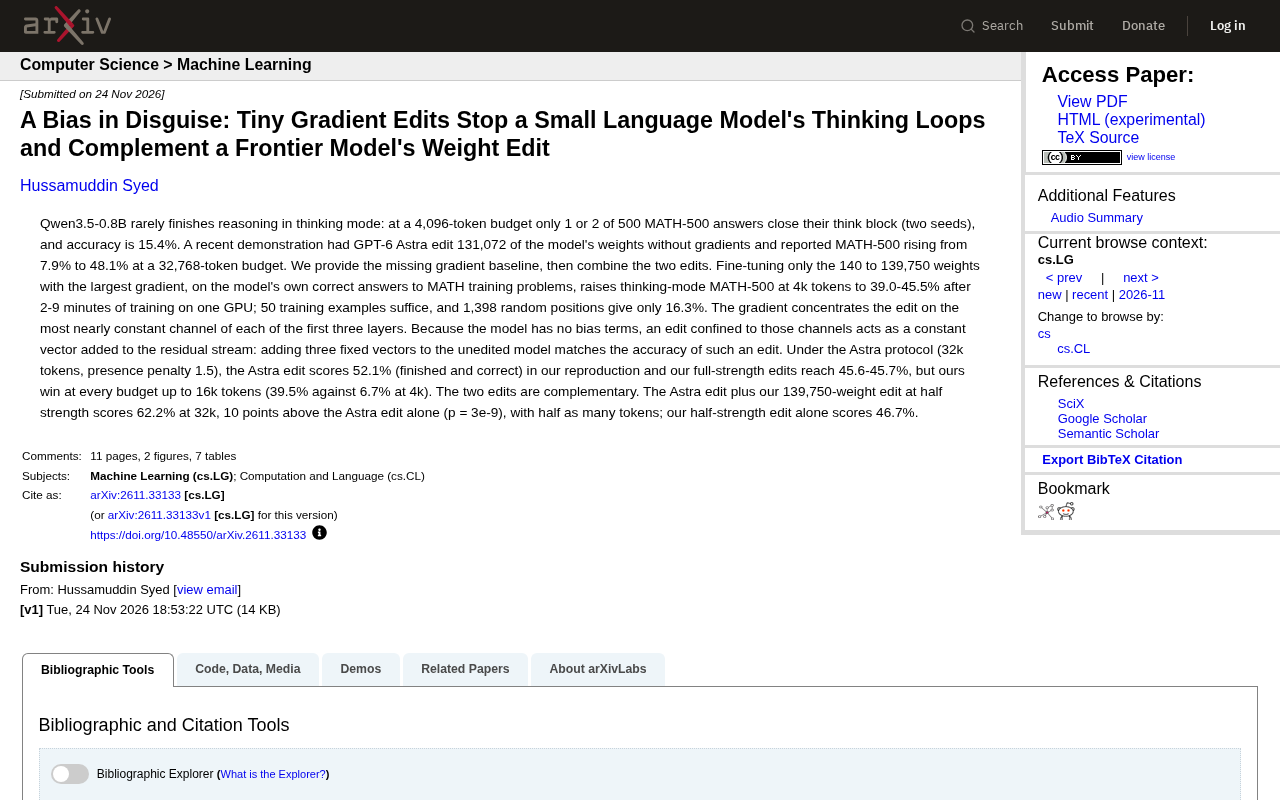
Qwen3.5-0.8B rarely actually completes its reasoning in thinking mode. Under a 4,096 token budget, only 1 to 2 of the 500 MATH-500 problems manage to close the think block (consistent across two random seeds), and accuracy stalls at 15.4%. This isn't because the model can't solve the problems—it's because it can't stop. The reasoning process gets truncated, so the answer never has a chance to appear.
In an earlier demonstration, GPT-6 Astra edited 131,072 weights of this model without gradients, raising MATH-500 from 7.9% to 48.1% under a 32,768 token budget. But that edit lacked a key control: a gradient-based baseline. The new study fills in this piece of the puzzle and combines the two types of editing.
Thinking mode and token budgets: In models that support "thinking," such as Qwen3.5, thinking mode makes the model first generate a stretch of internal reasoning (usually wrapped in a think block) before outputting the final answer. This reasoning also consumes tokens, and the total reasoning length is constrained by max_tokens or the context budget. When the budget runs out, the model may not have closed the think block yet, and the answer portion is truncated—which counts as incomplete during evaluation. As a result, "completion rate" and "accuracy" are tightly coupled: with an insufficient budget, the model isn't answering incorrectly; it simply never gets a chance to answer. Understanding this is essential to seeing why merely getting the model to "quit earlier" can substantially improve the metric—it leaves the limited tokens for the final answer.
Method: Only Editing the Weights with the Largest Gradients
The researchers' approach is quite restrained: fine-tune only the 140 to 139,750 weights with the largest gradients, using as training data the answers the model itself got right on MATH training problems—no external labels and no full-parameter fine-tuning required.
The results came quickly. After 2 to 9 minutes of training on a single GPU, thinking mode reached 39.0-45.5% accuracy on MATH-500 under 4k tokens. Just 50 training samples were enough; as a control, editing 1,398 randomly selected positions yielded only 16.3%, showing that the gain comes from the directionality of the gradients, not the number of edits itself.
A Counterintuitive Finding: The Edit Is Equivalent to Adding a Constant Vector
The gradients concentrate the edits on the "most nearly constant" channels in the first three layers. Because this model has no bias terms, edits restricted to these channels have the same effect as adding a constant vector to the residual stream. The researchers verified this: directly adding three fixed vectors to the unedited model matches the accuracy of this type of edit—in other words, the edit is essentially "disguising" itself as a bias term. This also explains the "A Bias in Disguise" in the title.
Gradient editing and sparse fine-tuning: Conventional fine-tuning updates all parameters, whereas gradient-based editing selects only a small number of weights with the largest absolute loss gradients to update, keeping the rest frozen. The intuition is that parameters with large gradients are the most sensitive to reducing the loss on the current task, so changing them yields the greatest benefit at the lowest cost. This is an extreme form of sparse fine-tuning: training cost is extremely low, and it is unlikely to damage the model's existing capabilities. The "140 to 139,750 weights" range in the article corresponds to a sweep from extremely sparse to moderately sparse; the "random-position control" is used to rule out the mundane explanation that "as long as you change enough parameters, performance improves," proving that directionality (i.e., the gradient signal) is the source of the gain.
Residual stream and bias terms: Each layer of a Transformer accumulates its new computation onto the hidden state via a residual connection; this hidden-state pathway running through all layers is called the "residual stream." If a layer lacks a bias term, that layer's linear transformation cannot express a "constant offset independent of the input"; adding a fixed vector to the residual stream is exactly equivalent to injecting a global bias into all subsequent layers. The researchers found that the gradient edits concentrate on the "most nearly constant" channels in the first three layers, meaning that what these edits are actually doing is supplying the bias capability missing from the model architecture. This explains why directly adding three fixed vectors can reproduce the edit's effect—the edit is not "teaching the model new knowledge" but "disguising" itself as a bias term, fine-tuning the model's output distribution.
Comparison: Each Type of Edit Wins in Different Regimes
Under the Astra protocol (32k tokens, presence penalty 1.5), the reproduced Astra edit scored 52.1% (complete and correct), while the researchers' full-strength edit scored 45.6-45.7%. But at every budget tier up to 16k tokens, the gradient edit leads: at 4k tokens, it's 39.5% vs. 6.7%.
This shows that the two target different bottlenecks: the Astra edit is stronger under ample budgets, while the gradient edit is better at getting the model to "quit earlier," which is more valuable in tight-budget scenarios.
Presence penalty and the Astra protocol: Presence penalty is a sampling-time penalty that applies an extra penalty when a token that has already appeared appears again; the higher the value, the more the model tends to avoid repeating words. In long-reasoning scenarios, it can curb the model from going around in circles and failing to converge, thereby indirectly affecting completion rate and token consumption. The "Astra protocol" in the article refers to a fixed evaluation configuration used when reproducing the Astra edit (32k token budget, presence penalty 1.5); comparing the two types of edits is fair only under this configuration. This also reminds readers that the strength of different editing methods is not absolute but strongly dependent on decoding settings such as budget and penalty parameters—conclusions may reverse under tight versus loose budgets.
Combination: 1+1 Is Greater Than 2
Stacking the Astra edit with a half-strength 139,750-weight gradient edit scored 62.2% under 32k tokens, 10 percentage points higher than the Astra edit alone (p = 3e-9), and used only half the latter's tokens. The half-strength gradient edit alone scored 46.7%.
The complementarity of the two edits has a clear mechanistic explanation: the Astra edit changes what the model "knows," while the gradient edit adjusts when the model "stops"; they act on different parts of the reasoning process.
Practical Implications
For developers with limited resources, this study offers several actionable clues:
- Efficient fine-tuning with small samples is feasible: 50 samples that the model itself answered correctly + a few minutes of single-GPU training can significantly improve thinking mode's completion rate, at a cost far below full-parameter fine-tuning.
- Choosing the right positions matters more than editing a lot: editing 1,398 random positions is far worse than editing the few weights selected by gradients; the choice of edit positions is key.
- In tight-budget scenarios, prioritize "brake"-type edits: if the inference budget is limited, teaching the model to terminate its thinking is more urgent than making it answer more accurately.
One caveat: these conclusions are currently based on a single small model and the MATH-500 benchmark, and whether they transfer to other model scales and task types still requires more validation. But the idea of "using gradients to find the model's thinking brake" offers an extremely low-cost new direction for small-model inference optimization.
One-line Summary
Fine-tuning only the few weights with the largest gradients teaches small models to "brake," doubling accuracy under tight inference budgets.
Paragraph Summary
Qwen3.5-0.8B often fails to answer in thinking mode because its reasoning process never closes, achieving only 15.4% on MATH-500 under a 4k token budget. A new study fine-tunes only the 140 to 139,750 weights with the largest gradients, training for a few minutes on 50 samples the model itself answered correctly, and raises 4k-budget accuracy to 39.0-45.5%, whereas randomly editing 1,398 positions yields only 16.3%, showing that the gain comes from gradient direction rather than the number of edits. The researchers also found that, because the model has no bias terms, these edits are equivalent to adding a constant vector to the residual stream—essentially a "disguised bias." Compared with the Astra weight edit, the gradient edit leads at every budget tier up to 16k, and stacking the two reaches 62.2% at 32k, 10 percentage points above the Astra edit alone while using only half the tokens.
Related articles

Nothing CMF Buds 2A Drops to $17.89 on Black Friday: A New Low for ANC Earbuds
Nothing CMF Buds 2A wireless earbuds Black Friday deal: just $17.89 on Amazon, about $11 off retail and a record low. ANC earbuds at an entry-level price.

When AI Creation Gets Accused of "Spitting": Hacker News Heats Up Over the Glaude Controversy
A Hacker News post, "Spitting in the Face of Glaude," sparks debate on AI creation transparency and attribution ethics. This analysis examines the blurred creator identity behind the controversy and offers practical advice for AI content production.

Akai Embraces Custom Firmware: MPC Sample 1.4 Lets Users AI-Program Their Sampler
Akai embraces the modding community with MPC Sample 1.4 firmware, supporting vibe-coded custom firmware and effects. We analyze the impact of this open strategy on music hardware and AI-assisted programming.