Microduck RL: An Open-Source Reinforcement Learning Training Environment for Small Robots
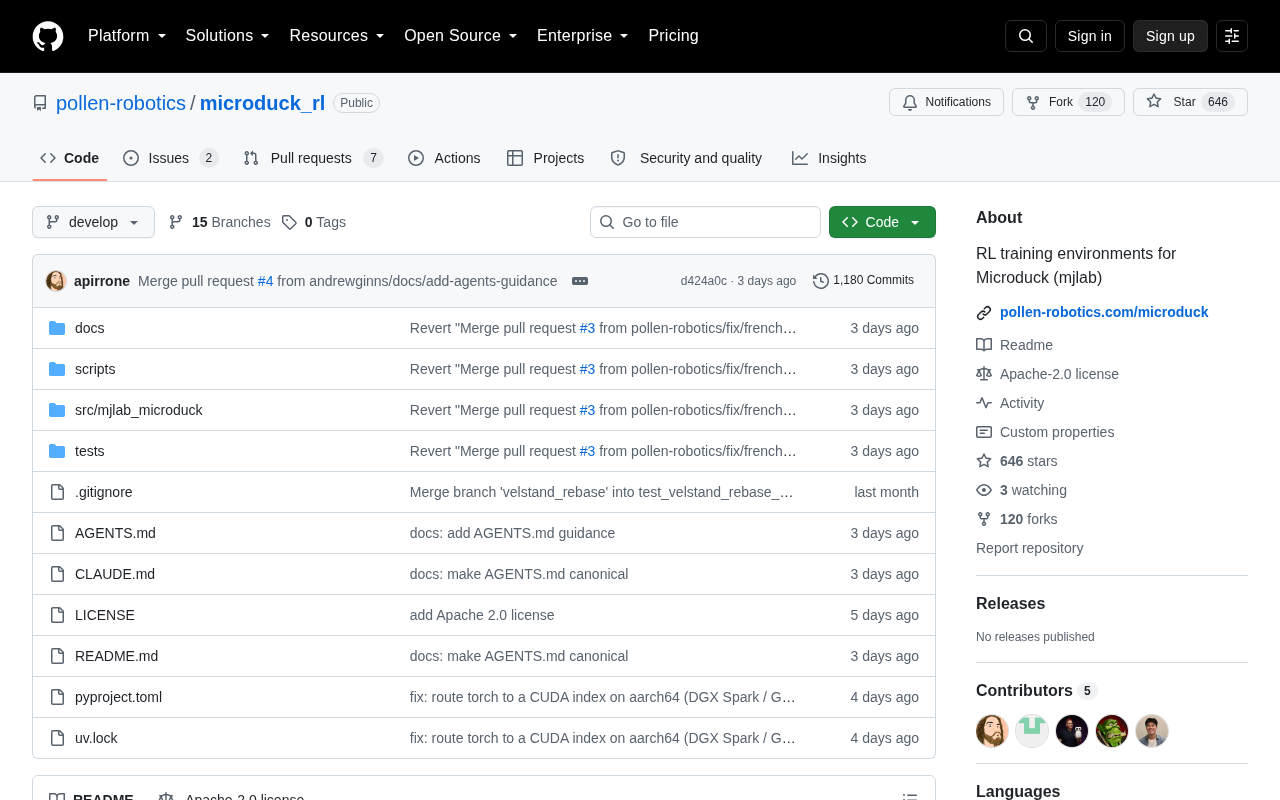
An open-source MuJoCo-based RL training environment for the Microduck robot by Pollen Robotics.
Pollen Robotics open-sourced microduck_rl, a Python-based reinforcement learning environment built on MuJoCo for training locomotion and control policies on the Microduck robot. The project supports Sim-to-Real transfer research and integrates with popular RL frameworks, making robot RL more accessible to researchers and hobbyists.
Microduck RL Project Overview
Pollen Robotics recently open-sourced the microduck_rl project on GitHub — a reinforcement learning (RL) training environment purpose-built for the Microduck robot. The project is built on mjlab and primarily developed in Python. Since its release, it has gained traction rapidly — amassing 632 Stars and 115 Forks to date, with 147 new Stars in a single day — making it a noteworthy newcomer at the intersection of robotics and reinforcement learning.
For developers working on bipedal/quadruped locomotion control and Sim-to-Real transfer research, ready-made training environments like this can significantly lower the barrier to experimentation. It not only provides a physics simulation foundation but also encapsulates the interfaces needed to connect with RL algorithms, allowing researchers to focus their energy on policy design and algorithm tuning.
What Is the Microduck Robot?
Microduck is a small-scale robot platform within the Pollen Robotics ecosystem. Pollen Robotics is a French robotics company known for its open-source hardware and software. Their best-known product is Reachy — an open-source upper-body humanoid robot widely used in human-robot interaction research and service robot prototyping. The company embraces an "Open Robotics" philosophy, making mechanical designs, firmware, and software frameworks fully available to the community. Microduck, as a smaller platform in their ecosystem, carries on this open-source tradition, enabling independent researchers and small labs to access a complete hardware + software toolchain at minimal cost — avoiding the massive investment of building a platform from scratch.
Combining Microduck with a reinforcement learning environment means developers can train locomotion, balance, and control policies in virtual simulation before transferring them to real hardware. This "simulate first, deploy later" paradigm is one of the mainstream approaches in current Embodied AI research.
Technical Stack Analysis: MuJoCo-Based Simulation Engine
microduck_rl is built on top of mjlab, which is closely tied to the MuJoCo (Multi-Joint dynamics with Contact) physics engine — a widely recognized high-performance engine in robot simulation, particularly adept at handling contact dynamics and joint constraints. These are precisely the core challenges in legged robot locomotion control.
MuJoCo was originally developed by Professor Emo Todorov at the University of Washington, acquired by DeepMind in 2021, and officially open-sourced in 2022. It uses a generalized coordinate system rather than a Cartesian coordinate system to describe multi-body dynamics, which gives it exceptional computational efficiency when handling high-DOF joint systems. Compared to similar engines like PyBullet and Isaac Gym, MuJoCo employs a unique convex optimization-based contact model for contact mechanics, enabling more stable handling of multi-point contact, sliding friction, and other physical interaction scenarios common in legged robots. Its C-language core enables single-step simulation to complete in microseconds — critical for RL training that requires millions or even billions of interaction steps.
Leveraging the MuJoCo toolchain, the project can generate large volumes of training data with high simulation efficiency. For reinforcement learning, sample efficiency and simulation speed directly determine training cost. Choosing a mature physics engine as the foundation ensures both physical fidelity and lays the groundwork for subsequent Sim-to-Real transfer.
A Python-First Development Experience
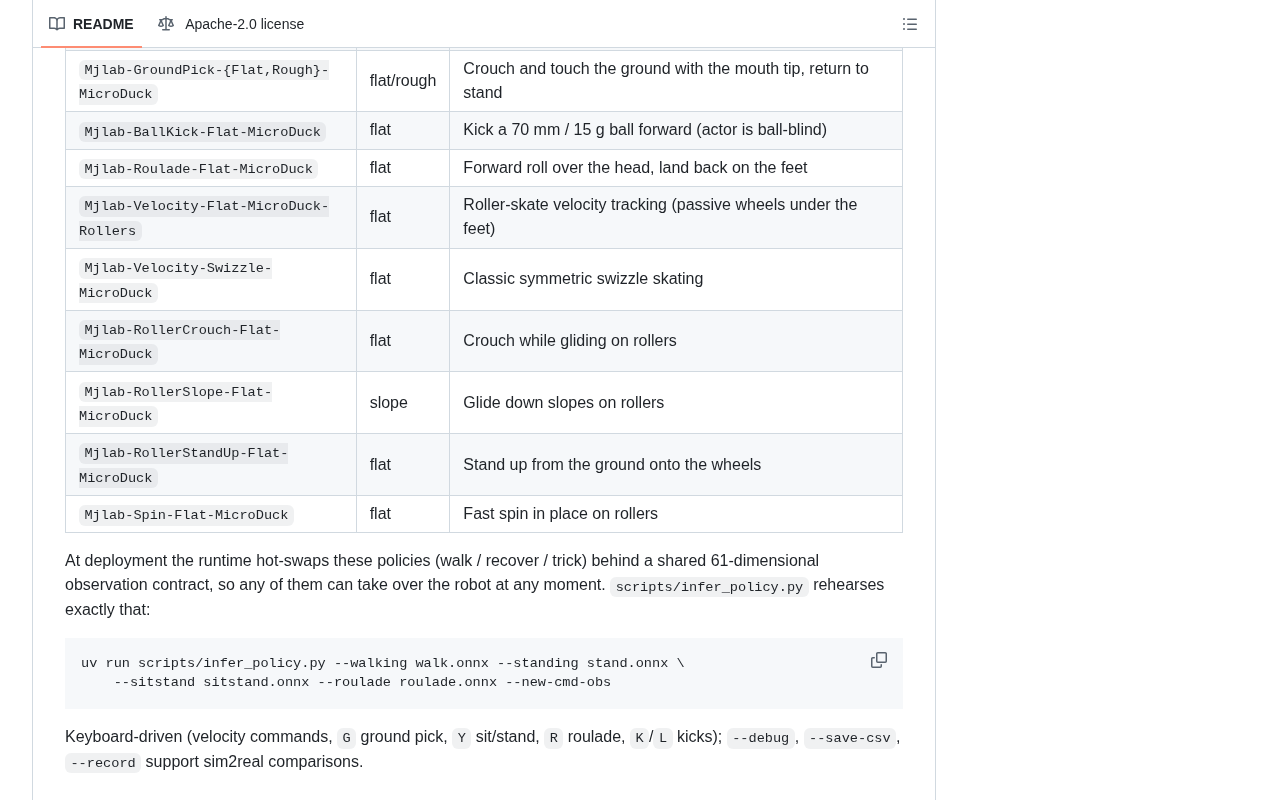
The project uses Python as its primary language, which aligns perfectly with the current reinforcement learning ecosystem. Whether it's PyTorch, JAX, or mainstream RL frameworks (such as Stable-Baselines3, RSL-RL, etc.), Python provides a seamless integration experience.
More specifically, Stable-Baselines3 (SB3) is one of the most popular RL algorithm libraries, packaging mainstream algorithms like PPO, SAC, and TD3 behind a unified Gymnasium interface specification. RSL-RL is a lightweight RL framework developed by ETH Zurich's Robotic Systems Lab specifically for legged robots, deeply integrated with Isaac Gym and specially optimized for large-scale parallel training scenarios. Additionally, the Brax physics engine in the JAX ecosystem can achieve fully differentiable simulation on GPU/TPU, passing gradient information directly back to the policy network — yielding sample efficiency orders of magnitude higher than traditional gradient-free RL methods in certain scenarios. microduck_rl's Python-first strategy means developers can flexibly switch between these frameworks, quickly define reward functions, observation spaces, and action spaces, and directly interface with existing policy optimization algorithms to compare how different algorithms perform on the same robotic task.
The Core Value of RL in Robot Locomotion Control
Traditional robot locomotion control typically relies on complex hand-crafted modeling and controller design. Reinforcement learning offers a fundamentally different path: letting robots autonomously learn optimal policies through trial and error in simulated environments. From Boston Dynamics to university research labs worldwide, RL-based legged robot gait learning has become a research hotspot.
This field has gone through several key phases. In the early period (2017–2019), ETH Zurich's RSL lab was among the first to validate end-to-end RL policies on the ANYmal quadruped robot. After 2020, with the advent of large-scale parallel simulation (e.g., NVIDIA Isaac Gym supporting thousands of environments running simultaneously), training time shrank from days to hours. Between 2023 and 2024, RL methods began expanding from quadrupeds to humanoid bipedal robots, with projects like Agility Robotics' Digit and Tesla's Optimus exploring RL-driven locomotion policies. Compared to traditional Model Predictive Control (MPC) or Zero Moment Point (ZMP) methods, RL policies don't require explicit dynamics equation modeling — they can automatically discover efficient locomotion patterns through massive trial and error, showing significant advantages especially in unstructured terrain walking and fall recovery scenarios.
The significance of microduck_rl lies in democratizing this methodology onto a small, accessible robot platform. Researchers and hobbyists can reproduce the complete training pipeline in an open-source environment without setting up expensive lab equipment — offering tremendous value for teaching, prototype validation, and community collaboration.
Sim-to-Real Transfer: The Critical Leap from Simulation to Reality
It's worth diving deeper into Sim-to-Real transfer, which remains one of the most critical bottlenecks in Embodied AI. Because simulated environments cannot perfectly replicate real-world physical properties — such as subtle variations in ground friction coefficients, motor response delays and nonlinearities, sensor noise, and more — policies that perform excellently in simulation often degrade significantly on real hardware. This is known as the "Reality Gap."
Current mainstream approaches to addressing this include Domain Randomization (randomly perturbing physical parameters during training to enhance policy robustness), System Identification (precisely measuring real hardware parameters and importing them into simulation), and adversarial training, among others. OpenAI's 2019 demonstration of using Domain Randomization to teach a robotic hand to solve a Rubik's cube in simulation and successfully transfer it to real hardware is considered a milestone achievement in this field. microduck_rl, built on MuJoCo's high-fidelity simulation capabilities, provides developers with a solid experimental foundation for exploring these transfer strategies.
Why Community Interest Is Surging
The project's 147 new Stars in a single day reflects strong community demand for "plug-and-play robot RL environments." Embodied AI and humanoid/legged robotics are currently in a research explosion phase — any open-source tool that lowers the entry barrier and provides reproducible baselines tends to gain rapid adoption.
Use Cases and Future Outlook
For developers looking to get started with robot reinforcement learning, microduck_rl offers a relatively complete starting point: a ready-made simulation environment, clean Python interfaces, and an active open-source community. Key application areas include:
- Locomotion control research: Training walking, balancing, and posture recovery capabilities;
- RL algorithm benchmarking: Serving as a standardized environment for validating new reinforcement learning algorithms;
- Education and outreach: Providing hands-on practice platforms for university courses or self-directed learning;
- Sim-to-Real transfer exploration: Studying how simulation-trained policies transfer to real hardware.
It's worth noting that as a rapidly evolving open-source project, its documentation completeness, environment stability, and real-hardware transfer effectiveness still await further community validation. Developers who are interested should follow the project's update cadence and Issue discussions to assess its maturity.
Overall, microduck_rl is a noteworthy addition to the open-source robot reinforcement learning ecosystem. As the Embodied AI wave continues to build, tools like this that lower experimental barriers will play an important role in driving community collaboration and technology adoption.
Related articles
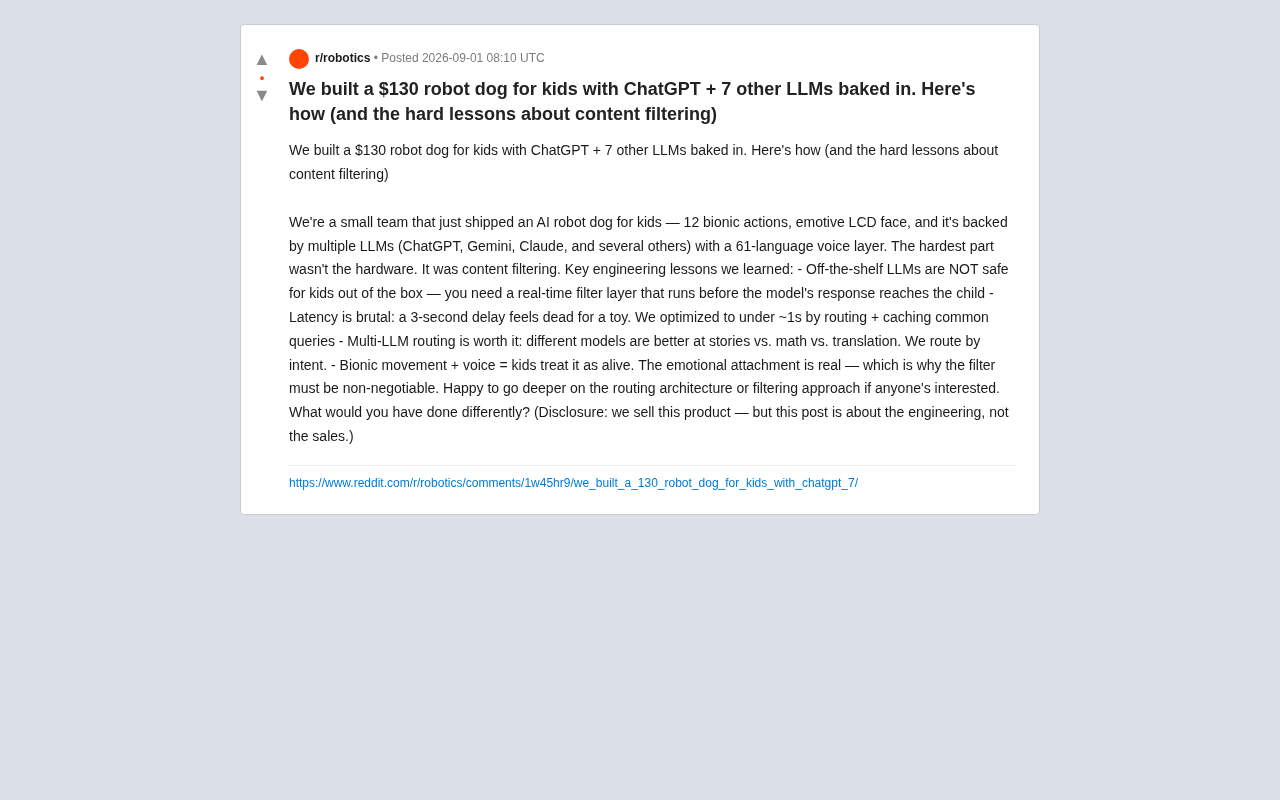
Building an AI Robot Dog for Kids: Multi-Model Routing, Content Filtering, and Latency Optimization
A $130 AI robot dog for kids integrates 8 LLMs with 61-language voice interaction. The team shares key engineering lessons on content safety filtering, multi-LLM intent routing, and sub-1-second latency optimization.

Can Omarchy Dominate the Sub-$1000 Laptop Market? An In-Depth Analysis
Omarchy, based on Arch Linux, shows unique advantages in the sub-$1000 laptop market. This analysis compares Windows and MacBook performance bottlenecks on low-spec hardware and examines why Omarchy enables cheap laptops to run smoothly, plus the ecosystem challenges and market prospects it faces.

AI Agent Beginner's Guide: Building a Creative Strategy Intelligent Assistant from Scratch
A complete guide to building a creative strategy AI Agent from scratch. No coding required — use tools like Dify and Coze to quickly build an intelligent assistant.