Microsoft Dataverse Plugin for Coding Agents: Natural Language-Driven Enterprise Low-Code Development

Microsoft's Dataverse coding agent plugin enables natural language-driven enterprise low-code development via GitHub Copilot and Claude Code.
Microsoft has introduced a Dataverse plugin for coding agents like GitHub Copilot CLI and Claude Code, allowing developers, analysts, and admins to complete data modeling, querying, security configuration, and documentation through natural language. Built on MCP and a layered skill architecture, it lowers the barrier to enterprise low-code development while maintaining governance and compliance.
As AI coding agents rapidly permeate software development workflows, Microsoft is bringing this wave into its enterprise-grade low-code platform. In the latest episode of the Low Code Revolution show, Kent Weir from the Microsoft Power Platform product team delivered a detailed demo of a Dataverse plugin built for coding agents — enabling developers, business analysts, and platform admins alike to complete Dataverse development tasks in minutes through natural language conversation, replacing what used to require tedious point-and-click operations.
From "Systems of Record" to "Systems of Agency"
Dataverse (formerly Common Data Service) is Microsoft's cloud-based relational data platform launched in 2016, built on Azure infrastructure to unify enterprise data storage and management. It uses an entity-relationship model with over 200 built-in standard business entities (such as Account, Contact, and Opportunity), while also supporting custom entities. Its core differentiator is the "cohesion" of data governance, security policies, and business logic within a single platform — unlike traditional databases that require these capabilities to be implemented separately at the application layer. The built-in role-based access control (RBAC) extends down to the field level, giving precise control over which roles can read or write which columns in which tables — a critical capability for compliance-heavy industries like finance and healthcare. It integrates deeply with Power Platform ecosystem components including Power Automate, Copilot Studio, Dynamics 365, and Power Apps.
Kent opened by addressing the widely debated concept of "SaaS Apocalypse" — the notion that AI agents will replace traditional Systems of Record. He believes most of this is market hype: these systems carry years of enterprise investment and critical business processes that can't be replaced overnight. That said, he acknowledged the underlying real trend: enterprises need these systems to be understandable, actionable, and executable by agents.
This trend has given rise to the concept of "Systems of Agency" — an extension of the classic enterprise architecture layering model. Traditional enterprise IT architecture categorizes systems into Systems of Record (core systems storing authoritative data, such as ERP and CRM), Systems of Engagement (user-facing front-end systems), and Systems of Insight (analytics and decision-support systems). As AI agents become capable of autonomously perceiving, deciding, and executing cross-system operations, a fourth layer emerges: Systems of Agency. This layer requires not just data accessibility, but that systems can have their business semantics understood by agents, their business rules enforced, and their side effects trusted. By pre-loading context through business skills and exposing interfaces via MCP, Dataverse is effectively upgrading itself from a System of Record to an agent-ready system.
As agent interactions become increasingly seamless, the importance of high-value business data is amplified rather than diminished. Interfaces and workflows are shifting from "click-based" to "natural language-based," but this doesn't mean trust and data governance can take a back seat — quite the opposite. As agents access more data, the need for guardrails and governance mechanisms is further reinforced.
Three Tools Working Together: MCP, Business Skills, and Coding Plugins
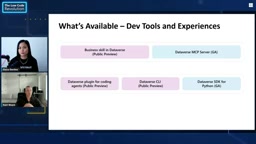
Dataverse currently offers three layers of key capabilities. First is Business Skills, now in public preview, and the Dataverse MCP Server, which has reached general availability (GA).
MCP (Model Context Protocol) is an open-source standard protocol released by Anthropic in November 2024, designed to address interoperability between AI models and external data sources and tools. Before MCP, every AI application had to build a custom integration adapter for each external system, creating an "M×N" integration problem. MCP simplifies this to "M+N" — a data provider implements an MCP Server once, and an AI application implements an MCP Client once, and the two can communicate. The GA release of the Dataverse MCP Server means any MCP-compatible AI client — whether Claude, GitHub Copilot, or a custom agent — can read and write Dataverse data in a standardized way, without Microsoft needing to build individual integrations for each partner.
The two work in tandem: the MCP Server acts as the channel for data interaction, but Dataverse often contains hundreds of tables and fields, making direct interaction cumbersome. The value of Business Skills lies in "pre-loading context" for the agent — it understands the underlying data model, guides the agent, and enforces business processes. It is then exposed via the MCP Server and can be plugged into any application using the service.
The star of this session is the Dataverse plugin for coding agents. It integrates with leading coding agents like GitHub Copilot CLI and Claude Code, enabling developers to use AI as a "pair programming partner" to dramatically accelerate application and agent development while keeping Dataverse as the core data platform.
Layered Skill Architecture
From an architectural standpoint, users simply install the Dataverse plugin once in their preferred coding environment, and the system automatically loads a set of plugins and skills. The demo loaded six skills in total. The top-level DV Overview skill acts as a router: when a user types "connect me to my Dataverse environment," DV Overview determines which skills to invoke — for example, calling the DV Connect skill to complete user authentication via PAC CLI.
PAC CLI (Power Apps CLI, now rebranded as Microsoft Power Platform CLI) is Microsoft's official command-line tool that allows developers to manage environments, package and deploy solutions, and import/export entity definitions from the terminal. It is a core tool in the Power Platform DevOps workflow. In the demo, the agent invoking PAC CLI for authentication essentially hands off the sequence of commands the developer would have typed manually to AI for automated orchestration — shifting developers from "memorizing and typing commands" to "describing intent and reviewing results," significantly reducing cognitive load.
The plugin integrates a full toolchain behind the scenes — the Dataverse MCP Server, Python SDK, PAC CLI, and Dataverse CLI. The core design philosophy is: don't expose complexity to the end user. Users simply express intent in natural language, and the agent and plugin determine the optimal execution path.
Three Roles, One Unified Experience
Kent used the fictional Zava Coffee Company as a backdrop to demonstrate how three different roles can leverage the same toolset to address their distinct needs. The company had previously relied on spreadsheets to manage its business and now needed to scale up, but the team lacked experience with Dataverse.
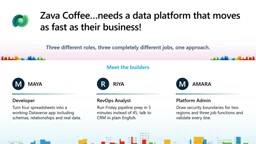
Developer Maya: From Connection to Modeling to Data Import
Maya is a developer who doesn't even know her organization URL. She simply installs the Dataverse plugin in the VS Code terminal, starts a Copilot session, and says in natural language: "Connect me to my Dataverse environment, I don't know the org URL." The system loads the connection skill, installs core tools, completes authentication, and lists existing tables via the MCP Server.
Next comes the modeling phase, which best demonstrates the plugin's value. Anyone familiar with Dataverse knows that building a data model in the Maker Portal, while not inherently complex, is extremely tedious — lots of clicking and typing, with easy risks of misspelling field names or forgetting prefixes, and high correction costs when mistakes are made. Maya simply describes her requirements in natural language, and the agent automatically creates multiple tables, specifies field types, establishes relationships, and even generates forms and views for model-driven apps.
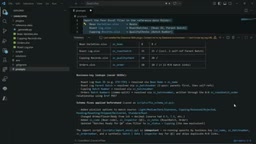
Notably, the agent generates a deterministic Python script. This design choice reflects deep enterprise-grade thinking: a core tension exists in AI code generation today — directly executing AI-generated operations carries risk (especially for database changes), but requiring manual review every time diminishes the value of automation. The Dataverse plugin's solution draws inspiration from Infrastructure as Code principles, using a deterministic code artifact as an intermediate layer — users can read, modify, and commit it to Git version control before executing it. This makes AI operations repeatable, auditable, and rollback-capable, aligning with enterprise change management compliance requirements. Data import is equally impressive: the agent uses libraries like openpyxl to parse complex Excel files containing relationships and business identifiers, maps the structure to newly created tables, and completes data validation.
Revenue Operations Analyst Ria: Semantic Understanding for Smart Queries
Ria needs to prepare for a Friday afternoon sales pipeline meeting. Her request: "Show me all open opportunities owned by Carlos that are closing this quarter with a value over $100K." Two highlights stand out behind this seemingly simple instruction: first, the system autonomously looks up who "Carlos" is — no email or unique identifier needed; the agent queries and resolves his owner ID before making the follow-up query. Second, "this quarter" is automatically inferred as April 1 through June 30. No additional instructions were needed — the agent accurately interpreted the business intent in natural conversational form.
Platform Admin Amara: Security Models and Automated Documentation
Amara needs to build a security model for the expanding Zava, involving two business units (Portland and Seattle), multiple roles (sales, warehouse, leadership), field-level security, team templates and permission assignments, all integrated into a solution. This type of task typically requires collaboration across business stakeholders, functional analysts, and security analysts.

Faced with this complex challenge, the coding agent doesn't blindly attempt a solution — instead it first formulates a plan and systematically works through each task. The entire reasoning process is highly transparent: it evaluates existing Publishers and reuses the correct prefix when creating artifacts. Kent also highlighted a frequently overlooked value — automated documentation generation. Security models typically need to be documented for audit purposes. Users can simply ask the agent to produce a spreadsheet or Word document for change tickets or compliance archiving.
Target Users and Enterprise Best Practices
Kent noted that this is a continuously evolving space. Power Platform has always pursued "democratization," striving to lower the barrier to development. This strategy reflects deep industry context: according to IDC projections, the global developer gap will reach 45 million by 2026, while business demand for applications far outpaces the supply of professional developers. Microsoft's "Citizen Developer" model aims to enable business analysts, operations staff, and other non-technical users to build applications directly — but traditional low-code tools still carry a significant learning curve, requiring users to understand data models, relationship design, and other concepts. The introduction of coding agents essentially equips citizen developers with an "intelligent guide": even without knowledge of Dataverse table relationship design, users can describe a business scenario in natural language and have the agent translate it into the correct technical implementation. This represents another leap forward in the democratization of low-code development.
The tasks demonstrated were previously handled primarily by professional (Pro) developers. Coding agents now further expand the range of people capable of building solutions: professional developers gain efficiency, while less experienced users gain a lower barrier to entry.
For teams that have already built up conventions, a key question is: can the plugin follow the team's established architectural standards? For instance, how lookup relationships should be created, or when to use one-to-many tables versus native many-to-many tables. Kent answered affirmatively — customers and partners can provide their own skills and context. By documenting naming conventions, relationship standards, and other best practices and committing them to a source repository linked to a project folder for the agent to reference, teams can ensure the agent adheres to their established architectural decisions and maintains consistency and compliance. This is essentially "giving the coding agent more context," and Kent views it as a win-win solution for all parties.
Conclusion
From the tedious point-and-click operations of the early Dynamics CRM era to today's natural language-driven coding agents that automatically handle data modeling, intelligent queries, security configuration, and documentation generation, the Dataverse plugin solution paints a clear picture of the paradigm shift underway in enterprise low-code development. It doesn't just teach agents "how to get things done in Dataverse" — it helps agents "understand the inner logic of Dataverse" — which is especially valuable for less experienced users. With enterprises still placing a high premium on trust, governance, and compliance, this may well be the pragmatic path by which coding agents truly make their way into enterprise-grade systems.
Key Takeaways
Related articles

Should You Open Source Your Project? A Layered Open Source Strategy Using Project Replay as a Case Study
Should indie developers open source their projects? Using the game custom achievement tool Project Replay as a case study, this article analyzes the open source decision and offers a practical layered strategy.

130+ Open-Source Interactive Security Awareness Training: Reshaping Habit Formation Through 3D Office Scenarios
A project with 130+ free open-source interactive security awareness exercises using immersive 3D office scenarios to simulate phishing, vishing, MFA fatigue attacks and more, building employee security habits.

From Musk to Jefferson: Beware the Cognitive Trap of Cross-Domain Experts
Why do geniuses in one field often become overconfident in others? From Musk's controversial interview to Jefferson's blind spots, an exploration of cross-domain cognitive arrogance.