Microsoft Developer Weekly: DirectX Crash Dumps, Azure Identity Updates, and Copilot Harness

Microsoft updates DirectX retail crash dumps, Azure SDK production identity, and Copilot Harness managed agents.
Microsoft's developer ecosystem recently saw updates in three directions: DirectX via Agility SDK 1.620 and PIX 2.610.28 lets retail games generate .dxdmp dumps on GPU crashes, enabling postmortem cross-hardware analysis with a default lightweight mode and a high-detail capture mode; the October Azure SDK update focuses on production-grade identity — .NET adds mTLS, proof-of-possession, and federated identity flows, Python/Java support user-assigned managed identities on Azure Arc servers and fix timeout and credential caching issues, and Rust gets its first stable Cosmos DB client; Copilot Harness in Microsoft Foundry enters public preview, offering a managed agent loop, sandbox, sub-agents, and MCP tool integration. The official guidance: use the managed harness when the execution mechanism isn't your differentiator, otherwise bring it into your own runtime. The common signal across all three is that "production-ready" has become the default premise.
DirectX: Bringing Console-Grade Crash Analysis to Windows Games
A long-standing problem for PC game developers: GPU crashes often happen on players' machines, and developers struggle to reproduce them. DirectX changes this with Agility SDK 1.620 and PIX 2.610.28 — retail games can now generate .dxdmp crash dump files.
When a GPU crash occurs, DirectX captures runtime state, application data, and supported hardware driver data before Windows resets the GPU. Studios can retrieve the .dxdmp file through their own crash reporting pipeline, then analyze it later in PIX — even on a different machine without the original GPU or driver.
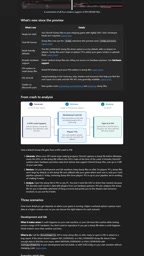
The mechanism also supports hang recording, guiding engineers to the shaders and resources involved. You may not have noticed that it distinguishes two modes: a default zero-overhead mode for everyday retail play, and a higher-detail capture mode that can be enabled during development, QA, or for a small group of players tracking down rare crashes. This "lightweight by default, escalate on demand" design brings a console-like postmortem workflow to Windows games across hardware vendors.
GPU Crashes and TDR: GPU crashes on Windows are typically triggered by TDR (Timeout Detection and Recovery) — when the GPU doesn't respond within about 2 seconds, the system resets the display driver to avoid a full system deadlock, but application state is often lost before the reset. The .dxdmp dump is a snapshot captured before the TDR reset occurs, so it contains the GPU pipeline, command buffers, and resource binding information at the moment of the crash. This is similar to the CPU-side minidump approach, but targets video memory and shader state. PIX, Microsoft's GPU debugging tool, can load .dxdmp offline and replay the event stream — which is why "analyze on another machine" works: analysis doesn't depend on the original hardware, only the dump file and symbols.
Azure SDK: Focus on Production-Grade Identity
The October release of Azure SDK focuses on identity authentication changes for .NET, Python, and Java, while bringing the first stable Cosmos DB client library for Rust.
On the .NET side, Azure Core adds mutual TLS, proof-of-possession, and managed identity and federated identity flows, and improves the behavior of DefaultAzureCredential when the instance metadata service is unavailable. Python and Java now support user-assigned managed identities on Azure Arc-enabled servers, and fix issues with timeouts and incorrect cached credentials.

For Rust developers, Cosmos DB 1.0 provides a stable client, driver, and SDK macros. These updates may seem scattered, but the common thread is clear: making identity more predictable in production environments.
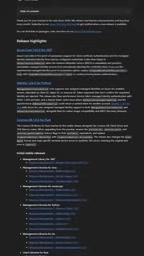
In other words, fewer surprising credential chains and failures, and broader managed identity support across more languages and hybrid environments. For teams deploying services to the cloud and dealing with complex identity topologies, these improvements are often more valuable than new features themselves.
Proof-of-Possession and Federated Identity: Proof-of-possession means the client not only presents a token but also proves it holds the corresponding private key, reducing the risk of token replay after theft — commonly implemented as mTLS or DPoP. Federated identity allows workloads to exchange external identity provider credentials (such as Kubernetes service account tokens, GitHub OIDC) for Azure access tokens, eliminating long-term client secrets. Azure Arc-enabled servers refer to machines deployed on-premises or in other clouds but brought under Azure management via the Arc agent; managed identity support was previously limited, and the addition of user-assigned managed identities for Python/Java means these hybrid environments can now use keyless credentials to access Azure resources.
Copilot Harness: Managed Agent Loop Enters Public Preview
The third announcement is that Microsoft Copilot Harness enters public preview in Foundry Agent Service. It targets tasks requiring tools, files, multi-step and long-running execution, providing a managed agent loop and sandbox.
Developers can define agents declaratively, package reusable skills, connect Foundry tools and MCP tools under explicit authentication and approval, delegate constrained work to built-in sub-agents, and keep agent definitions alongside application code.
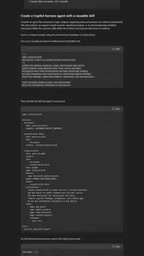
The official trade-off is straightforward: when the execution mechanism itself isn't your application's differentiator, use the managed harness; when it is, bring this into your own agent runtime. This criterion is quite useful for teams evaluating whether to build or buy agent infrastructure.
Agent Loop and MCP: The so-called "agent loop" refers to the control flow where the model repeatedly performs "reason — call tool — observe result" until the task is complete. A managed harness means the platform handles scheduling, retries, state persistence, and timeouts for this loop, and developers only declare goals and available tools. MCP (Model Context Protocol) is an open protocol connecting models to external tools/data sources. Once Foundry integrates MCP tools, agents can reuse existing MCP servers without writing custom adapters for each tool. Sandbox provides an isolation boundary for code execution and file operations; combined with authentication and approval controls, it prevents long-running tasks from accessing resources beyond their permissions.
Looking at These Updates Together
The three announcements point to gaming, cloud identity, and agents respectively, but the common signal is that Microsoft is making "production-ready" the default premise: crash diagnostics must run silently on real player devices, identity authentication must behave predictably when credential chains fail, and agent execution must run long tasks within clear approval boundaries. For developers, the most worthwhile things to follow in the short term are the actual integration cost of DirectX dumps and the migration cost of Copilot Harness between self-built runtimes and managed solutions.
Also, .NET Conf will be held from November 10 to 13, with Microsoft streaming live from the studio. Developers interested can pay attention.
Related articles
 Tech Frontiers
Pushing the Limits of Extreme Sudoku on a 16GB GPU: Insights from Depth and Flow Matching
A researcher trained a 16.54M-parameter model on a 16GB GPU to solve extreme Sudoku, finding effective depth breaks the 60% plateau and flow matching with improved sampling pushes accuracy past 99% with ~50× lower layer-evaluation budget.
 Tech Frontiers
AI Agent Approval Workflows: Why Human Confirmations Always Get Mindlessly Clicked
Why do AI agent approval workflows always get mindlessly clicked? A Reddit discussion shows that separating rules from keys, low-frequency high-risk approvals, and GitHub Environments-style gates are the keys to effective approvals.
 Tech Frontiers
MuJoCo: An Analysis of DeepMind's Open-Source General-Purpose Physics Simulator
An in-depth analysis of Google DeepMind's open-source physics simulator MuJoCo: high-performance C++ kernel, MJCF modeling format, contact solving principles, MJX GPU acceleration, and robot reinforcement learning use cases.