Microsoft MAI Models Land on Vercel AI Gateway: Voice, Transcription, and Image in One Place

Microsoft MAI models join Vercel AI Gateway, covering voice, transcription, and image with published pricing.
Vercel announced that Microsoft MAI series models are now integrated into its AI Gateway, including voice synthesis, real-time and non-real-time transcription, and image generation/editing. Developers can call multiple media capabilities within the same gateway while using existing deployment workflows. Vercel published per-modality pricing and emphasized MAI's zero data retention posture and training data transparency. The article outlines a path from account setup to application integration, recommending teams start with bounded use cases, estimate usage by billing units, and review data sent to models. For enterprises, the main opportunity lies in integrating relevant AI capabilities into existing web products, not just expanding the model list.
Vercel's AI Gateway model catalog has received a significant expansion. According to Vercel's official announcement, Microsoft's MAI series models are now officially integrated, covering three major modalities: voice generation, speech transcription, and image generation. Developers can call multiple media capabilities within the same gateway while continuing to use their existing deployment workflows.
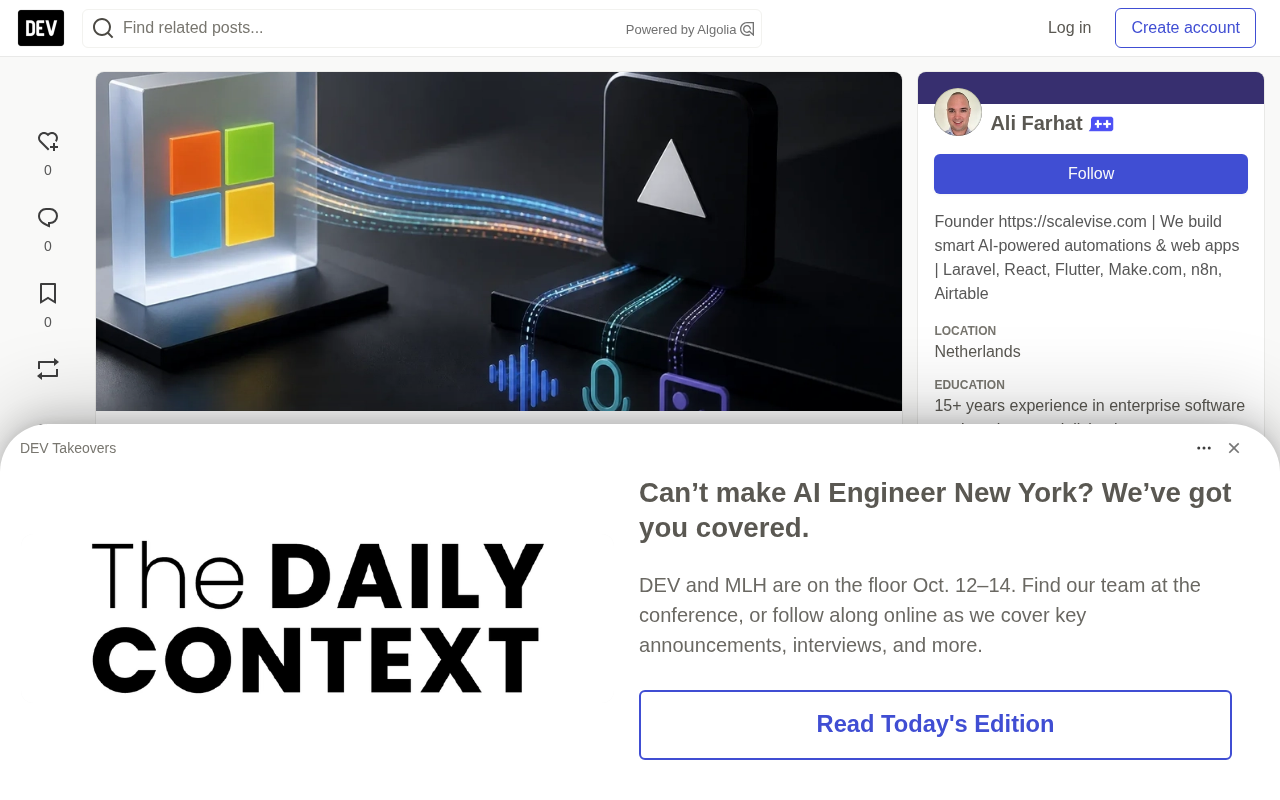
MAI Model Matrix Covers Three Media Capabilities
This launch is not just the addition of a single endpoint, but a systematic catalog expansion. According to Vercel's official announcement, the first batch of available MAI models includes:
- MAI-Voice-2.1 and MAI-Voice-2.1-Flash: Providing multilingual, expressive voice synthesis capabilities
- MAI-Transcribe-2-Streaming: Designed for real-time transcription scenarios
- MAI-Transcribe-2: Handling non-streaming transcription tasks
- MAI-Image-2.6 and related variants: Diffusion-based image generation and editing
This means a product team can evaluate voice, transcription, and image workflows simultaneously without having to treat each modality as a separate platform integration. For example, an application can use transcription to process recorded or live audio, generate voice output when needed, or add image generation and editing capabilities to content-oriented workflows.
Vercel also emphasized MAI's zero data retention posture and transparency around training data usage. For teams that need to evaluate whether an AI vendor's data handling practices match their own information processing requirements, this detail is worth noting — though it does not exempt the application side from reviewing what data is sent and what internal controls are in place.
About the Microsoft MAI Series: MAI (Microsoft AI) is a series of foundation model brands introduced by Microsoft's internal AI team, belonging to a different product line from OpenAI models hosted on Azure. The MAI series covers multiple modalities including voice, transcription, and image, positioned to provide general-purpose media capabilities that can be integrated with third-party platforms rather than being limited to Microsoft's own product ecosystem. This integration with Vercel AI Gateway means developers can call these models through a unified gateway interface without directly connecting to Microsoft's API or Azure account system — a significant reduction in multi-platform authentication and configuration complexity for teams already deploying frontends and backends on Vercel.
About Zero Data Retention: Zero data retention is a data handling commitment meaning that the model service provider will not persistently store input prompts, audio, or images after completing inference, nor will it use them for model training. This commitment is typically presented in contracts or terms of service, but actual implementation varies by vendor — some only refrain from logging at the API level, while others anonymize data across their entire infrastructure. Developers need to assess whether this commitment is sufficient given their own compliance requirements (such as GDPR, HIPAA, or internal industry standards), and remain responsible for the data content and logging policies on their end.
Pricing Published: Billed Separately by Modality
Vercel's AI Gateway catalog page has published specific model pricing. Different models use different billing units, and teams should estimate costs using the units that match their actual usage, such as character count, image count, or audio hours.
| MAI Model | Primary Capability | Published Price |
|---|---|---|
| MAI-Voice-2.1 | Multilingual expressive voice | $22 per million characters |
| MAI-Image-2.6 | Diffusion-based image generation and editing | $0.01 per image |
| MAI-Transcribe-2-Streaming | Real-time transcription | $0.54 per hour |
| MAI-Transcribe-2 | Non-streaming transcription | $0.10 per hour |
| MAI-Voice-2 | Voice model | $22 per million characters |
This table is suitable for early budget reference, but should not be treated as a complete project cost estimate. Real-time transcription is priced by the hour, voice synthesis by character, and images by output count — teams should measure expected activity within their own workflows before making features available to users.
About the Cost Difference Between Streaming and Non-Streaming Transcription: Streaming transcription requires real-time text output while audio is continuously being fed in, placing higher demands on inference infrastructure for latency and concurrency, which is why hourly pricing is typically significantly higher than non-streaming options. Non-streaming transcription allows the system to process complete audio files in batches, making fuller use of compute resources and thus costing less. When choosing between them, teams should not just compare unit prices but also consider user experience: scenarios like live captions and meeting notes are latency-sensitive and suit streaming, while podcast transcription and archived audio processing can use non-streaming to save costs.
About the Budget Implications of Modality-Based Pricing: Voice synthesis is billed by character, images by count, and transcription by hour — these three billing units correspond to different usage patterns. For example, voice synthesis costs are directly tied to text length, making it suitable for estimating customer service announcements or accessibility reading costs; image generation is billed per image, making it easy to calculate per-call costs for content production tools; transcription is billed by the hour, requiring an estimate of total audio duration multiplied by the unit price. Converting these units into monthly or per-user costs is necessary to accurately tie them to business metrics.
From Account Setup to Application Integration: The Path to Implementation
Vercel's MAI catalog page outlines the basic sequence of steps: obtain an API key, consult the documentation, call the relevant endpoints through AI Gateway, then follow the standard Vercel deployment process. For existing Vercel projects, this is a practical starting point, since model calls can be integrated into the same application environment without having to set up separate deployment pipelines for each modality.
For teams trying this for the first time, the following order is recommended:
- Choose a bounded use case, such as transcribing uploaded recordings or generating images for a specific feature
- Match the model to the interaction pattern: Use streaming transcription models when real-time captions are needed, and non-streaming models when audio can be processed after capture
- Estimate usage based on published billing units, then decide whether to make the feature broadly available
- Integrate through AI Gateway, using the API key and documentation, then deploy via your project's usual Vercel workflow
- Review the data sent to the model, evaluating how MAI's zero data retention posture relates to your own information processing needs
This release does not mean every application needs all three modalities. A service that only needs accurate audio-to-text conversion can start with transcription; a product with a mature text experience may be more interested in voice output; image generation and editing are better suited to scenarios where visual assets are already part of the workflow. Starting with a measurable use case helps teams validate user value and operational costs before adding more AI capabilities.
The Real Opportunity for Enterprises
For enterprises, the main opportunity is not just a longer model list, but the ability to integrate relevant AI capabilities into existing web products using a developer platform that already hosts their deployment workflows. Vercel has published availability, pricing, and integration guidance, but application quality still depends on product design, testing, and monitoring of real usage.
Frequently Asked Questions
Which Microsoft AI models are available on Vercel AI Gateway?
Vercel lists MAI-Voice-2.1, MAI-Voice-2.1-Flash, MAI-Transcribe-2-Streaming, MAI-Transcribe-2, MAI-Image-2.6, and related variants.
What is the difference between MAI-Transcribe-2 and MAI-Transcribe-2-Streaming?
The former is for real-time transcription, while the latter is a non-streaming transcription option.
How much do MAI models cost on Vercel AI Gateway?
Published examples include: MAI-Voice-2.1 at $22 per million characters, MAI-Image-2.6 at $0.01 per image, streaming transcription at $0.54 per hour, and non-streaming transcription at $0.10 per hour.
How do developers get started with MAI on Vercel?
Obtain an API key, use Vercel documentation to call MAI endpoints through AI Gateway, integrate into an existing project, and deploy via the standard Vercel workflow.
Related articles

iPhone Duo Battery Life Tested: One Charge a Day Is Unavoidable, and the Large Screen Is the Culprit
iPhone Duo battery test: heavy use needs at least one charge a day, and about 30% remains after 6.5 hours of screen-on time. How often the large screen is unfolded is key; a MagSafe battery pack helps, and long-term degradation is also worth watching.

Kimi K3.1 Pro Open-Sourced: 2.8 Trillion Parameters Close In on Opus
Moonshot releases the open-source MoE model Kimi K3.1 Pro, with 2.8T total parameters and 104B activated, trailing Opus 5.5 by under 1 point on Terminal Bench 4.0.

Costco Tech Price Guessing: Are Monitors, Keyboards, Mice, and Bose Speakers Worth It?
A YouTube blogger guesses prices of Costco tech products: 2K 180Hz monitor, Logitech keyboard and mouse, Bose speaker, and CyberPower UPS, revealing warehouse-store selection and brand premium.