Microsoft Used AI Agents to Port Copilot Runtime to Rust for $120,000

Microsoft spent ~$120K using AI agents to autonomously migrate its Copilot runtime to Rust.
Microsoft disclosed an engineering effort in which AI agents autonomously migrated the Copilot runtime to Rust for approximately $120,000. The agentic approach had AI plan tasks, write code, run tests, and iterate on fixes in a largely self-contained loop. Rust was chosen for its compile-time memory safety and near-C performance. If this investment replaces months of work by multiple engineers, it signals a shift in software development economics — compute costs substituting for labor. However, replicability hinges on test coverage, documentation quality, and AI infrastructure support, and AI-generated code still requires rigorous human review.
Microsoft's AI-Driven Code Migration Experiment
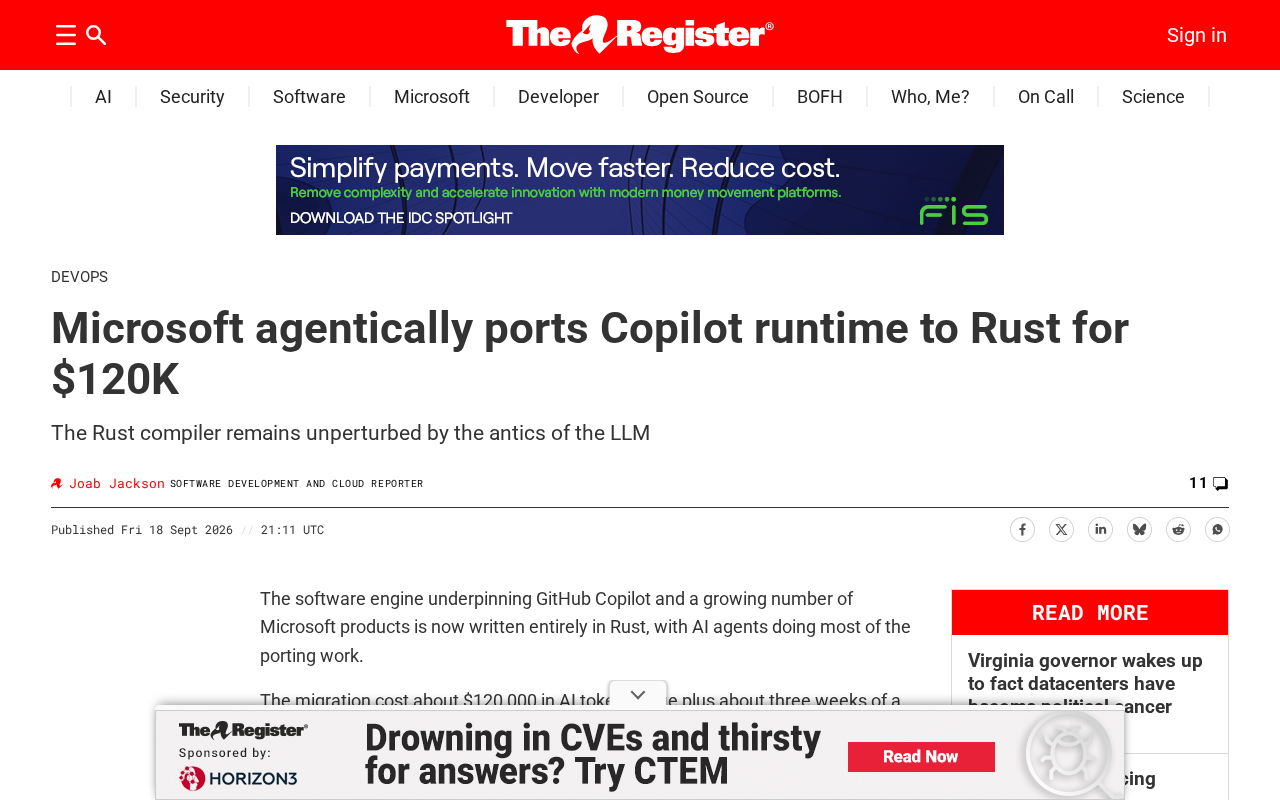
Microsoft recently disclosed a noteworthy engineering effort: using AI agents to automatically migrate the Copilot runtime to Rust, with a total project cost of around $120,000. The news sparked discussion in technical communities like Hacker News, touching on two of the hottest topics in modern software engineering — the real capability limits of AI-assisted programming, and the value of migrating to Rust as a systems language.
According to publicly available information, the standout feature of this migration was that it was completed "agentically" — meaning a large portion of the code conversion, testing, and debugging was driven autonomously by AI, rather than through the traditional approach of manual line-by-line rewriting. For a runtime component of considerable scale, a total investment of $120,000 likely represents significant savings in time and labor compared to a fully manual migration.
It's worth noting that the original source material is limited (the Hacker News post had only a title, 5 upvotes, and 0 comments). The analysis below draws on general industry practices, and some portions represent reasonable inference rather than official details from Microsoft.
Why Migrate to Rust
The Dual Case for Memory Safety and Performance
Rust has become a darling of systems programming in recent years, primarily because its ownership mechanism guarantees memory safety at compile time — eliminating null pointer dereferences, data races, and similar common vulnerabilities without the need for garbage collection. For a core component like the Copilot runtime that demands high performance and long-term stability, Rust delivers execution efficiency comparable to C/C++ while dramatically reducing the risk of memory safety bugs.
Microsoft's commitment to Rust is well-established: parts of the Windows kernel and Azure infrastructure have already adopted the language. Migrating the Copilot runtime to Rust aligns naturally with Microsoft's broader technical direction.
Rust's ownership model is what sets it apart from other systems languages. Each value has exactly one "owner" at runtime; memory is automatically freed when the owner goes out of scope. The borrowing rules enforce at compile time that at any given moment, there is either exactly one mutable reference or any number of immutable references — fundamentally eliminating dangling pointers and data races. This stands in sharp contrast to C/C++'s manual memory management and Java/Python's reliance on garbage collectors. Rust moves safety checks to the compilation phase, introducing neither runtime overhead nor the pause latency associated with GC. For an AI inference runtime that requires low-latency responses, this is especially critical: GC pauses in high-concurrency scenarios can cause unpredictable tail latencies, whereas Rust's deterministic memory management effectively avoids such issues.
The Technical Challenges of Migration
Cross-language porting is never a simple matter of syntactic translation. It involves differences in memory models, shifts in concurrency paradigms, replacement of third-party dependencies, and thorough re-validation of countless edge cases. Traditionally, this kind of work is time-consuming and labor-intensive, and is highly prone to introducing regression bugs in the details. This is precisely where AI agents add value — using automation to handle tedious, repetitive, yet rigorous conversion tasks.
The Role of AI Agents in Code Migration
From Code Completion to Autonomous Engineering
The most noteworthy signal from this effort is that AI programming tools are evolving from "completion suggestions" toward "autonomously executing complete engineering tasks." In the past, Copilot primarily played an assistive role, offering line-level or function-level code suggestions to developers. An agentic mode of operation, however, means AI can plan tasks, write code, run tests, and iteratively fix issues based on feedback — forming a relatively self-contained development loop.
The "agentic" working mode typically relies on a tool-use loop at the technical level: the large language model not only generates text but also calls external tools such as file read/write, command-line execution, and test runners, dynamically adjusting its next steps based on the results (including error messages) those tools return. In a code migration context, a typical agent workflow might look like: read source file → generate corresponding Rust code → invoke the compiler → analyze compilation errors → fix the code → run tests → continue iterating based on failing test cases, until predefined acceptance criteria are met. The key difference between this pattern and a traditional CI/CD pipeline is that the error-fixing step is completed autonomously by the AI, rather than blocking and waiting for human intervention. Leading agentic frameworks today include AutoGen, LangGraph, and Microsoft's own AutoGen Studio.
The Economics Behind $120,000
The $120,000 figure itself is worth examining. It likely encompasses significant token costs from model API calls, compute expenses, and the overhead of necessary human oversight. If this investment replaces what would otherwise take several engineers several months to complete, the return on investment is quite compelling. It also hints at a new cost structure for software development: replacing a portion of labor costs with quantifiable compute costs.
That said, whether this is truly cost-effective depends on the quality and maintainability of the migrated code, and how much follow-up human correction is required. AI-generated code still requires rigorous review for correctness and stylistic consistency — and those hidden costs should not be overlooked.
Implications for Software Engineering
A New Path for Modernizing Large-Scale Legacy Code
Enterprises are sitting on enormous volumes of legacy systems — written in aging languages, expensive to maintain. If AI agents can reliably perform language migrations and modernization efforts, it would open an entirely new path for the industry to pay down technical debt. Microsoft's experiment can be seen as a meaningful early reference case.
The concept of "technical debt" was coined by software engineer Ward Cunningham in 1992, using a financial metaphor to describe the architectural and code quality trade-offs made for short-term delivery speed that must be repaid at a higher cost later. According to industry research from organizations like Stripe, developers spend roughly 33% of their time dealing with technical debt, with global productivity losses estimated at over $850 billion per year. Legacy system migration is among the most expensive forms of technical debt repayment — typically requiring a freeze on new feature development, dedicated project teams, and significant regression risk. If AI agents can substantially lower the barrier and cost of such migrations, the biggest beneficiaries will be enterprises in traditional industries whose core businesses still run on COBOL, VB6, or early Java codebases, yet struggle to find enough engineers to carry out migrations.
Measured Optimism Going Forward
It's worth emphasizing that a single case study is insufficient to prove this approach is universally replicable. The success of the Copilot runtime migration may be attributable to Microsoft's deep internal knowledge of the codebase, comprehensive test coverage, and access to world-class AI infrastructure. For typical enterprise projects with weak test coverage and sparse documentation, the effectiveness of AI-driven migration may be considerably lower.
Conclusion
Microsoft's migration of the Copilot runtime to Rust via AI agents at a cost of approximately $120,000 is a landmark signal that AI-assisted software engineering is maturing. It demonstrates the potential of autonomous agents on complex engineering tasks, while also raising real questions about cost, quality, and replicability. As more such efforts accumulate, the way software is built — and the economics of building it — may undergo a profound transformation.
Related articles

Why Does the Tesla Roadster Need to Fly? A Deep Dive into Musk's Wild Demo
Tesla's Roadster launch showed wall-climbing, upside-down driving, and flying stunts—but The Vergecast notes the demo car may lack a battery, the Rocket version is invite-only and not street-legal, and the website terms don't guarantee delivery. After nine years of delays, why does this car still need to exist?

AI Is Not a Replacement: Human-AI Collaboration Through the Lens of Factory Root Cause Analysis
Starting from factory root cause analysis, this article explains how AI accelerates evidence chain construction rather than replacing human experts, exploring the pragmatic implementation logic and business value of 'AI supporting people rather than replacing them.'

AI Agent Decision Auditing: Building an Evidence Chain in Regulated Workflows
Starting from a Reddit discussion, this article analyzes three core issues in AI agent decision auditing within regulated workflows: what fields audit records should contain, how to handle feedback latency for erroneous decisions, and how to continuously calibrate LLM judge consistency with human judgment.