Midjourney Cloud City Prompt Breakdown: How the sref Parameter Creates a Unified Visual Style

How one Reddit creator's "Deep Sleep City" prompt and sref parameters make cinematic AI city visuals reproducible.
A Reddit creator shared the complete prompt and two sref style reference numbers behind the AI-generated piece "Deep Sleep City," turning "how to get great results" from guesswork into a reusable template. The article breaks down the prompt's three-layer structure — subject (buildings), environment (sea of clouds), and spatial relationships (distant skyline) — and explains how sref seeds stabilize color, lighting, and texture across a series far more efficiently than describing abstract style words. The creator also mentioned composing the music personally, reflecting a growing trend of integrating AI visuals into complete audiovisual workflows.
The Prompt Logic Behind a "City Above the Clouds"
A Reddit creator recently shared an AI-generated piece called "Deep Sleep City" — a sprawling mega-metropolis piercing through cloud cover, its skyline stretching endlessly into the distance. What made this post particularly valuable was that the creator not only revealed the complete prompt, but also shared the sref parameters used for style control, giving fellow creators a directly reusable template for this kind of cinematic visual aesthetic.
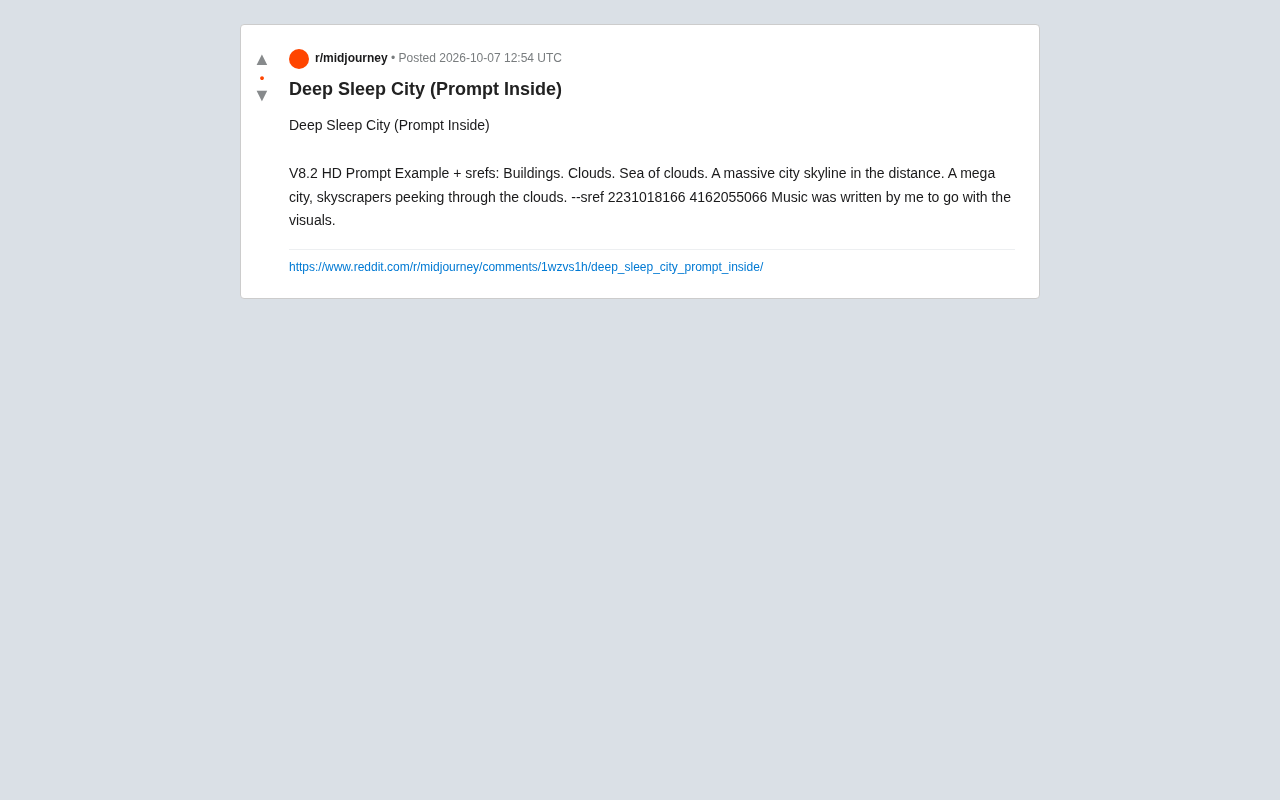
What makes these kinds of shares so useful is that they demystify "getting great results" — turning it from something almost magical into a reproducible structure. The core prompt the creator shared is remarkably concise: Buildings, Clouds, Sea of clouds, A massive city skyline in the distance, A mega city, skyscrapers peeking through the clouds. Just a handful of phrases, yet they map out the subject, atmosphere, and depth of the image with precision.
Breaking Down the Prompt Structure
The Layered Logic of Keywords
Look closely at this prompt set and you'll notice it follows a rhythmic pattern — moving from near to far, from concrete to atmospheric:
- Subject elements: Buildings, skyscrapers — establishing the core visual objects in the frame;
- Environmental atmosphere: Clouds, Sea of clouds — responsible for creating that dreamy, hazy quality;
- Spatial relationships: A massive city skyline in the distance, skyscrapers peeking through the clouds — explicitly defining depth and perspective.
The strength of this approach is that the model can much more clearly understand the layering of the scene, rather than flattening everything onto the same plane. Separating phrases with periods or commas lets each concept stand as its own "visual instruction" — a fairly reliable writing style across most major AI image generation tools.
The sref Parameter: The Key to Visual Consistency
At the end of the prompt, the creator appended --sref 2231018166 4162055066 — arguably the most noteworthy element of the entire configuration. sref (Style Reference) is a Midjourney feature that lets you reference specific style seed numbers, keeping the generated output consistent in terms of color grading, lighting, and texture.
In this case, the creator used two sref numbers simultaneously, meaning the model blends both style references together. For creators looking to build a cohesive series of works with a unified visual tone, this is an extremely practical technique. Rather than repeatedly describing abstract qualities like "cinematic feel," "cool color palette," or "soft lighting" in the prompt, you can simply lock in a verified style seed — saving tokens and producing more stable results.
The "V8.2 HD" mentioned in the title suggests the creator used a relatively recent model version; HD typically corresponds to higher output resolution and finer detail.
sref is a feature that Midjourney has progressively refined since v6. The underlying logic encodes the visual characteristics of an existing generated image (or a built-in style seed number) into a numerical fingerprint. When generating subsequent images, the model references this fingerprint across dimensions like composition, color palette, and lighting treatment — without directly copying the content. Unlike the --style parameter, which selects from preset style packages, sref is far more flexible. Users can extract a number from one of their own satisfying generations and reuse it, or reference community-shared "style seed libraries" like the creator did here. When two numbers are listed together, the default weighting is 50/50, though you can use --sv (style weight, ranging from 0–1000) to adjust the blending ratio — higher values mean stronger style influence. This mechanism makes style both reproducible, stackable, and fine-tunable, and is one of Midjourney's defining features compared to other mainstream AI image generation tools.
From Static Images to Audiovisual Works
Worth noting is that the creator explicitly mentioned "the music was composed by me to match the visuals." This hints at a broader trend: AI-generated visual assets are increasingly being integrated into more complete creative workflows, rather than existing as isolated single images.
When AI handles the generation of high-quality static or animated visuals and the creator handles music composition and narrative arrangement, individual creators can produce near-professional audiovisual content at remarkably low cost. This collaborative model of "AI generates the visuals + human provides the creative direction" is one of the most productive ways to use AIGC tools today.
The maturation of AIGC in the visual domain is pushing individual creators toward a more "full-stack" role. Traditionally, a 30-second concept video of a cityscape would require collaboration across 3D modeling, rendering, and compositing — a multi-day production cycle. In today's toolchain, creators can generate keyframes in Midjourney, add motion using tools like Runway or Kling, and layer in self-composed or AI-assisted music — compressing the entire workflow into a matter of hours. This division of labor — "AI handles technical execution, humans make creative decisions" — means that the quality ceiling is no longer determined by tool costs, but returns to the creator's own understanding of visual language and narrative rhythm.
Takeaways for Creators
This seemingly simple share actually packs in several reusable lessons:
- Layer your prompts: Organizing keywords by subject, environment, and spatial relationship is more effective than piling on adjectives;
- Leverage style references:
srefstabilizes output style and is a powerful tool for building consistent series; - Quality over quantity in keywords: A compelling scene can be described with just six or seven phrases — over-stacking tends to confuse the model;
- Cross-medium integration: Pairing AI-generated images with original music significantly elevates a work's polish and recognizability.
For users learning AI image generation, the most direct path to mastering style control is to copy the creator's prompt and sref numbers, reproduce the result, and then iterate from there.
Related articles

Why Does the Tesla Roadster Need to Fly? A Deep Dive into Musk's Wild Demo
Tesla's Roadster launch showed wall-climbing, upside-down driving, and flying stunts—but The Vergecast notes the demo car may lack a battery, the Rocket version is invite-only and not street-legal, and the website terms don't guarantee delivery. After nine years of delays, why does this car still need to exist?

AI Is Not a Replacement: Human-AI Collaboration Through the Lens of Factory Root Cause Analysis
Starting from factory root cause analysis, this article explains how AI accelerates evidence chain construction rather than replacing human experts, exploring the pragmatic implementation logic and business value of 'AI supporting people rather than replacing them.'

AI Agent Decision Auditing: Building an Evidence Chain in Regulated Workflows
Starting from a Reddit discussion, this article analyzes three core issues in AI agent decision auditing within regulated workflows: what fields audit records should contain, how to handle feedback latency for erroneous decisions, and how to continuously calibrate LLM judge consistency with human judgment.