Midjourney Medieval Scene Prompt Techniques: Breakdown & Practical Guide

A detailed breakdown of a Midjourney medieval castle Prompt revealing professional AI image generation techniques.
This guide dissects a Reddit-sourced Midjourney Prompt for generating medieval castle interiors, explaining how keywords like medieval, empty, and inside castle work together with parameters --ar 16:9, --raw, and --stylize 750. It covers diffusion model mechanics, cross-attention weighting, and provides practical tips for adjusting stylization, atmosphere modifiers, and aspect ratios.
The Core Method of AI Scene Generation Through a Single Prompt
In the field of AI image generation, Midjourney has become the go-to tool for many creators building virtual scenes, thanks to its outstanding visual quality and artistic expressiveness. A recent medieval castle scene generation case circulating on the Reddit community provides us with an excellent learning sample — through a seemingly simple Prompt, we can deconstruct the core methodology behind professional-level AI art creation.
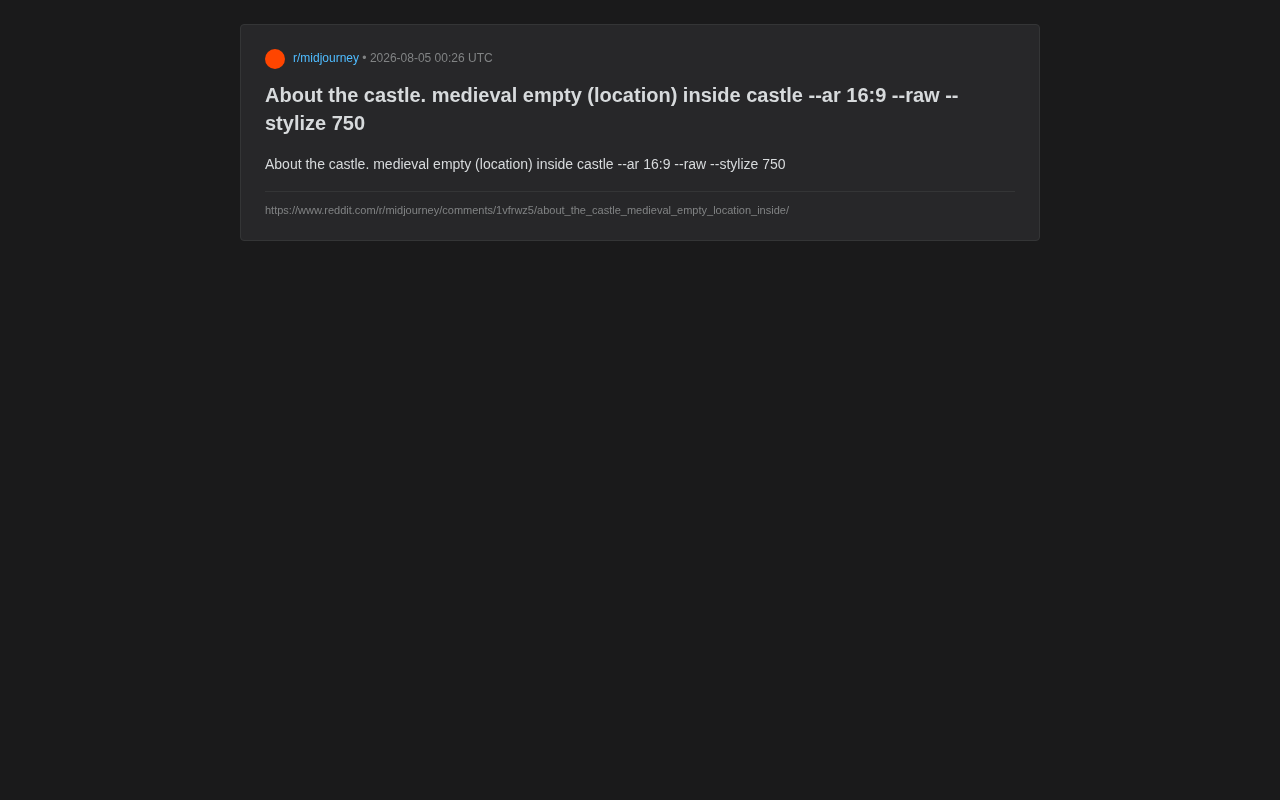
The full Prompt reads: About the castle. medieval empty (location) inside castle --ar 16:9 --raw --stylize 750. At first glance it seems unremarkable, but every parameter carries a clear creative intent.
Prompt Structure Breakdown: Subject Description & Scene Positioning
Functional Roles of Keywords
The first half of the Prompt — About the castle. medieval empty (location) inside castle — defines the core content of the image. It contains several key terms:
- medieval: Establishes the historical era, guiding the model to invoke visual elements related to medieval architecture, stone textures, arched structures, and more. The reason AI models can accurately generate medieval castle scenes is that their training data includes vast quantities of relevant imagery — historical architecture photography, film stills, game concept art, and art history illustrations. The word "medieval" is associated in the model's semantic space with visual features like Romanesque and Gothic pointed arches, ribbed vaults, rough stone masonry, torch lighting, and narrow window slits. These features form stable semantic mappings in text-image alignment models like CLIP, so a single word can trigger rich visual associations.
- empty: This is an easily overlooked but critically important modifier. It tells the model that the scene should contain no characters or cluttered objects, creating a serene, desolate atmosphere.
- inside castle: Locks the viewpoint to the castle interior rather than an exterior panorama.
A noteworthy detail: the (location) in parentheses is a technique some creators use as a placeholder or semantic emphasis, helping the model focus on the concept that "this is a location."
The Art of Parameter Control
The three parameters in the second half of the Prompt are where true professionalism shines:
--ar 16:9 Aspect Ratio: This ratio naturally suits cinematic shots and game scenes, creating broad, grand visual tension — perfect for conveying the depth of a castle interior. As the standard widescreen ratio and the native ratio of most current display devices, 16:9 images can be directly used for game UI design, film storyboards, or desktop wallpapers without additional cropping.
--raw De-beautification Mode: This is an important parameter introduced in newer versions of Midjourney. It reduces the model's default "beautification" tendency, minimizing overly artistic processing so the output adheres more closely to the literal Prompt description. From a technical perspective, the --raw parameter essentially changes the model's sampling strategy and conditional guidance approach. In Midjourney's default mode, internal "aesthetic enhancement prompts" (similar to implicit positive prompts) are layered on top of user Prompts, automatically adding guidance signals that boost visual appeal. Enabling --raw significantly weakens or removes these internal enhancements, making the model respond more purely to user-input text. This is analogous to lowering the CFG Scale in Stable Diffusion or using negative prompts to remove specific styles. For scene creation pursuing realism and authentic atmosphere, as well as commercial applications requiring precise control over image content, --raw is nearly essential.
--stylize 750 Stylization Strength: The value ranges from 0 to 1000. Higher values give Midjourney more artistic freedom, making images more decorative and stylized; lower values make the output more faithful to the Prompt itself. This parameter can be compared to a combined adjustment of Classifier-Free Guidance Scale and aesthetic scoring in other diffusion models — low stylize values mean the model follows text semantics more strictly, while high values grant the model more "creative freedom" to add extra visual elements based on aesthetic preferences learned from training data. This mechanism is essentially a tradeoff between "fidelity" and "aesthetic quality." The choice of 750 here falls in the medium-high range, maintaining visual appeal while preserving strong controllability.
Why This Prompt's Design Philosophy Is Worth Studying
Precise Control Through Minimalist Expression
Many beginners fall into the trap of "keyword stuffing," believing that more detailed descriptions and more adjectives yield better results. But this case demonstrates the opposite — it achieves precise scene definition with minimal language. The three words medieval, empty, and inside each carry a distinct function with no redundancy and no conflicting expressions.
This "less is more" philosophy actually aligns better with how diffusion models work. Diffusion Models are the core technical architecture behind current AI image generation. The basic principle: during training, Gaussian noise is gradually added to images until they become pure noise; during inference, the process starts from random noise and progressively restores a clear image through the learned denoising process. During denoising, the text Prompt guides the generation direction through Cross-Attention mechanisms — each keyword competes for "weight" in the attention layers. Too many keywords can actually dilute the model's attention, causing key elements to be underrepresented — like a painter hearing instructions from ten people simultaneously and not knowing what to prioritize.
Synergy Between Parameters and Semantics
The brilliance of this case lies in the coordination between semantic description and technical parameters. The semantic intent of empty (desolate), combined with the --raw (de-beautification) parameter, jointly reinforces the barren, realistic atmosphere. If a high stylize value were used or the raw parameter removed, the image would likely gain unnecessary decorative elements that destroy the core intent of "emptiness." This consistency between parameters and semantics reflects a mature creator's deep understanding of tool mechanics — they know not only "what to write" but also "how to make the tool execute their intent."
Practical Adjustment Tips for Medieval Scene Prompts
For creators looking to reproduce similar effects, consider the following adjustment approaches:
- Adjust stylize value: For more realism, lower it to 300-500; for a more dreamlike, artistic feel, raise it above 800. Note that the effect of stylize values doesn't change linearly — it varies significantly across different subjects and styles. Testing in increments of 50-100 for comparison is recommended.
- Layer atmosphere modifiers: Beyond empty, try terms like dim lighting, dusty, or abandoned to strengthen the scene's mood. These modifiers are associated in the model's semantic space with specific lighting patterns, color tendencies, and material representations, effectively guiding the emotional direction of the final image.
- Use aspect ratio wisely: Vertical compositions with
--ar 9:16can emphasize towering castle structures, while ultra-wide panoramas can use--ar 21:9. Aspect ratio doesn't just affect composition — it indirectly influences the model's layout logic for scene elements. Ultra-wide formats tend to generate more horizontally expansive environmental details, while vertical formats encourage the model to emphasize vertical structures. - Combination testing: Start with default stylize for a baseline, then gradually adjust parameters and compare results to build your parameter intuition. Leverage Midjourney's multi-image variation features (such as V1-V4 selection or the Vary function) to quickly explore visual differences across parameter combinations on the same semantic foundation.
Conclusion: The Underlying Logic of Good Prompts
This medieval castle Prompt from the Reddit community, though brief in text, fully demonstrates the thinking framework behind professional AI art creation: clear subject positioning, precise atmosphere modification, and appropriate parameter control. For professionals in game art, film concept design, scene illustration, and related fields, mastering this structured approach to Prompt writing can significantly improve both efficiency and output quality when using AI tools.
The barrier to AI image generation is lowering, but what truly separates the skilled from the rest is always a deep understanding of tool principles and clear expression of creative intent. When you understand how diffusion models interpret text, how attention mechanisms allocate weights, and how parameters regulate the generation process, you're no longer "hoping for luck" — you're consciously "directing" a powerful visual engine to realize your creative vision.
Related articles

Why CodeAct Code-First Agents Haven't Won Yet: A Deep Dive into the Paradigm's Dilemma
Deep analysis of why CodeAct code-first agents haven't replaced ReAct chat-first frameworks. Examining model training bias, protocol limitations, MCP design flaws, and sandbox challenges.

Qwen3-Max Deep Dive: How Coding and Collaboration Capabilities Are Redefining AI Development Assistants
Deep analysis of Alibaba's flagship model Qwen3-Max, covering its coding, Cowork collaboration capabilities, and potential for redefining AI-assisted software development.

Unsloth Releases Quantized DeepSeek V4 Flash: Lossless Performance at 162GB
Unsloth releases UD dynamic quantized versions of DeepSeek V4 Flash 0731, offering six variants from 162GB lossless to 83GB extreme compression using MXFP4+BF16 mixed precision.