Milvus 2.6 Core New Features Explained: Tiered Storage, Architecture Deep Dive & RAG in Practice
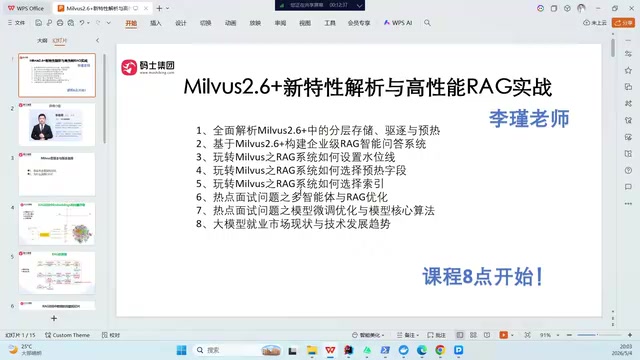
Milvus 2.6 core features and practical RAG deployment strategies explained
This article systematically introduces Milvus's position as essential AI-era infrastructure, explains how vector databases solve the fundamental problem of similarity search over unstructured data, provides a detailed analysis of Milvus 2.6's cloud-native storage-compute separation architecture, and combines real-world RAG system scenarios to help developers understand the technical principles and deployment strategies of enterprise-grade vector databases.
Why Milvus Is Essential Infrastructure for the AI Era
In 2026, as large model applications continue to explode, vector databases have become an indispensable core component in AI application development. If MySQL is the standard toolkit for traditional Java development, then Milvus is the "MySQL" of the AI/LLM era — it is currently the world's most popular open-source vector database, with tens of thousands of stars on GitHub and an extremely active community.
This article is based on content from an in-depth technical open course, systematically covering the core new features of Milvus 2.6.x and combining them with hands-on experience building high-performance RAG (Retrieval-Augmented Generation) projects to help developers quickly master enterprise-grade vector database deployment strategies.
The Essence of Vector Databases: From Exact Queries to Similarity Search
Limitations of Traditional Relational Databases
Relational databases like MySQL excel at exact queries on structured data: equality matching, range queries, fuzzy searches (LIKE statements), etc. However, when facing the unstructured data of the AI era — images, text, audio, video — traditional databases fall short.
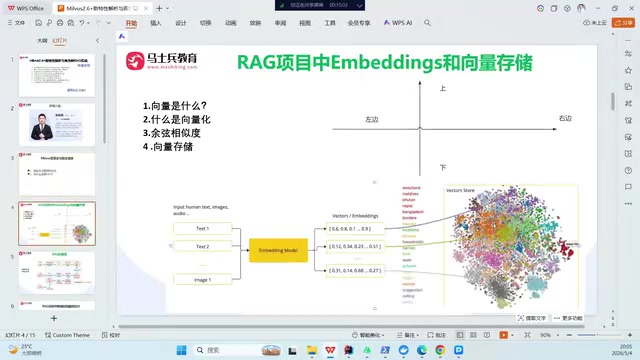
What Problem Does a Vector Database Actually Solve?
Milvus's core capability is computing vector similarity. Here's an intuitive example: suppose you have a database containing billions of images and need to find the one most similar to a photo of your cat within a few milliseconds. This kind of fast retrieval over high-dimensional vectors is precisely where Milvus delivers its core value.
The workflow of a vector database can be summarized in four steps:
- Embedding: Convert unstructured data (text, images, etc.) into high-dimensional vectors using models
- Vector Storage: Efficiently write vector data into the database and build indexes
- Similarity Computation: Use algorithms like cosine similarity or Euclidean distance to quickly find the most similar vectors
- Result Return: Return search results to the upstream application
The Technical Principles of Embedding
Embedding is the process of mapping unstructured data into a high-dimensional mathematical space. Taking text as an example, pre-trained language models like BERT and GPT can convert a passage of text into a floating-point array of 768 or 1536 dimensions. The position of this array in mathematical space encodes the semantic information of the original content — semantically similar content has vectors that are closer together in space. This property is the mathematical foundation of vector retrieval. In the image domain, the CLIP model goes a step further by mapping both images and text into the same vector space, enabling cross-modal retrieval. Higher vector dimensions provide stronger expressiveness but also increase computational overhead — this is the core trade-off in engineering practice.
This workflow is especially critical in RAG systems — a user's query is converted into a vector, the most relevant document fragments are retrieved from a knowledge base, and then passed to a large model to generate an answer.
The Complete Technical Pipeline of RAG Systems
RAG (Retrieval-Augmented Generation) is currently the mainstream architectural paradigm for enterprise-grade LLM deployment. Its core idea is combining the generative capabilities of large models with the retrieval capabilities of external knowledge bases, addressing pain points such as knowledge cutoff, frequent hallucinations, and the inability to leverage private domain data. The complete RAG pipeline includes two phases: the offline phase (document parsing → text chunking → Embedding vectorization → writing to the vector database) and the online phase (user question → query vectorization → vector retrieval → recalled document reranking → Prompt construction → LLM answer generation). Among these, the text chunking strategy (Chunk Size, overlap window), the number of retrieved results (Top-K), and the choice of reranking model (Reranker) are the three key variables that affect the final performance of a RAG system, and represent the main battleground for engineering optimization.
Deep Dive into Milvus 2.6 Cloud-Native Architecture
Core Components and Architecture Design
Milvus 2.6 adopts a fully cloud-native architecture, which is one of the key reasons enterprises choose it. The architecture includes several core components:
- Coordinator: Responsible for routing different types of operations to the corresponding processing nodes
- Stream Node: Handles real-time data stream ingestion and consumption
- Query Node: Handles the computational tasks of vector search queries
- Data Node: Manages data persistence and index building
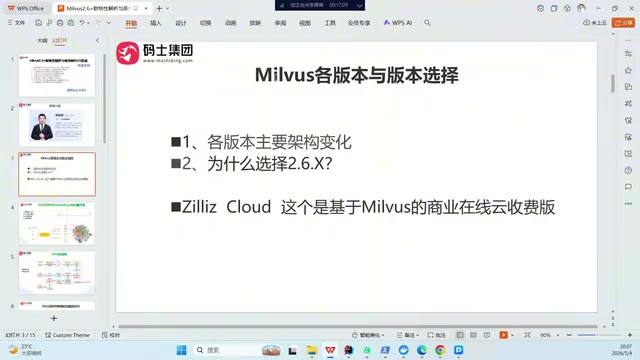
Cloud-Native Architecture and Storage-Compute Separation Design
The core of Milvus 2.6's cloud-native architecture is its storage-compute separation design. Traditional databases couple computation and storage on the same node — scaling requires expanding both types of resources simultaneously, which is costly and inflexible. Milvus persists data to object storage (S3/MinIO) while making compute nodes (Query Node, Data Node) stateless and independently elastic. This means when query pressure is high, you only need to scale out Query Nodes; when storage pressure is high, you only need to expand object storage capacity — dramatically improving resource utilization. In this architecture, etcd serves as the distributed coordination layer, storing cluster metadata and node states as the "nerve center" of the entire system. This architectural design makes Milvus naturally suited for Kubernetes Pod elastic scheduling capabilities, which is also why it is called a "cloud-native vector database."
Related articles
 Tutorials
ChatGPT Plus Subscription Guide: Are GPT-5.5, image-2, and Codex Worth the Upgrade?
A detailed look at ChatGPT Plus features — GPT-5.5, image-2, and Codex — with a Plus vs Pro comparison and a complete step-by-step subscription guide for users outside the US.
 Tutorials
Harness AI Engineering in Practice: Using Claude Code to Master Enterprise-Level E-Commerce Development
Deep dive into Harness AI Engineering: master enterprise e-commerce development with Claude Code using the Rules, Skills, Wiki, and Changes framework.
 Tutorials
Cursor + Codex Dual-IDE Collaboration: A Practical Methodology for Open-Source Project Customization
A complete methodology for open-source project customization based on real-world experience, detailing the Cursor+Codex dual-IDE workflow, seven-stage process, MVP validation, and AI source code reading techniques.