MiMo-v2.6-Pro Deep Dive: A Three-Dimensional Assessment of Intelligence, Performance, and Price

MiMo-v2.6-Pro analyzed through a three-dimensional framework: intelligence, performance, and price.
MiMo-v2.6-Pro is a newly released LLM generating discussion in technical communities. This article builds an evaluation framework across intelligence (MMLU, GPQA, coding benchmarks), performance (TTFT, throughput, concurrency stability), and price (cost-effectiveness vs. GPT-4o, Claude 3.5 Sonnet). The key takeaway: model selection is about trade-offs tailored to your specific use case, not chasing the top of every leaderboard.
MiMo-v2.6-Pro Draws Attention
MiMo-v2.6-Pro, a recently launched large language model, has sparked discussion in technical communities such as Hacker News. Conversations around this model have centered on three dimensions: Intelligence, Performance, and Price — which happen to form the most critical evaluation framework for assessing any commercial or open-source LLM today.
It's worth noting that publicly available information on this model remains limited. This article will build around this evaluation framework to help readers understand why these three dimensions matter so much in model selection, and how to weigh them in real-world decision-making.
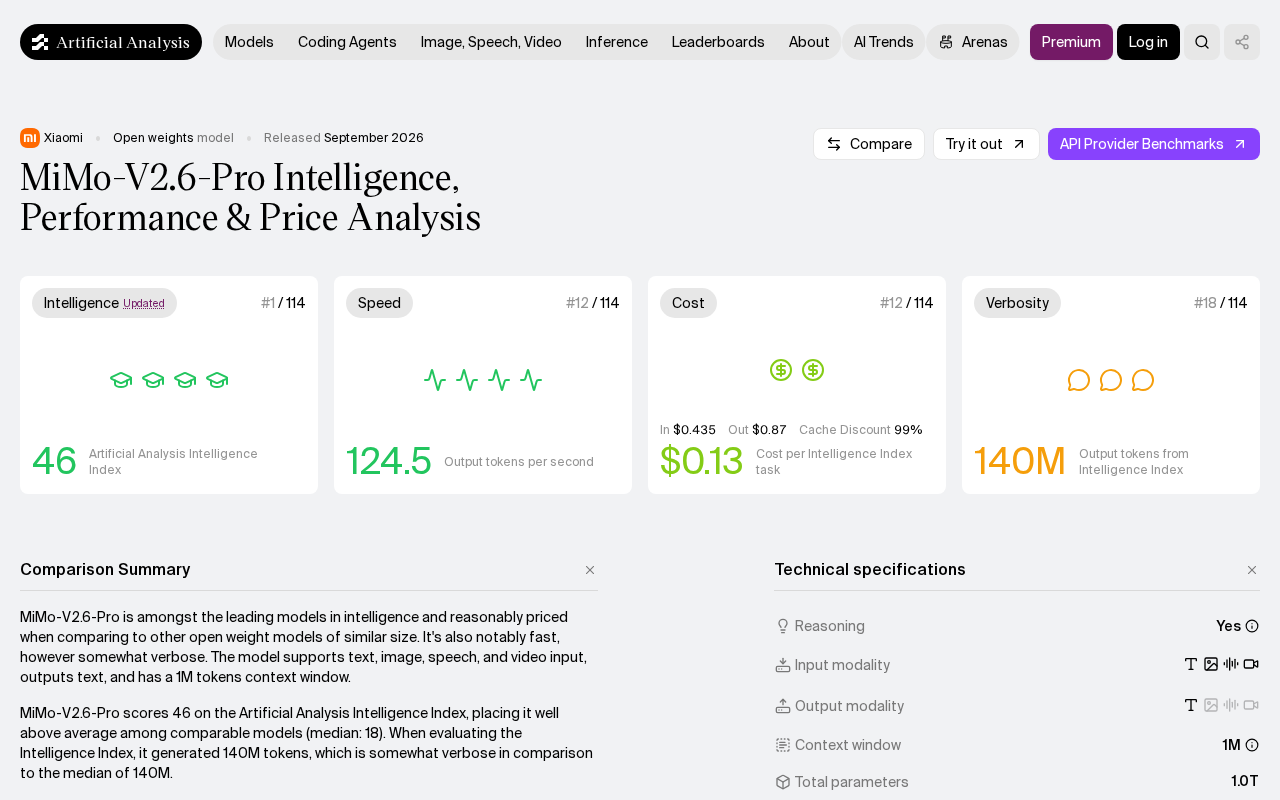
Intelligence: Where Is the Capability Ceiling?
A model's intelligence is typically measured through a series of standardized benchmarks covering reasoning, code generation, math problem-solving, and multi-turn dialogue comprehension. For a model positioned as "Pro" tier like MiMo-v2.6-Pro, users' core expectation is reliable, consistent output on complex tasks.
When evaluating intelligence, several key metrics deserve attention: performance on general reasoning benchmarks (such as MMLU and GPQA), accuracy on programming tasks, and the ability to retain information across long-context scenarios. These indicators collectively determine whether a model can handle real production requirements — not just shine in demo environments.
For teams looking to integrate a model into actual workflows, higher intelligence isn't always better — it needs to match the specific task at hand. A model that excels at mathematical reasoning but carries a high cost may not be the right fit for applications primarily focused on text summarization.
MMLU (Massive Multitask Language Understanding) is a multiple-choice benchmark spanning 57 subjects — including mathematics, law, medicine, and history — designed to measure a model's breadth of knowledge and reasoning ability. GPQA (Graduate-Level Google-Proof Q&A) focuses on graduate-level professional science questions that are difficult to answer even with search engine assistance, making it better at differentiating top-tier models. Beyond these two, HumanEval and SWE-bench are the mainstream choices for evaluating coding ability: HumanEval tests function-level code completion, while SWE-bench simulates real GitHub Issue resolution scenarios, offering a more engineering-relevant measure of "code intelligence." It's also worth noting the risk of benchmark "contamination" — if test questions appear in training data, model scores can be inflated and fail to reflect true generalization ability, which is why the industry increasingly values secondary validation on private or dynamically updated datasets.
Performance: Balancing Speed and Stability
The performance dimension focuses on response latency, throughput (tokens processed per second), and stability under high concurrency. These metrics directly impact user experience — especially in products requiring real-time interaction, where even a few hundred milliseconds of latency difference can become a decisive factor.
For MiMo-v2.6-Pro, performance evaluation should cover both Time to First Token (TTFT) and generation speed. The former affects users' perception of how "responsive" the model feels; the latter determines the total time for generating long outputs. Whether the model maintains stable throughput under batch requests is also a critical verification point for enterprise-level deployment.
Performance and intelligence often involve trade-offs — larger, smarter models typically mean higher computational overhead and slower responses. A high-quality model therefore needs to strike an engineering balance between the two.
Time To First Token (TTFT) refers to the time elapsed from sending a request to receiving the first output token, directly determining the user's perception of whether "the model is thinking." In streaming output mode, a shorter TTFT brings the interaction experience closer to real-time conversation. The complementary metric is TPOT (Time Per Output Token) — the average time to generate each subsequent token — and together they paint the complete picture of end-to-end latency. At the engineering deployment level, KV Cache hit rate significantly impacts throughput in concurrent scenarios: when multiple requests share the same prefix (such as a system prompt), efficient KV Cache reuse can dramatically reduce computational overhead. Quantization techniques (such as INT8 and AWQ) trade model weight precision for faster inference speed, at the cost of potentially introducing minor accuracy loss.
Price: Cost-Effectiveness Is the Ultimate Consideration
Price is the decisive factor that determines whether technology can achieve large-scale adoption. The same level of intelligence and performance can have vastly different commercial viability if costs differ by several multiples. For API services billed per token, the unit price for input and output — as well as whether bulk discounts are available — will significantly affect long-term costs.
Assessing MiMo-v2.6-Pro's price competitiveness requires placing it within a comparative landscape of similar models. The key question is: given a comparable level of intelligence, does it offer a cost advantage per unit? For high-frequency applications, even saving a few cents per thousand tokens can add up to a substantial sum over time.
The truly valuable analysis isn't looking at price figures in isolation, but calculating "cost-effectiveness" — the intelligence and performance gained per unit of cost. This is the core insight of the "Intelligence, Performance, and Price" evaluation framework.
Current mainstream LLM API pricing generally follows a dual-track structure of "input token price + output token price," with output tokens typically costing 2 to 5 times more than input tokens — because generation involves autoregressive token-by-token computation, while input can be processed in parallel. Some providers have also introduced "cache hit pricing" — applying a lower discounted rate when repeated long system prompts hit the cache, which offers significant cost optimization for applications with fixed prompt templates. When making cross-model comparisons, estimating monthly costs for MiMo-v2.6-Pro versus models like GPT-4o, Claude 3.5 Sonnet, and Gemini 1.5 Pro on the same task scenarios is typically more practically meaningful than simply comparing the listed price per million tokens — because the number of tokens different models consume to complete the same task can vary significantly.
How to Rationally Approach This Type of Model Evaluation
The value of the three-dimensional evaluation framework lies in reminding decision-makers that no single model can be optimal across all dimensions. The essence of model selection is making trade-offs between intelligence, performance, and price based on your own specific use case.
For readers following MiMo-v2.6-Pro, the recommendation is to wait for complete official benchmark data and then conduct validation tests against your actual use cases, rather than relying solely on a single leaderboard ranking. Real business data almost always reflects a model's suitability better than general benchmarks.
Given the limited public information currently available, this article primarily offers an evaluation perspective and analytical framework. As more test data is disclosed, MiMo-v2.6-Pro's true positioning across the three dimensions will gradually become clear.
Related articles

AI Is Not a Replacement: Human-AI Collaboration Through the Lens of Factory Root Cause Analysis
Starting from factory root cause analysis, this article explains how AI accelerates evidence chain construction rather than replacing human experts, exploring the pragmatic implementation logic and business value of 'AI supporting people rather than replacing them.'

AI Agent Decision Auditing: Building an Evidence Chain in Regulated Workflows
Starting from a Reddit discussion, this article analyzes three core issues in AI agent decision auditing within regulated workflows: what fields audit records should contain, how to handle feedback latency for erroneous decisions, and how to continuously calibrate LLM judge consistency with human judgment.

Apple Opens Multiseat Subscription Purchasing: App Subscriptions Can Now Be Sold in Bulk to Businesses and Schools
Apple opens multiseat purchasing for auto-renewable subscriptions: businesses and schools can bulk-buy via Apple Business and Apple School Manager, adding or removing seats anytime. Enabled by default in App Store Connect—developers should verify settings; group purchasing sandbox testing opens October 2026.