MiniMax Code Hands-On Review: How AI Development Team Mode Redefines Programming Collaboration

MiniMax Code introduces AI team collaboration with architect, developer, and tester agents for self-contained delivery.
MiniMax Code (MCode) redefines AI programming by replacing single-agent models with a Multi-Agent Team comprising an architect, developers, and testers. Through hands-on tests—Starbucks financial report visualization and Next.js website development—the review demonstrates how MCode's quality gate mechanism, three-layer memory system, and automated planning deliver production-ready code in 8-10 minutes without manual intervention.
From Chatbox to Agent Team: AI Programming Enters the Era of Team Collaboration
If 2024 was the inaugural year of large model conversations and 2025 the explosion period for AI programming assistants, then we're currently witnessing the rise of a new trend—AI Agent team-based collaboration. MCode (MiniMax Code), the desktop-level product launched by MiniMax, is a prime example of this trend.
Unlike most AI programming tools on the market, MiniMax never went down the traditional Chatbox route. From the original MiniMax Agent to the now-upgraded MCode, the company has consistently bet on the Agent direction. This time, the core selling point is even more radical: it's not a single AI assistant, but an entire AI development team—comprising an architect, programmers, and testers, each with distinct responsibilities, collaborating to deliver results.
The Pain Point of Single Agents: Code Gets Written, Then Abandoned
Anyone who's done AI-assisted development knows the feeling: you ask Claude Code or Cursor to write code, and it does—but then it drops the ball. No running, no testing, no verification. When you run the tests yourself, a pile of bugs awaits, and then you have to repeatedly ask the AI to fix and debug, making interaction costs extremely high.
This is fundamentally a limitation of the single-Agent model. One AI role has to understand requirements, write code, AND self-test—without proper division of labor and process constraints, output quality is naturally hard to guarantee. Even if you use Claude Code's plan mode to plan before executing, these steps still require manual triggering and supervision.
MCode's solution introduces an Agent Team mechanism: the architect handles requirement decomposition and solution planning, developers handle coding implementation, and testers handle delivery verification. The key point is—code is only delivered to the user after tests pass. This self-contained quality assurance mechanism is much closer to real production-level development workflows.
From a technical perspective, Multi-Agent systems are not an entirely new concept—their theoretical foundations trace back to distributed artificial intelligence research. In traditional software engineering, role division (architect, developer, test engineer) follows the classic Software Development Life Cycle (SDLC) model. Mapping this concept to AI systems, the core challenges lie in inter-Agent communication protocols, task dependency graph construction, and conflict resolution mechanisms. Unlike single-Agent Chain-of-Thought reasoning, Multi-Agent architectures require designing explicit message-passing interfaces and state synchronization mechanisms to ensure each Agent's output can be correctly consumed by downstream Agents. MCode's innovation lies in encapsulating this complex multi-agent coordination mechanism into an automated process that's invisible to the user.
Hands-On Test 1: Starbucks Financial Report Data Visualization

The first test task was to have MCode generate an HTML5 visualization analysis report based on Starbucks financial data scraped from Wind. The entire process was completed through Agent Team collaboration, powered by MiniMax's latest M3 model.
MiniMax is one of China's leading large model companies, and its M3 model is the company's latest-generation foundation model, with focused optimizations in code generation, long-context understanding, and instruction following. Similar to OpenAI's GPT series or Anthropic's Claude series, M3 is a large-scale pretrained language model, but MiniMax increased the proportion of code corpora and structured data in its training data mix, making it more capable in programming tasks. This means that when processing structured information like financial report data, M3 can more accurately understand data relationships and generate corresponding visualization code.
The test results were quite impressive:
- Data Accuracy: After manual verification, all data in the report matched the original financial statements exactly, with no AI-fabricated data. MCode has built-in review mechanisms ensuring only user-provided data is used
- Design Fidelity: The report automatically adopted Starbucks' signature green color scheme, even though the user never specified a color palette
- Content Completeness: Coverage included revenue analysis, business segmentation, store data, balance sheet, cash flow, and multiple other dimensions
- Usability: Any chart in the report can be directly screenshotted for PPT use, with one-click PPT generation also supported
Hands-On Test 2: Next.js Tech Company Website Development
The second test was more challenging—developing a responsive tech company website using Next.js, with Starbucks-inspired styling, positioned as a consumer APP product showcase.
Next.js is a React full-stack framework developed and maintained by Vercel, and is one of the mainstream choices for modern frontend engineering. It provides out-of-the-box capabilities including Server-Side Rendering (SSR), Static Site Generation (SSG), API routes, and file-system routing. Choosing Next.js as the test task is representative because it involves project scaffolding configuration, component-based development, routing design, style system integration, and multiple other engineering aspects—effectively testing an AI programming tool's ability to handle real engineering projects. This isn't simple single-file code generation; it requires understanding project structure and inter-module dependency relationships as a systematic engineering effort.
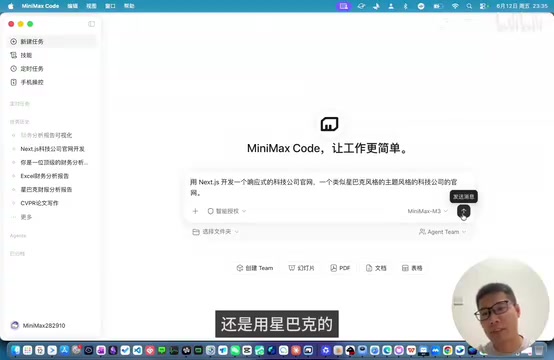
Planning First, Not Mindless Execution
After receiving the task, MCode didn't immediately start writing code. Instead, it first developed a complete development plan (Plan), then assigned tasks to different sub-teams. This process is fully automated—no manual intervention required from the user.
The specific execution flow:
- Project Scaffolding + Design System: The first team handles project structure initialization and design specifications, producing design documents and component guidelines
- Core Page Implementation: The second team develops based on the previous step's documentation, and validates the design system's completeness before starting development
- Mobile Adaptation: After the PC version is complete, another team handles responsive adaptation in parallel
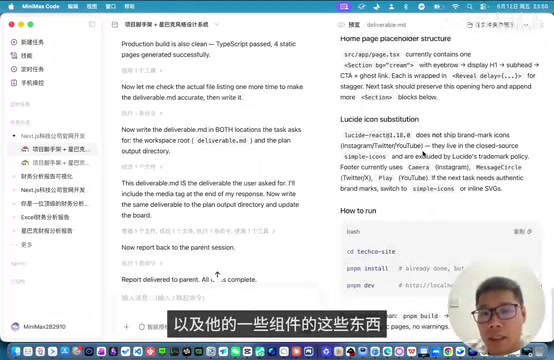
Delivery Verification Mechanism
The most impressive aspect is MCode's delivery workflow. After each sub-task is completed, it's not directly handed to the supervisor—instead, self-verification is performed first. Only after verification passes is it handed to the parent task, which then assigns the next step. This layer-by-layer verification, step-by-step delivery mechanism is highly consistent with how real software development teams work.
The "verification" here is essentially an AI-native implementation of the Quality Gate concept from software engineering. Quality Gates are a core concept in Continuous Integration/Continuous Delivery (CI/CD) pipelines, referring to preset quality check standards that code must pass before flowing from one stage to the next. Common quality gates include unit test coverage, static code analysis, and integration test pass rates. MCode internalizes this engineering practice into the Agent collaboration workflow, meaning AI-generated code is no longer "written and delivered" but goes through automated verification before entering the next phase—this is the critical leap from "code generation tool" to "software engineering system."
When users can't wait and want to preview early, MCode also demonstrates flexibility—it determines that the PC version has passed verification and can be previewed first, while mobile development continues in the background. This "partial delivery, continuous iteration" strategy is very pragmatic.

Final Result
The launched website includes complete pages for product introduction, brand story, project showcase, and contact information, with an overall clean and professional style. While the task itself isn't particularly complex, the entire process from requirement confirmation to project launch takes approximately 8-10 minutes—quite impressive efficiency.
Three-Layer Memory System and Mobile Management
MCode has several other noteworthy features:
- Three-Layer Memory System: Remembers user coding habits and project conventions; collaboration efficiency continuously improves with usage time, like a well-coordinated development team
- Local Execution: Code runs locally, ensuring data security
- Feishu/WeChat Integration: Supports issuing tasks and monitoring progress via mobile, enabling mobile management
Regarding the three-layer memory system, its technical implementation involves multiple levels of AI system memory mechanisms: short-term memory corresponds to information within the current session's context window; medium-term memory covers cross-session project-level information (such as project architecture, tech stack choices, completed modules); long-term memory accumulates user preferences and historical patterns (such as code style, naming conventions, commonly used design patterns). Implementation typically combines vector database retrieval (RAG), structured knowledge graph storage, and embedding-based similarity matching. The value of this mechanism is that it allows AI tools to accumulate project experience like real team members, significantly reducing repetitive communication costs—you don't need to tell the AI every time that "our project uses TypeScript" or "components use PascalCase naming."
Comparison and Reflection: Is Agent Team the Right Direction?
There are similar team collaboration concepts on the market, such as Kimi's Team feature, but MCode's implementation is closer to real software engineering workflows—with clear role division, task dependencies, delivery verification, and quality gates.
For non-technical entrepreneurs, MCode's value is particularly prominent. You don't need to know how to write a PRD, design prototypes, configure MCP, or even distinguish between frontend and backend—you just need to clearly state what you want, and the AI team handles everything else. This is precisely the qualitative shift from "AI tool" to "AI co-founder."
The MCP (Model Context Protocol) mentioned here is a standardized protocol proposed by Anthropic for enabling large models to connect with external tools and data sources. It defines a unified interface for how models discover, invoke, and receive external services. In AI programming tools, MCP is commonly used to connect code repositories, databases, API documentation, and other external resources. For technical users, configuring MCP means understanding concepts like JSON Schema, tool descriptions, and permission management; MCode completely shields this complexity, allowing non-technical users to access full development capabilities without understanding the underlying toolchain connections.
Of course, MCode is still in its early stages, and its performance on truly complex enterprise-level projects remains to be further validated. But the direction it represents—the evolution from single Agent to Agent Team—is undoubtedly one of the most noteworthy trends in AI programming. The underlying logic of this trend is clear: the complexity of software engineering has never been a point problem but a systemic one. No single AI, however powerful, can simultaneously play all roles well—just as in reality, no single person can excel at architecture design, coding implementation, and quality assurance all at once. The emergence of Agent Teams essentially reimplements decades of software engineering best practices—division of labor, process management, quality assurance—in an AI-native way.
Key Takeaways
Related articles
Altman: Taking OpenAI Public This Year Would Be 'Ill-Advised'
OpenAI CEO Sam Altman says going public this year would be 'ill-advised,' even as the company has confidentially filed IPO paperwork. Here's what it means for AI.

An Open Letter to Dario: If AI Safety Is Real, Open the Model Weights
Developer Jacob's open letter to Anthropic CEO Dario Amodei went viral on Hacker News, challenging the contradiction between AI safety rhetoric and closed-source models: if safety truly matters, why not open the weights?
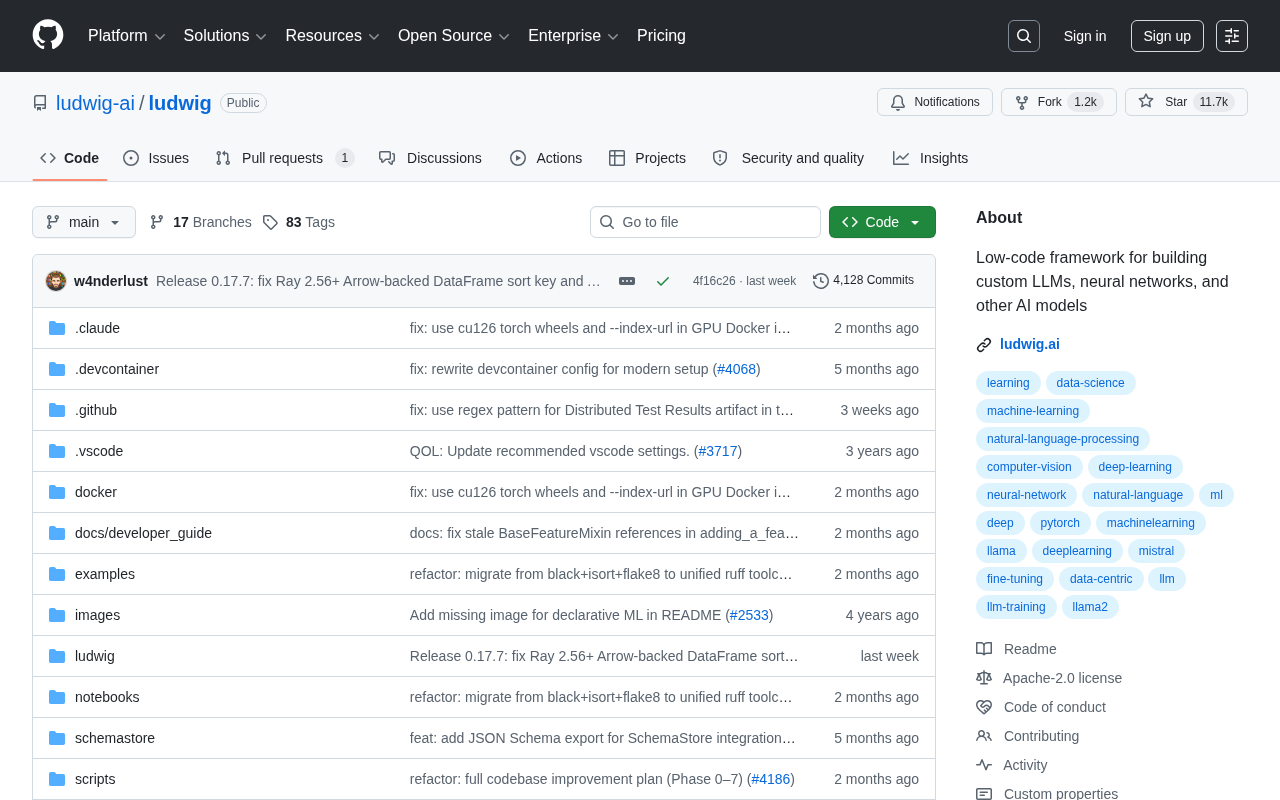
Ludwig: Building Custom LLMs and Neural Networks with Declarative Low-Code Configuration
Ludwig is an open-source low-code ML framework that builds custom LLMs and neural networks via declarative YAML config — no boilerplate training code required.