MiniMax H3 in Practice: Building a Combined REF2VA and FL2VA Workflow
A practical guide to combining MiniMax H3's REF2VA and FL2VA modes in ComfyUI for optimal video generation.
This guide compares MiniMax H3's REF2VA and FL2VA generation modes across visual quality, motion performance, and audio cloning. REF2VA excels in visual fidelity while FL2VA handles dynamic motion and audio better. A ComfyUI fusion workflow is presented that uses REF2VA for video generation, FL2VA for audio refinement, and LightX2V LoRA for acceleration, achieving high-quality results in about 3 minutes on an RTX 5090.
The Two Modes of MiniMax H3: REF2VA vs FL2VA
Since the release of MiniMax H3, community discussion around its two major generation modes — REF2VA and FL2VA — has never ceased. REF2VA (Reference-to-Video-Audio) and FL2VA (Flow-to-Video-Audio) are the two core inference modes of the MiniMax H3 multimodal generation model. REF2VA drives generation based on reference images, extracting visual features from reference frames (such as facial structure, texture details, and lighting information) to guide video synthesis — essentially closer to an image-conditioned generation paradigm. FL2VA, on the other hand, drives generation based on Optical Flow estimation, focusing more on modeling and propagating motion trajectories by predicting inter-frame pixel displacements to achieve more coherent dynamic effects. The architectural differences between the two directly determine their distinct performance in visual fidelity and motion consistency.
Both modes support images, videos, and audio references as input, but in practice, their respective strengths and weaknesses are quite apparent.
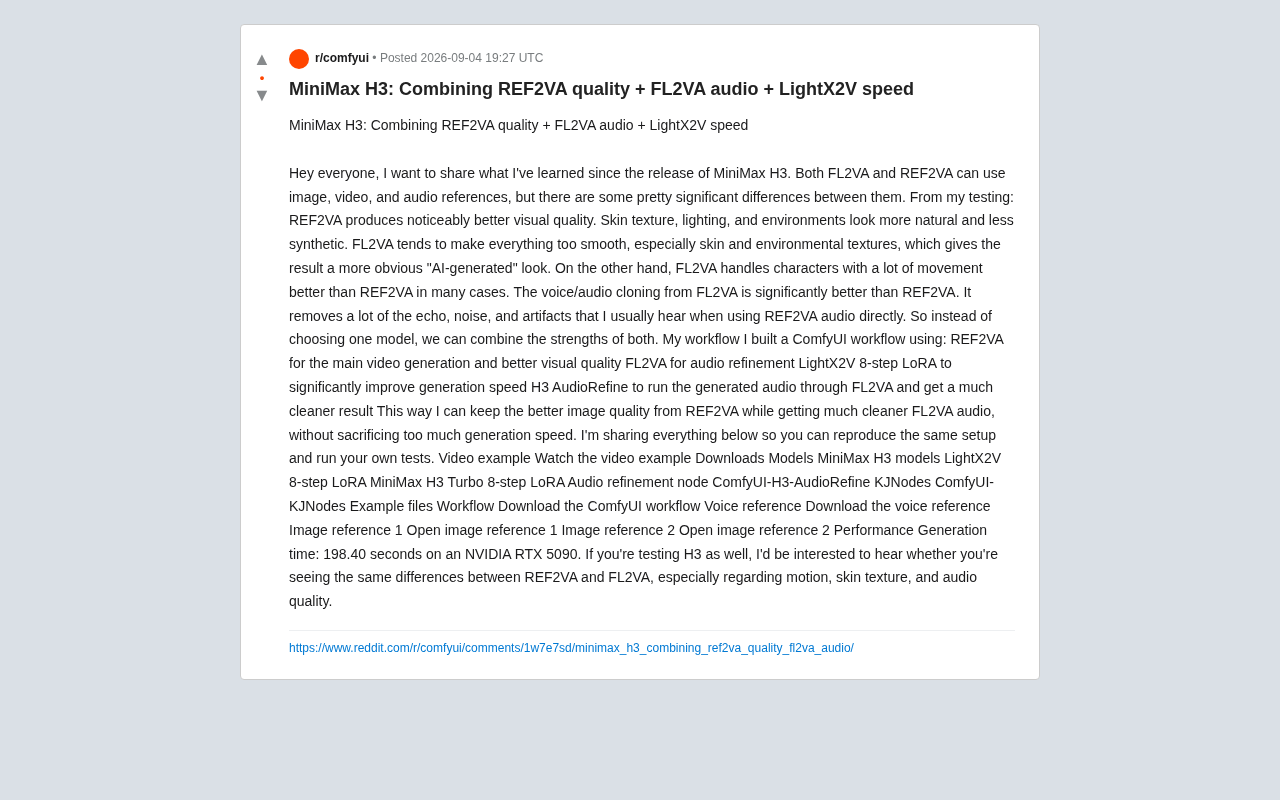
A Reddit user shared his findings after extensive testing, along with a highly valuable combined workflow solution. The core idea is simple yet insightful: rather than choosing between the two models, combine the strengths of both to compensate for each other's weaknesses.
Detailed Comparison of REF2VA and FL2VA: Three Key Dimensions
Visual Quality: REF2VA Takes the Lead
Based on the user's hands-on testing, REF2VA has a clear advantage in visual quality. Whether it's skin textures, lighting effects, or environmental details, the images generated by REF2VA appear more natural, with less of that typical "synthetic look." This is closely related to REF2VA's architecture design based on reference image feature extraction — it can more precisely preserve high-frequency texture information and lighting distribution from the original reference frame, thereby reconstructing more realistic visual details during generation.
By comparison, a prominent issue with FL2VA is that the output looks "overly smooth" — especially skin and environmental textures get over-processed, resulting in more obvious "AI-generated" artifacts. This over-smoothing phenomenon is known as "blurriness" in deep learning, typically caused by the model's tendency to generate mean predictions across pixels during optimization rather than preserving sharp texture edges. For creators pursuing photorealism and cinematic quality, this smoothing effect is often unwelcome.
Motion Performance: FL2VA Is More Stable in Dynamic Scenes
However, the story doesn't end there. When handling characters with large-scale movements, FL2VA often outperforms REF2VA. This is directly related to FL2VA's core architecture based on Optical Flow estimation — Optical Flow is a classic technique in computer vision for describing pixel motion between adjacent frames, modeling displacement vectors for each pixel along the temporal dimension to achieve motion tracking. FL2VA deeply integrates this motion modeling capability into the video generation process, enabling it to maintain better temporal consistency, reduce inter-frame flickering, and minimize motion distortion when handling fast movements, large-scale body actions, and complex camera movements.
This means that if your video contains significant dynamic action, FL2VA may deliver more coherent and stable motion results.
This reminds us that a model's strengths aren't absolute — they depend on the specific use case:
- Static or slow-paced scenes → Better suited for REF2VA
- Intense motion scenes → More reliant on FL2VA's processing capabilities
Audio Cloning: FL2VA Has a Significant Edge
When it comes to audio and voice cloning, FL2VA clearly outperforms REF2VA. The user noted that using REF2VA directly for audio processing often produces echoes, noise, and various artifacts, while FL2VA effectively eliminates these issues and outputs much cleaner audio.
Audio Artifacts are common quality issues in AI audio generation, including echo, metallic noise, frequency cutoffs, and harmonic distortion. These artifacts typically stem from imperfections in the model's frequency-domain reconstruction — particularly in high-frequency regions, where generative models often struggle to accurately reproduce the natural overtone structure of human voice. Voice Cloning technology extracts speaker-specific vocal characteristics (such as timbre, intonation patterns, and prosodic rhythm) and transfers them to new speech content. In multimodal video generation scenarios, audio cloning needs to stay synchronized with the character's lip movements and emotional expressions, placing higher demands on audio quality. FL2VA's advantage in audio processing likely stems from its stronger temporal signal modeling capabilities, enabling better preservation of signal continuity and purity when reconstructing audio waveforms.
For projects requiring voice cloning or character dubbing, this difference is especially critical — noisy, echo-laden audio can significantly drag down the overall production quality.
Building the Combined Workflow: Getting the Best of Both in ComfyUI
Introduction to ComfyUI
ComfyUI is a node-based open-source graphical workflow editor designed specifically for Stable Diffusion and other AI generation models. Unlike traditional WebUIs, ComfyUI organizes generation processes using a Directed Acyclic Graph (DAG) approach, where each node represents an independent computation step (such as model loading, sampling, VAE decoding, etc.), and users connect nodes to form a complete generation pipeline. This architecture naturally supports modular design, allowing users to freely insert custom nodes, LoRAs, ControlNet, and other extension components, greatly lowering the barrier to building complex workflows. The ComfyUI community has developed thousands of custom node packages covering images, video, audio, and many other domains — it's precisely this ecosystem vitality that makes multi-model fusion workflows like the one described here possible.
Core Design Philosophy
Based on the testing conclusions above, this user built a combined workflow in ComfyUI that cleverly merges the advantages of both models:
- REF2VA: Handles primary video generation, ensuring superior visual quality
- FL2VA: Handles audio refinement, outputting cleaner sound
- LightX2V 8-step LoRA: Significantly boosts generation speed
- H3 AudioRefine: Processes the generated audio through FL2VA for purer results
Among these, the LightX2V 8-step LoRA and Turbo 8-step LoRA are distillation-accelerated LoRAs. LoRA (Low-Rank Adaptation) was originally a parameter-efficient fine-tuning technique that injects low-rank decomposition matrices into the weight matrices of pre-trained models to adapt to specific tasks without retraining the entire model. In this context, these LoRAs compress the denoising process — which normally requires dozens of sampling steps — down to just 8 inference steps, dramatically reducing generation time. This technique is typically trained using Progressive Distillation or Consistency Distillation methods, making the few-step model's output approximate the quality of the multi-step model as closely as possible. "8-step" means the model only needs 8 forward passes to complete sampling, saving approximately 70%-85% of computation compared to the standard 25-50 step inference.
Through this combination, creators can retain REF2VA's high image quality while enjoying FL2VA's clean audio, without making too many compromises on generation speed.
Required Components Checklist
The complete workflow depends on the following components:
- MiniMax H3 Model (primary generation model)
- LightX2V 8-step LoRA and MiniMax H3 Turbo 8-step LoRA (acceleration modules)
- ComfyUI-H3-AudioRefine (audio refinement node)
- ComfyUI-KJNodes (utility node collection)
This modular design is the beauty of the ComfyUI ecosystem — each component can be independently replaced and optimized, allowing creators to flexibly adjust according to their needs.
Performance and Hardware Requirements
In terms of performance, this workflow completes a single generation in approximately 198.40 seconds (about 3 minutes 20 seconds) on an NVIDIA RTX 5090 GPU.
The NVIDIA RTX 5090 is a flagship consumer-grade GPU based on the Blackwell architecture, equipped with 32GB of GDDR7 memory and over 21,000 CUDA cores. For AI video generation tasks, VRAM capacity is one of the most critical bottleneck factors — as a multimodal large model, MiniMax H3's parameters and intermediate activations require substantial VRAM during inference. The 32GB of VRAM allows the RTX 5090 to fully load the H3 model and its associated LoRA weights without model quantization or sharding. In comparison, the RTX 4080 with 16GB VRAM or the RTX 4090 with 24GB may need to rely on techniques like FP8 quantization and model offloading when running the same workflow, which would further increase generation time.
Considering that this pipeline integrates processing from two models along with audio refinement, and benefits from LightX2V 8-step LoRA acceleration, this generation time is quite reasonable. However, it's worth noting that the RTX 5090 is a top-tier consumer GPU — users with lower-end hardware may see significantly longer generation times.
This also reflects a reality in the current AI video generation landscape: high-quality output often comes with a substantial computational threshold. For users hoping to replicate this workflow, ample VRAM and a powerful GPU remain unavoidable prerequisites. The demand for VRAM in AI video generation is growing rapidly, and in professional production environments, professional cards with 48GB or more of VRAM (such as the NVIDIA A6000 or H100) remain the more ideal choice.
Combinatorial Thinking: More Important Than Choosing a Single Model
The most valuable takeaway from this case isn't any specific parameter or node — it's the combinatorial thinking behind it. In an era of increasingly abundant AI tools, it's difficult for any single model to be optimal across all dimensions. Rather than agonizing over "which model is better," it's more productive to deeply understand each tool's strengths and weaknesses, then strategically orchestrate them together.
This mindset has a classic analogy in software engineering — the "Unix Philosophy": have each tool do one thing and do it well, then pipe the outputs of different tools together to accomplish complex tasks. ComfyUI's node-based workflow design aligns perfectly with this philosophy, enabling users to combine different models, LoRAs, and post-processing modules like building blocks, constructing the generation pipeline that best suits their needs.
The author also invited community discussion at the end of their post, hoping other testers would share their observations on motion performance, skin textures, and audio quality. This spirit of open sharing and cross-validation is a vital driving force behind the rapid iteration of open-source AI tools.
If you're also using MiniMax H3, consider running this workflow yourself to see if you can reproduce the same results — or discover your own optimal combination.
Key Takeaways
Related articles

The End of .name Domains: Why Personal Brand Digital Assets Are So Fragile
Developer Neil Fraser's .name domain faces extinction, sparking deep discussion in the tech community about digital asset fragility. This article analyzes .name domain history, the rental nature of domains, niche domain risks, and lessons from decentralized identity for personal brand protection.

Lovable CTO's Vision: The Future of SaaS Is Apps That Agents Can Call
Lovable CTO Fabian Hedin argues SaaS will shift from human-facing interfaces to agent-callable capability platforms. Learn how MCP connects AI agents to apps.

OpenAI Declares the AGI Era Has Arrived: Conceptual Controversies and Technical Realities
OpenAI launches GPT-6 Astra claiming the AGI era has arrived, sparking controversy. Deep analysis of AGI definition ambiguity, technical progress realities, industry standards battle, and practical impacts on users and developers.