MiniMax H3 Open-Source All-in-One Package: One-Click AI Comic Drama Workflow

A Bilibili creator packaged MiniMax H3 with Kangfei UI into a free local package that turns novels into AI comic dramas in one click.
The article introduces an AI comic drama integration solution from a Bilibili creator, packaging MiniMax H3, four-step accelerated LoRA, and Kangfei UI (based on ComfyUI) into a free, locally-run workflow. Tests show generation time dropped from about 21 minutes to 8-13 minutes with improved quality. 12GB VRAM with 32GB RAM runs 5-second 480P video; 8GB VRAM also works. The workflow includes five steps plus 588 built-in model configurations.
A New Turning Point for AI Comic Drama Creation
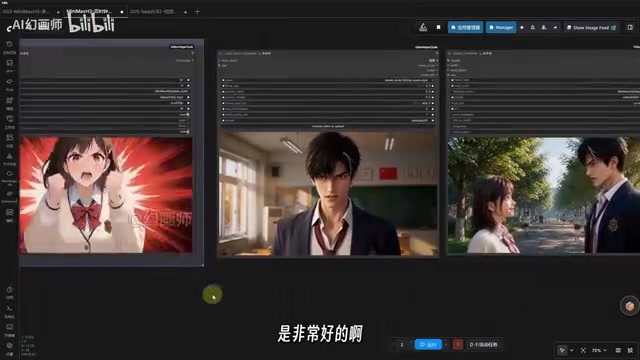
An integrated solution released by a Bilibili creator packages the MiniMax H3 model with the Akiba-Kangfei UI into an out-of-the-box workflow. According to the video demo, users simply drop in a novel and can generate AI comic drama content with synchronized audio and video in one click. The core selling points of this solution are straightforward: free, Chinese interface, no generation count limits, and local execution.
From a technical standpoint, it integrates the MiniMax H3 model, LoRA acceleration modules, and ComfyUI nodes, lowering the technical barrier to AI comic drama creation. What used to require piecing together multiple tools and debugging countless parameters is now compressed into a single decompress-and-use experience.
MiniMax H3 is a video generation large model released by MiniMax (稀宇科技), serving as one of the technical foundations for its Hailuo AI video generation capabilities, supporting text-to-video and image-to-video. Its weights and inference code have been progressively open-sourced in the community, enabling third-party developers to build localized workflows based on it. Compared to pure cloud API calls, local deployment offers the advantages of data never leaving the machine, no per-call billing, and no call frequency limits—but at the cost of higher VRAM and compute requirements. H3 performs notably well in Chinese-language prompt understanding, character motion coherence, and audio-video synchronization, which is why it is widely used for "comic drama" scenarios requiring character performance and dialogue.
ComfyUI is a node-based visual workflow engine for diffusion models. Users build generation pipelines by dragging and connecting different functional nodes (loading models, encoding prompts, sampling, decoding, upscaling, etc.) rather than relying on a fixed form-based interface. Its advantages are reusability, shareability, and fine-grained parameter tuning, with the community distributing workflows as JSON files or all-in-one packages. The "Kangfei UI" mentioned in the article is likely a domestically repackaged version built on top of ComfyUI, featuring a built-in Chinese interface, pre-installed models and nodes, and reduced setup costs for beginners.
Four-Step Accelerated LoRA Brings a Leap in Efficiency
According to the video, an open-source community member (referred to as "Brother Ba T8" by the creator) made MiniMax H3's four-step accelerated LoRA compatible with the Kangfei UI, and developed a dedicated node for dual-ten intermediate sampling to address issues that arose after integration.
In terms of measured data, the creator conducted a comparison using the same reference image, prompt, and parameters:
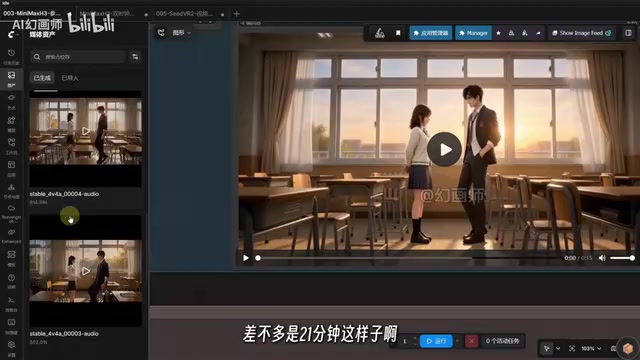
- Before iteration: generation took approximately 1300 seconds (about 21 minutes)
- After four-step accelerated LoRA integration: about 800 seconds (about 13 minutes)
- When running 480P at 400,000 pixels: about 8 minutes
The test conditions were 500,000 pixels with a 15-second duration maxed out. The creator stated that after acceleration, not only was the time reduced, but the generation quality also improved.
LoRA (Low-Rank Adaptation) is a lightweight model fine-tuning technique. Without modifying all the weights of the original large model, it adjusts capabilities by attaching a pair of small low-rank matrices to certain layers of the original model, so file sizes are typically only tens to hundreds of MB. In the diffusion model ecosystem, LoRA has two common uses: one is injecting a specific style or character, and the other is "distillation acceleration" as described here—compressing a process that originally required dozens of sampling steps down to about 4 steps. The basic principle of accelerated LoRA is teaching the model a "large-step jump" mapping from noise to image (or video frame), thereby drastically reducing sampling steps and directly cutting down processing time.
Sampling steps are one of the core variables determining generation time. Diffusion/flow-matching models progressively denoise from random noise during generation, with each step invoking model inference once—more steps mean finer detail but slower speed. The "dedicated node for dual-ten intermediate sampling" likely refers to the author developing a customized sampling node after the original sampling scheduler and step configuration no longer matched following the integration of the four-step LoRA, ensuring stable and consistent visuals even at extremely low step counts.
Feasibility of Running on Low-Spec Devices
The creator cited test results from an official team member of the Kangfei UI: an RTX 360 GPU with 12GB VRAM paired with 32GB of system memory can run 5-second 480P video normally; 8GB VRAM also works. This means users with mid-to-low-end configurations can also try this solution without relying on cloud compute.
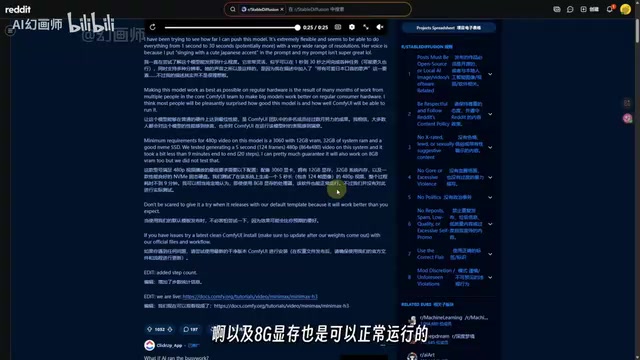
It should be noted that the above data all comes from a single creator's test video, and actual performance may vary across different hardware environments and parameter settings. It is recommended to rely on your own device's real-world testing.
Video generation demands far more VRAM than image generation, because in addition to the model weights themselves, it must cache latent variables along the time dimension as well as intermediate results from attention computations. When VRAM is insufficient, two types of degradation strategies are typically triggered: one is offloading the model or intermediate tensors to system memory and swapping them back in batches as needed, at the cost of slower speed; the other is reducing resolution, duration, or batch size. Therefore, "8GB VRAM can also run it" often means running at shorter durations or lower pixel counts rather than being fully equivalent to higher-end devices. System memory (RAM) is equally critical here—the role of 32GB is primarily to provide buffer space during model offloading, LoRA switching, and data exchange, and insufficient memory can become a bottleneck earlier than VRAM.
Workflow Breakdown
The usage logic of the workflow is fairly clear:
- Select model: configure the model as demonstrated by the creator; the four-step LoRA must be enabled, and CLIP V1 remains unchanged
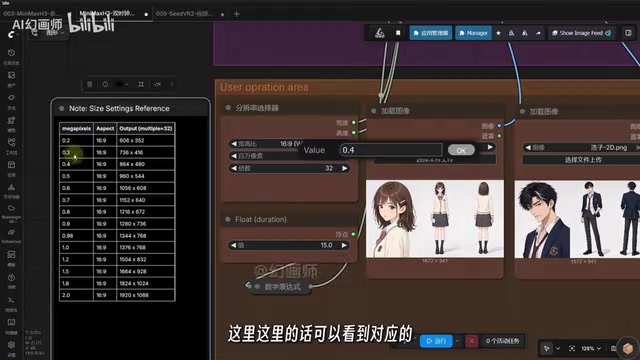
- Upload assets: upload reference images in the user operation area
- Adjust resolution: choose pixel values based on your own configuration. Those unsure about their setup can lower it; the workflow annotates the correspondence between parameters and resolution
- Set duration: video seconds can be maxed out to 15 seconds; the node also supports uploading reference videos and reference audio
- Prompt generation: the creator provides a companion agent—submit the MiniMax H3 prompt generation document to the agent, input a rough plot, and receive output in a format compliant with the official prompt guide
If you are unsatisfied with the generated resolution, there is also a separate video high-definition upscaling workflow—upload a low-pixel video and click run.
What This Solution Means
The core pain point of the AI comic drama track has always been the fragmentation of storyboard generation, character consistency, audio-video synchronization, and post-production editing. This all-in-one package attempts to connect the entire chain from text to finished video within a single workflow, making "novel in, video out" a reality.
The package comes with 588 curated AI functional model configurations built in, enabling batch output mode. The "no review" feature emphasized by the creator in the video refers to local execution being free from cloud content moderation restrictions—this is both a technical characteristic and an implication that users need to manage content compliance themselves.
From a broader perspective, MiniMax H3's continuous iteration in the open-source community (LoRA acceleration, node optimization) is rapidly closing the experience gap between open-source solutions and closed-source commercial products. When the cost of generating a 15-second video drops from 20 minutes to 8 minutes, the economics of batch creation change entirely.
For creators looking to enter the AI comic drama space, the barrier is indeed visibly lowering. But tools are only the starting point—script quality, storyboard design, and character development remain the key variables determining whether a work is good or bad.
Character consistency is the core challenge distinguishing AI comic dramas from ordinary AI short videos. The same character must maintain consistent facial features, hairstyle, clothing, and art style across multiple storyboards, otherwise the audience will feel like the character has been "swapped." Common approaches include: using reference images + image-to-video to lock in appearance, using LoRA to solidify character features, or repeatedly anchoring appearance descriptions in prompts. The addition of reference video and reference audio nodes provides controllable inputs for lip-sync with dialogue and motion continuity.
It is worth noting the dual nature of the "local execution without cloud moderation" feature: it does remove platform restrictions on themes and content, making creation freer, but it also means the responsibility for content compliance falls entirely on the user. When copyrighted material, real-person likenesses, or sensitive topics are involved, the risk is borne by the creator. This is also a precondition that is often emphasized but easily overlooked when such open-source all-in-one solutions are shared.
One-line Summary
A Bilibili creator packaged MiniMax H3 with Kangfei UI into a free local all-in-one package that turns novels into AI comic dramas in one click.
Paragraph Summary
The article introduces an AI comic drama integration solution released by a Bilibili creator, packaging the MiniMax H3 video model, four-step accelerated LoRA, and Kangfei UI (based on ComfyUI) into an out-of-the-box local workflow, featuring free access, a Chinese interface, and no generation count limits. Measured tests show that after integrating the four-step accelerated LoRA, generation time under the same conditions dropped from about 21 minutes to about 8 to 13 minutes, with improved quality. Official team testing indicates that 12GB VRAM paired with 32GB RAM can run 5-second 480P video, and 8GB VRAM also works. The workflow covers five steps—selecting a model, uploading assets, adjusting resolution, setting duration, and prompt generation—and comes with 588 model configurations supporting batch output. The author believes this is rapidly closing the experience gap between open-source and closed-source solutions, but emphasizes that script, storyboard, and character development remain key to work quality.
Related articles

Why Does the Tesla Roadster Need to Fly? A Deep Dive into Musk's Wild Demo
Tesla's Roadster launch showed wall-climbing, upside-down driving, and flying stunts—but The Vergecast notes the demo car may lack a battery, the Rocket version is invite-only and not street-legal, and the website terms don't guarantee delivery. After nine years of delays, why does this car still need to exist?

AI Is Not a Replacement: Human-AI Collaboration Through the Lens of Factory Root Cause Analysis
Starting from factory root cause analysis, this article explains how AI accelerates evidence chain construction rather than replacing human experts, exploring the pragmatic implementation logic and business value of 'AI supporting people rather than replacing them.'

AI Agent Decision Auditing: Building an Evidence Chain in Regulated Workflows
Starting from a Reddit discussion, this article analyzes three core issues in AI agent decision auditing within regulated workflows: what fields audit records should contain, how to handle feedback latency for erroneous decisions, and how to continuously calibrate LLM judge consistency with human judgment.