MiniMax H3 REF: A SOTA-Level Image Editing Model That Generates Native 4K Images in One Minute

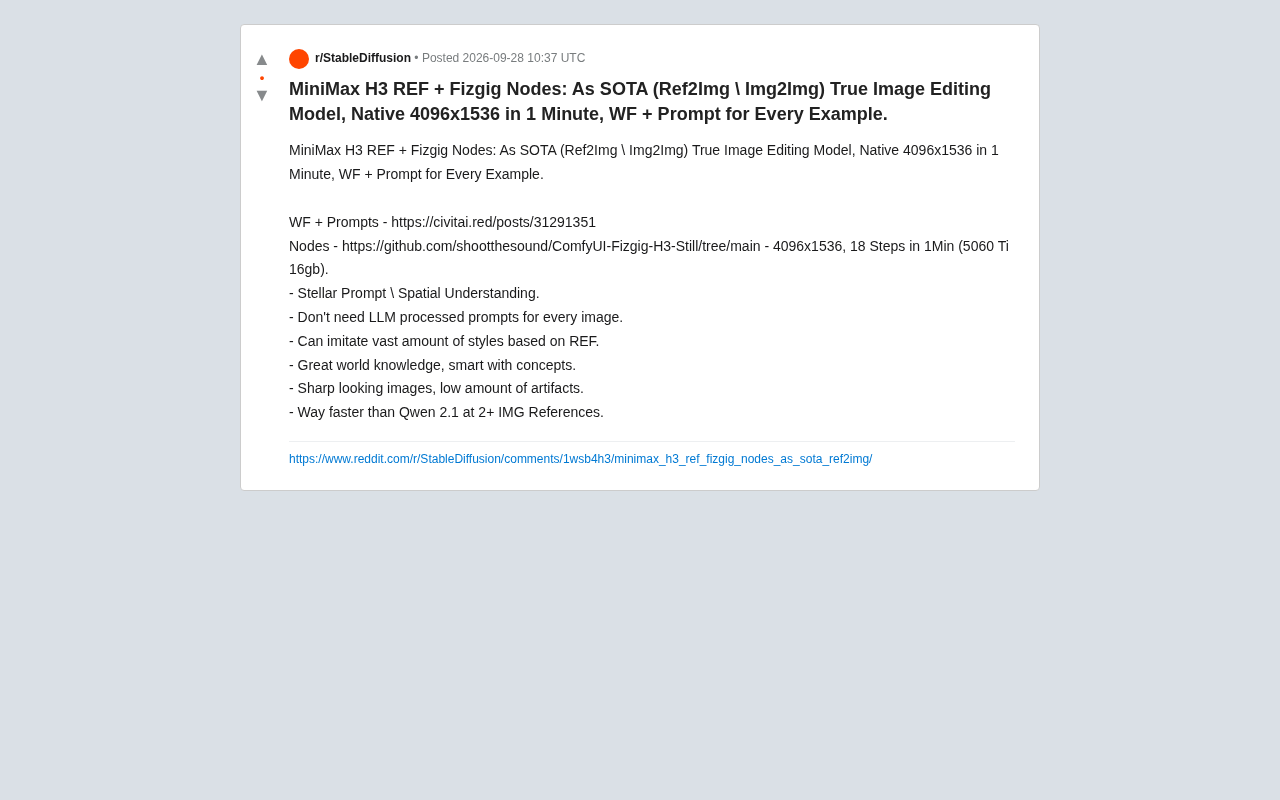
MiniMax H3 REF + Fizgig nodes generates native 4K images in ~1 min on mid-range GPUs with multi-reference editing.
MiniMax H3 REF is an image editing model built around Ref2Img, strong spatial understanding, and prompt-following — all without requiring LLM pre-processing. Running on a Fizgig-powered ComfyUI workflow, it natively outputs 4096×1536 images in about one minute on an RTX 5060 Ti 16GB. The poster reports it outpaces Qwen 2.1 on multi-reference tasks, though no standardized benchmarks are provided. All workflows and per-example prompts are publicly available on Civitai, making it straightforward for mid-range GPU users to test reference-based editing firsthand.
MiniMax H3 REF paired with Fizgig nodes is rapidly becoming one of the most-discussed image editing solutions in the ComfyUI community. This combination bills itself as a "true image editing model," with a focus on Ref2Img (reference-to-image) and Img2Img capabilities. Its biggest selling point is the ability to natively output 4096×1536 high-resolution images in roughly one minute — all on a mid-range GPU.
Performance: Native 4K Output in One Minute
According to benchmark data shared by the original poster on Reddit, MiniMax H3 REF can produce a native 4096×1536 image on a single RTX 5060 Ti 16GB GPU in just 18 sampling steps, taking approximately one minute. What makes this significant is that it's not a pseudo-4K image stitched together through post-processing upscaling — it's natively generated by the model itself, which means stronger guarantees on detail consistency and structural coherence.
For users accustomed to the tedious cycle of generating at lower resolutions and then repeatedly upscaling and patching, native 4K-level output on a mid-range card is a genuinely practical combination. The original poster specifically noted that outputs are "sharp" with minimal artifacts — no small feat when the long edge exceeds 4,000 pixels.
Ref2Img and Spatial Understanding
MiniMax H3 REF is positioned as a "true image editing model," with its core capabilities built around reference images. The poster highlighted several key features:
- Strong prompt following and spatial understanding: The model handles spatial relationships described in prompts well (who is where, how objects are arranged) — a known weakness in many generative models.
- No LLM pre-processing required: Unlike some workflows that first use a large language model to rewrite or expand prompts, you can feed prompts directly and get consistent results, reducing workflow complexity.
- Strong style mimicry: Using a reference image, the model can replicate a wide variety of visual styles, making it well-suited for editing tasks that require maintaining a consistent aesthetic.
- Solid world knowledge and conceptual understanding: The model handles abstract or compositional descriptions intelligently.
Taken together, these features make H3 REF better suited as an editing tool rather than a pure text-to-image model — its value lies in "making controlled modifications to existing material," not just generating from scratch.
Background: What Is Ref2Img? Ref2Img (Reference-to-Image) is a task paradigm in image generation where one or more reference images are used as conditional inputs to guide the model in producing new images that share certain properties — content, style, or structure — with the reference. It differs from traditional Img2Img in that Img2Img typically adds noise to the input image before denoising it, producing results highly correlated with the original. Ref2Img, by contrast, focuses on "extracting specific attributes from the reference (such as character appearance, scene mood, or visual style) and transferring them to a new composition," which demands stronger semantic understanding and disentanglement. Spatial understanding refers to the model's ability to accurately parse positional relationships in prompts (e.g., "a person standing on the left," "indoor background") — a common weakness in diffusion models that often requires ControlNet or additional layout guidance to address. H3 REF claims native support for both of these capabilities, suggesting its training data and objectives were specifically optimized for editing scenarios rather than relying on external plugins as a patch.
Multi-Reference Image Comparison with Qwen
One explicit comparison the poster raised is that when using two or more reference images, MiniMax H3 REF is noticeably faster than Qwen 2.1. Multi-reference image tasks are a frequent need in image editing — for example, simultaneously referencing a character, a scene, and a style image for compositing — and this type of task typically places higher demands on VRAM and inference time.
It's worth noting that this comparison comes from a single source's subjective testing and does not provide standardized benchmarks under identical hardware and parameter conditions. The conclusion that it's "faster" can serve as a directional reference, but the actual margin should be verified by users within their own workflows.
Background: Qwen and Multi-Reference Tasks The Qwen 2.1 referenced here refers to Alibaba's open-source Qwen2.5-VL multimodal model series' image generation branch (or its derived image editing workflows), which has gained traction in the ComfyUI community for complex editing tasks requiring multimodal understanding. The reason multi-reference image tasks have such a significant impact on inference speed is that each additional reference image increases the context length during the attention computation phase, causing VRAM usage and compute to grow non-linearly. Different models handle multi-reference images through different architectural strategies — some concatenate tokens, others inject through cross-attention layers — leading to meaningful efficiency differences. This context helps explain why "number of reference images" becomes a key variable in speed comparisons between models.
Fizgig Nodes and the Open-Source Workflow
This setup is built on the open-source ComfyUI-Fizgig-H3-Still nodes, with the workflow files (WF) and the corresponding prompts for each example published on Civitai. The poster "included both the workflow and prompt for every single example," which makes community reproduction significantly easier — users can download the workflow directly, study the prompts to understand the model's best practices, and skip the trial-and-error of figuring out parameter configurations from scratch.
The combination of open-source nodes + public workflows + per-example prompts is what sets this share apart from a typical "showcase" post. Reproducibility is front and center, and it makes it much easier for other users to judge whether this solution fits their own hardware and needs.
Background: ComfyUI and Custom Nodes ComfyUI is currently the most widely used open-source Stable Diffusion visual workflow framework, featuring a node-based editing interface where users build generation pipelines by connecting different functional nodes — no coding required. "Custom Nodes" are the core extension mechanism of its ecosystem — developers can package functionality such as model loading, sampling strategies, and image preprocessing into standalone node packages and open-source them, which community users can then install and call directly in their own workflows. The Fizgig nodes are exactly this type of extension, custom-built for MiniMax H3 REF to handle input adaptation, reference image injection, and resolution control. Civitai is the community's go-to platform for sharing models and workflows, supporting direct download of
.json-format ComfyUI workflow files that, combined with prompts, enable one-click reproduction — dramatically lowering the cost of sharing knowledge across users.
How to Think About This Solution
The MiniMax H3 REF + Fizgig combination demonstrates meaningful progress in the open-source image editing ecosystem across three dimensions: native high resolution, multi-reference image support, and a low hardware barrier. Its positioning is clear — it targets users who need controlled, reference-based editing without being bottlenecked by high-resolution output speeds.
That said, all performance and quality claims in this piece come from the original poster's unilateral testing, and the "SOTA" label deserves particular skepticism given the lack of third-party cross-model evaluations. For users interested in trying it out, the best approach is to grab the public workflow and prompts and run a real task in your own environment — let the results speak for themselves.
Related articles

JobRunner MCP Server: AI Agents Can Now Fix Failed Java Jobs
JobRunner launches an open-source MCP server enabling AI agents to view cluster status, diagnose failures, and recover Java jobs—incident response from any cloud coding environment or existing agent.

MLAI Digital Launches 9 Security Agents: MCP Server Safeguards the Full Lifecycle of Agentic AI
MLAI Digital launches Security MCP Server with nine built-in specialized security agents covering vulnerability discovery, attack simulation, prompt injection detection, API and infrastructure assessment, and accelerated remediation—embedding security validation across the full Agentic AI lifecycle from development to production.

Running Isaac Lab on H100 GPUs: Exploring Better Approaches
Exploring optimization methods for running Isaac Lab on NVIDIA H100 GPUs, including MIG configuration, mixed precision, TensorRT acceleration, and community experience to improve robotics simulation and reinforcement learning efficiency.