MiniMax H3 Video Generation Faster Than Playback: 10-Second Real-Time AV Synthesis in Just 8.7 Seconds

MiniMax H3 generates a 10.1-second audio-visual video in just 8.7 seconds, breaking the real-time barrier.
MiniMax's H3 model achieves a landmark milestone: generating a complete 10.1-second video with synchronized audio in just 8.7 seconds, surpassing real-time playback speed for the first time. This breakthrough results from a three-way collaboration between MiniMax's multimodal H3 model, the vLLM-Omni inference framework, and FastVideo's open-source FastH3 acceleration solution, with NVIDIA hardware support. The achievement signals a paradigm shift from offline batch processing toward real-time interactive video generation.
When Video Generation Outpaces Playback Speed
Video generation technology has long faced an awkward reality: producing a mere few seconds of video often requires waiting several minutes or even longer.
Background on Video Generation Technology: Traditional video generation relies on Diffusion Models, which generate image or video frames by progressively denoising random noise. Each frame requires tens to hundreds of iterative computation steps, and a few seconds of video typically contains dozens or even hundreds of frames. This computation-intensive nature, combined with temporal coherence constraints (adjacent frames must maintain smooth transitions), makes the computational demands of video generation far exceed those of static image generation. Even on high-performance GPUs, generating a 5-10 second video often requires several minutes of waiting, severely limiting the possibilities for interactive applications.
A recent breakthrough demonstration is rewriting this landscape — a complete 10.1-second MP4 video, including visuals and synchronized audio, was rendered in just 8.7 seconds.
In other words, video generation speed has surpassed the video's own playback duration for the first time — we've crossed the threshold of "real-time video generation." This achievement was made possible through multi-party collaboration: MiniMax's H3 model serves as the core engine, running on the vLLM-Omni inference framework, combined with FastVideo team's open-source FastH3 acceleration solution, with continuous support from NVIDIA in hardware and joint optimization.
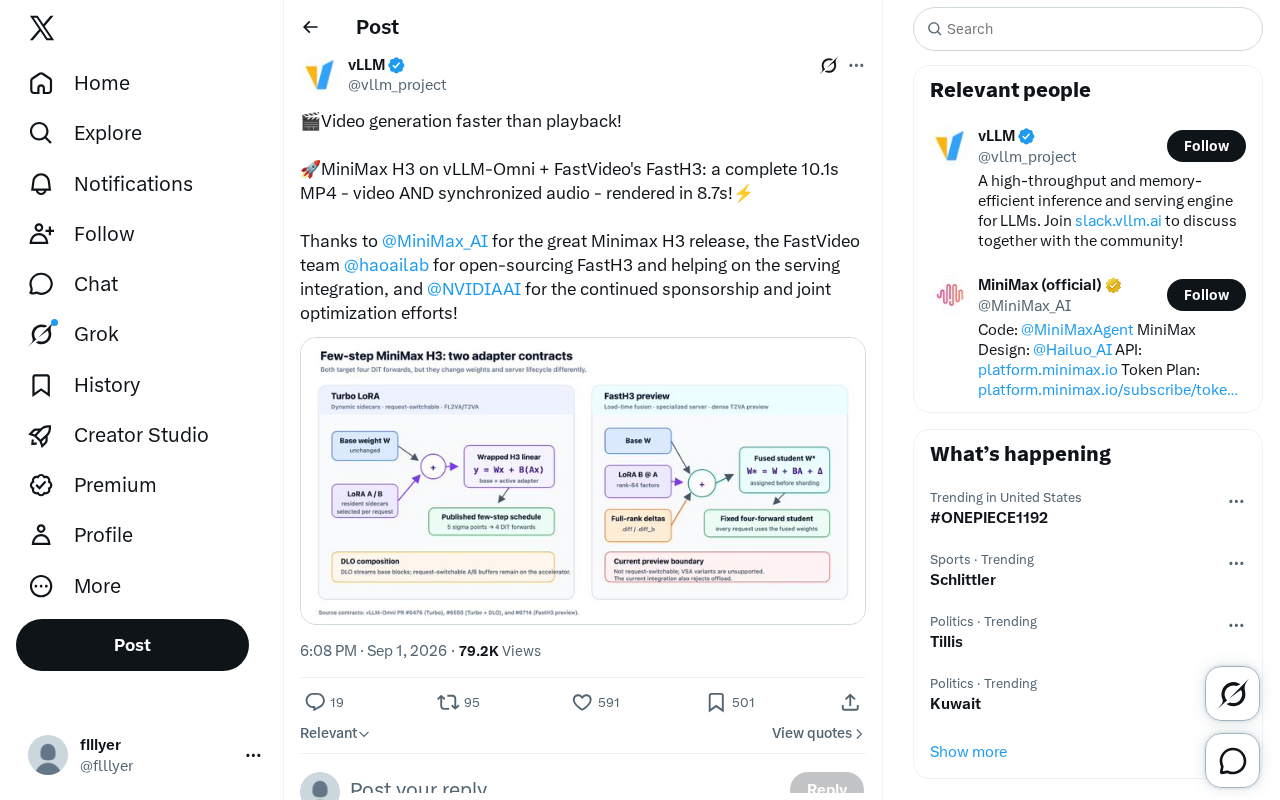
Technical Breakdown: The Multi-Party Acceleration Pipeline
What makes this demonstration noteworthy isn't just the speed figures themselves, but the complete and reproducible acceleration pipeline it reveals. The entire solution consists of three critical components, each indispensable.
MiniMax H3: Multimodal Audio-Visual Synchronized Generation Model
MiniMax H3 is the underlying engine powering this capability. Unlike traditional video models that only generate visuals, H3 can simultaneously generate video frames and a synchronized audio track. Audio-visual synchronization has long been a recognized challenge in the video generation field — visuals and sound must be precisely aligned on the timeline, as any delay or misalignment is immediately perceivable by human eyes and ears. H3 integrates this capability into a single generation pipeline, laying the foundation for an end-to-end real-time experience.
MiniMax and H3 Model Deep Dive: MiniMax is an AI company focused on large model technology, having previously built a solid reputation in the industry with its text generation and multimodal capabilities. The H3 model is their latest video-audio joint generation model, employing an end-to-end multimodal architecture. Unlike most video generation models on the market (such as Runway, Pika, etc.) that only output silent visuals, H3 can synchronously generate matching audio tracks based on video content — for example, adding footstep sounds to walking movements, or water sounds to splashing water. This audio-visual synchronization capability requires the model to learn deep correspondences between visual and auditory signals during training, representing a frontier exploration in multimodal generation.
vLLM-Omni: High-Efficiency Inference Framework for Multimodal Tasks
vLLM is a widely recognized high-performance framework in the LLM inference space, known for its memory management (such as PagedAttention) and throughput optimization. vLLM-Omni is its extension into the multimodal domain, specifically designed for generation tasks that simultaneously process multiple data streams like video and audio. Deploying H3 on vLLM-Omni means the model can fully leverage framework-level scheduling and parallel optimization during actual serving, rather than remaining at theoretical lab speeds.
vLLM Technical Deep Dive: vLLM is a high-performance LLM inference framework open-sourced by the UC Berkeley team. Its core innovation is PagedAttention technology — borrowing from the paged memory management concept in operating systems, it dynamically allocates and reclaims KV cache for the attention mechanism in fixed-size blocks. This design dramatically reduces memory fragmentation and VRAM usage, enabling a single GPU to handle larger batch sizes and significantly improving throughput. vLLM-Omni is the framework's extension for multimodal scenarios, supporting efficient scheduling of non-text data streams like video and audio, transferring optimization techniques originally designed for language models to the video generation domain.
FastVideo's FastH3: Specialized Inference Acceleration Solution
FastH3, open-sourced by the FastVideo team (haoailab), is a specialized inference acceleration solution tailored for the H3 model. Video generation typically relies on multi-step iterative sampling in diffusion models — more steps yield higher quality but longer processing times. FastH3 dramatically reduces the computational steps required for generation through techniques like distillation, step compression, and cache reuse, while preserving output quality as much as possible. This is the component that compressed generation time to below playback duration.
Diffusion Model Acceleration Technical Deep Dive: Standard diffusion models (such as DDPM, DDIM) typically require 50-1,000 sampling steps to generate high-quality output, with each step involving a complete neural network forward pass. Step compression techniques aim to achieve comparable quality with fewer steps. Key approaches include: Distillation — training a "student model" to mimic the output distribution of a "teacher model" with fewer steps; Consistency Models — directly learning single-step or few-step mappings from noise to clear images; and Latent Diffusion — performing the diffusion process in a low-dimensional latent space rather than pixel space. FastH3 applies a combination of these techniques to dramatically reduce the inference steps of the H3 model, achieving near real-time generation speed.
What "Faster Than Playback" Means for the Industry
Generating a 10.1-second video in 8.7 seconds — this ratio (approximately 0.86x real-time) may seem like just an engineering metric, but its industry implications are far-reaching.
Opening the Door to Streaming Video Generation
When generation speed exceeds playback speed, it becomes theoretically possible to generate and play simultaneously — users don't need to wait for the entire video to finish rendering before the visuals start streaming out. This mirrors the buffering logic of video streaming services, except the content is no longer pre-recorded but created in real time.
Streaming Generation Technical Details: "Generate-while-playing" streaming video generation is not as simple as frame-by-frame output. Video diffusion models typically generate in a compressed latent space, requiring a VAE decoder (Variational Autoencoder Decoder) to reconstruct latent vectors back into pixel-level visuals. The traditional approach waits until all frames' latent vectors are generated before decoding them all at once, whereas streaming generation requires parallelizing the decoding process with the generation process — already-generated frames begin decoding and outputting while earlier frames are still being denoised. This demands precise pipeline scheduling and memory management to avoid blocking caused by dependencies between frames. vLLM-Omni's scheduling capabilities and FastH3's optimization strategies together support this streaming output possibility.
Lowering the Barrier for Interactive AI Content
Real-time video generation is a prerequisite for building applications like interactive virtual avatars, real-time game visuals, and dynamic advertisements. Only when generation latency falls below the user's perceptible waiting threshold do these scenarios become commercially viable.
Transforming the Cost Structure of Video Generation
Faster generation speeds directly correspond to shorter GPU compute time. The same hardware resources can serve more requests per unit of time, thereby amortizing the cost of each generation. This is crucial for enterprises looking to deploy AI video generation services at scale.
Commercial Reality Check: Despite rapid technical progress, the commercialization of AI video generation still faces multiple challenges. First is cost: even if single generation time shrinks to 10 seconds, the underlying GPU compute costs remain substantial — a single H100 inference call may cost several cents to several dozen cents in the cloud, and scaled services require massive hardware investment. Second is quality consistency: current models perform well in simple scenarios (single subjects, static backgrounds) but still show noticeable artifacts when dealing with complex motion, multi-object interactions, or long-duration coherence. Finally, there are copyright and safety concerns: intellectual property ownership of generated content, deepfake risks, and content moderation mechanisms are all compliance issues that must be resolved for commercial deployment. Therefore, "real-time generation" is more of a technical feasibility breakthrough, and reaching large-scale commercial application still requires continuous optimization across cost, quality, compliance, and other dimensions.
The Ecosystem Significance Behind Open-Source Collaboration
Notably, this achievement wasn't a closed internal demo from a single company, but a quintessential example of open-source ecosystem collaboration: MiniMax released open model weights, the FastVideo team open-sourced their acceleration solution and assisted with service integration, and NVIDIA provided hardware sponsorship and joint optimization.
This "Model — Framework — Hardware" three-layer division of labor is becoming the norm in the AI infrastructure space:
- Model developers focus on pushing the boundaries of capability
- Inference framework teams focus on maximizing engineering efficiency
- Hardware vendors focus on unleashing underlying computational performance
When all three align around the same goal, the result is often a comprehensive breakthrough that would be unattainable by any single team. For developers, the open-sourcing of solutions like FastH3 also means this acceleration capability isn't an unreachable black box, but a public asset that can be studied, reproduced, and further improved.
A Measured Perspective: The Distance from Demo to Deployment
While celebrating this milestone, it's important to maintain a healthy dose of caution. The current demonstration is still a 10.1-second short video, and its resolution ceiling, stability in complex scenarios, and whether the same speed can be sustained under high-concurrency serving all require further data validation.
The Reality of Hardware Dependencies: Achieving "faster than playback" video generation places extremely high demands on hardware. This demonstration most likely used NVIDIA's latest generation of data center GPUs (such as the H100 or the upcoming B-series), which feature hundreds of TFLOPS of FP16/BF16 floating-point compute, up to 80GB of VRAM, and Tensor Core units specifically optimized for Transformer workloads. Video generation models typically have parameters in the billions or even tens of billions, and each frame requires processing massive spatial-temporal attention computations. On consumer-grade GPUs (such as the RTX 4090), inference speed for the same model could be 5-10x slower. Therefore, the current "real-time" capability is more of a technical validation under high-end hardware configurations, and there's still a considerable gap before ordinary developers or consumers can replicate it at low cost.
That said, the symbolic significance of this milestone cannot be underestimated. It marks AI video generation's transition from an "offline batch processing" mindset toward a "real-time interactive" paradigm. When generation speed is no longer the bottleneck, the relationship between creators and AI becomes more immediate and fluid. It's foreseeable that application innovations centered around real-time audio-visual generation will likely emerge in rapid succession in the coming period.
Related articles

iPhone Duo Battery Life Tested: One Charge a Day Is Unavoidable, and the Large Screen Is the Culprit
iPhone Duo battery test: heavy use needs at least one charge a day, and about 30% remains after 6.5 hours of screen-on time. How often the large screen is unfolded is key; a MagSafe battery pack helps, and long-term degradation is also worth watching.

Kimi K3.1 Pro Open-Sourced: 2.8 Trillion Parameters Close In on Opus
Moonshot releases the open-source MoE model Kimi K3.1 Pro, with 2.8T total parameters and 104B activated, trailing Opus 5.5 by under 1 point on Terminal Bench 4.0.

Costco Tech Price Guessing: Are Monitors, Keyboards, Mice, and Bose Speakers Worth It?
A YouTube blogger guesses prices of Costco tech products: 2K 180Hz monitor, Logitech keyboard and mouse, Bose speaker, and CyberPower UPS, revealing warehouse-store selection and brand premium.