MiniMax M2.5/M2.7 Retirement: M3 API Migration Guide and Cost Analysis

MiniMax M2.5 and M2.7 will retire on November 18, 2026, and developers need to migrate to M3.
MiniMax has announced the retirement timeline for M2.5 and M2.7: no longer available to new users starting October 19, 2026, and officially discontinued on November 18, with an official recommendation to migrate to M3. The article outlines the core migration work, including confirming the M3 model ID, checking request parameter and response format compatibility, comparing output quality and latency, and evaluating changes in pricing, context windows, and rate limits. Because public material does not provide specific pricing or API change details for M3, the author recommends that developers consult official documentation early, validate in a test environment, and control risk through canary releases and retained rollback paths, avoiding a rushed launch before the hard deadline.
Event Overview: MiniMax Model Retirement Timeline
According to an RSS source, MiniMax has announced the retirement plan for its M2.5 and M2.7 models: starting October 19, 2026, these two models will no longer be available to new users; on November 18, 2026, they will officially be discontinued. The company recommends that users migrate to the M3 model before then.
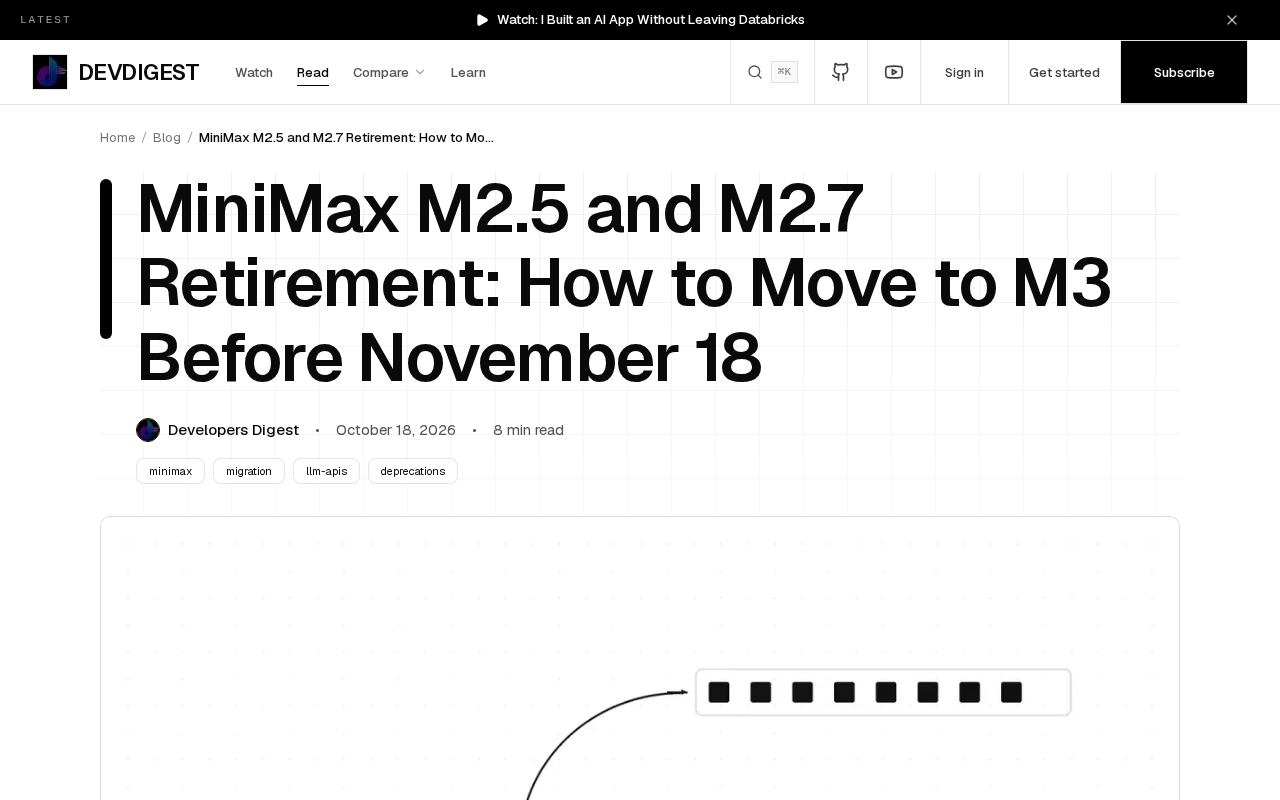
This timeline gives existing users roughly a one-month window (from the cutoff for new user registrations to full retirement), but given the actual workload of API integration, testing, and cutover, developers need to plan early.
Models That Need Migration and Their Replacements
According to the original information, this retirement involves two model IDs: M2.5 and M2.7. The officially recommended migration target is M3. Developers currently using these two models need to replace the model identifiers in their code with the corresponding M3 ID.
Although the original text does not fully list the exact strings for all model IDs, it clearly identifies "which model id to switch to" as one of the core migration questions. Developers are advised to check the official MiniMax documentation for the exact M3 model ID and to validate it in a test environment first.
Model IDs and API Version Management
In most large-model APIs, the "model ID" is the string value of the model field in the request body (such as minimax-m2.5 or a date-stamped version number), and it determines which weights and inference configuration the server routes to. Vendors typically adopt one of two naming strategies: a stable alias (such as m2) that points to the latest minor version, or an immutable snapshot (such as m2-2025xxxx) that guarantees long-term behavioral consistency. When migrating, whether to prefer the stable alias or the snapshot depends on how much output determinism the business requires—production systems generally pin snapshots, while test environments use aliases to detect changes early. In addition, some platforms decouple the model ID from the API version (endpoint path), so changing models does not require changing the SDK version; others require upgrading the SDK in tandem, in which case client library compatibility needs attention. It is advisable to centralize model identifiers in code as environment variables or constants rather than scattering them across many places, so that a retirement cutover requires changing only one location.
API Changes and Migration Steps
The original material mentions that "the exact API change" is one of the key points of the announcement, but it does not provide specific change details. Based on general model migration experience, possible change points include:
- Model ID replacement: the model field in request parameters needs to be updated to the M3 identifier.
- Parameter compatibility: M3 may introduce new parameters or deprecate old ones, so the request body needs to be checked.
- Response format: there may be subtle differences in output structure that require adjusting parsing logic.
Recommended migration steps:
- Confirm M3 availability and the model ID in the MiniMax console.
- Replace the model ID with M3 in the development environment and run existing test cases.
- Compare output quality and latency between M2.5/M2.7 and M3.
- Roll out production traffic gradually and monitor error rates and cost changes.
- Complete the full migration before November 18.
Cost Considerations: Does Migration Mean a Price Increase?
The original title mentions "what it costs," indicating that cost is a key factor in the migration decision. However, the source material itself does not provide specific pricing data for M3. Before migrating, developers should focus on comparing the following dimensions:
- Per-token price: whether input and output token prices change.
- Context window: whether M3 supports a larger context, which affects costs for long-text scenarios.
- Call limits: whether rate limits are adjusted, which may affect the architecture of high-concurrency applications.
If M3 is priced higher than M2.5/M2.7, developers need to assess whether the post-migration unit economics still hold, and if necessary optimize prompt length or introduce caching strategies.
Token Billing and Context Windows
Large-model APIs typically bill by token, and input (prompt) and output (completion) prices are often different—output is usually more expensive. A token is the smallest unit of text produced by the model's tokenizer; in English, about 4 characters correspond to 1 token, while for Chinese it depends on the tokenizer, typically about 1–2 tokens per Chinese character. Billing also includes hidden inputs such as system prompts, conversation history, and tool definitions, and in long-context scenarios this overhead can far exceed the user-visible text. The context window refers to the maximum number of tokens (input plus output) that a single request can accommodate; the larger the window, the more long documents can be processed, but the higher the cost per call. Some vendors use tiered pricing or charge extra for portions exceeding the base window. Therefore, when comparing the cost of M3 with M2.5/M2.7, you cannot look only at the list price per million tokens; you also need to estimate the real bill based on actual prompt length distribution, output length, and cache hit rate.
Impact on Developers and Recommendations
Model retirement is not uncommon in the AI API ecosystem, but for production systems that depend on specific model behavior, migration often brings uncertainty and additional engineering effort. A few practical recommendations:
- Don't wait until the last minute: November 18 is the hard deadline, but new users were already cut off on October 19, which means community support and documentation updates may shift to M3 early.
- Keep rollback capability: before fully switching, retain the call path for the old models in case M3 performs worse than expected in certain scenarios.
- Watch for output quality differences: different model versions may produce different output styles for the same prompt, especially for tasks involving structured output or specific instruction following; it is advisable to build automated evaluations.
For new projects that are not yet using M2.5/M2.7, adopting M3 directly is the more reasonable choice, avoiding another migration in the near future.
Canary Releases and Rollback
A canary release means first directing a small proportion of production traffic to the new model, observing for a period, and then gradually expanding—a standard practice for reducing model migration risk. Implementation usually relies on a gateway or feature flags to split traffic by user ID, request proportion, or tenant dimension, along with monitoring of metrics such as error rate, latency percentiles (P50/P95/P99), output refusal rate, and token consumption. Rollback capability requires that the old model's call path remain available during the switch and that configuration can be switched back immediately—which often means the model ID cannot be hard-coded but should be delivered dynamically through a configuration center. Because model behavior differences may surface only on specific inputs, the canary period should also run offline evaluation sets in parallel, automatically comparing outputs from the old and new models. It is worth noting that in the retirement announcement, the date for "ceasing new user access" is earlier than the "official discontinuation," so the canary window is actually compressed; testing and ramp-up plans should be scheduled backward from that date.
Summary
MiniMax's model retirement provides clear dates and a migration direction, but the public material lacks specific pricing and API change details for M3. The immediate priorities for developers are to confirm the M3 model ID, test compatibility, and complete the switch before November 18. On cost, it is advisable to make detailed comparisons based on the official pricing page rather than relying on secondhand information.
Related articles

AI New Grad Resume Diagnosis: How to Stand Out for ML/CV Roles?
How can AI/ML new grads optimize their resumes to get interviews? Based on a real Reddit case, this article analyzes project selection, depth display, and structure for ML/CV roles, with actionable revision advice.

OpenAI Opens Up Decision Models as Competition with Jev Heats Up
OpenAI makes its decision model widely available, directly challenging first mover Jev. We analyze the impact on the decision model competitive landscape and key considerations for developers and enterprises.

Startup Growth Secrets: Early Sales Are Not the Key
At Disrupt, experts from Lovable, Polska, and Theory Ventures said early startup growth depends not on early sales but on a repeatable sales process, a clear ICP, team development, and data-driven iteration.