Mira Murati's Testimony Reveals the Truth Behind Altman's Firing from OpenAI

Murati's testimony reveals the inside truth behind Altman's firing by OpenAI's board
Before Thanksgiving 2023, OpenAI CEO Altman was abruptly fired by the board for being "not consistently candid." Former CTO Mira Murati's sworn testimony in the Musk v. Altman case reveals for the first time the internal details of this power transition. The lawsuit's discovery process has broken Silicon Valley's customary wall of secrecy, exposing deep governance contradictions in AI companies between nonprofit missions and commercial interests.
The AI Industry Shockwave Before Thanksgiving 2023: Altman's Sudden Removal
One week before Thanksgiving 2023, the AI industry experienced its most dramatic moment in history. OpenAI CEO Sam Altman was abruptly removed from his position by the board of directors, and the internal power struggle at the creator of ChatGPT stunned the entire tech world. The board's explanation was simply that Altman was "not consistently candid in his communications with the board."
This brief and vague statement sparked endless speculation, with outsiders offering countless theories about the real reasons behind the firing. Now, through witness testimony and trial evidence in the Musk v. Altman case, the public finally has an opportunity to glimpse the truth behind this power transition.
OpenAI's Unique Governance Structure: The Institutional Root of Conflict
OpenAI was founded in 2015 and initially operated as a nonprofit organization with the core mission of "ensuring that artificial general intelligence benefits all of humanity." In 2019, to attract large-scale commercial investment (particularly Microsoft's multi-billion-dollar infusion), OpenAI created a unique "capped-profit" subsidiary structure—investor returns were limited to 100x their initial investment, with any excess reverting to the nonprofit parent.
This hybrid structure is extremely rare in legal and governance terms, and it planted the institutional seeds for future power conflicts: a nonprofit board held ultimate control, yet had to manage a tech company valued at over $100 billion under enormous commercial pressure. The tension between nonprofit ideals and commercial reality forms the essential backdrop for understanding the 2023 firing.
Why Mira Murati's Testimony Matters
First-Hand Account from the Most Central Figure
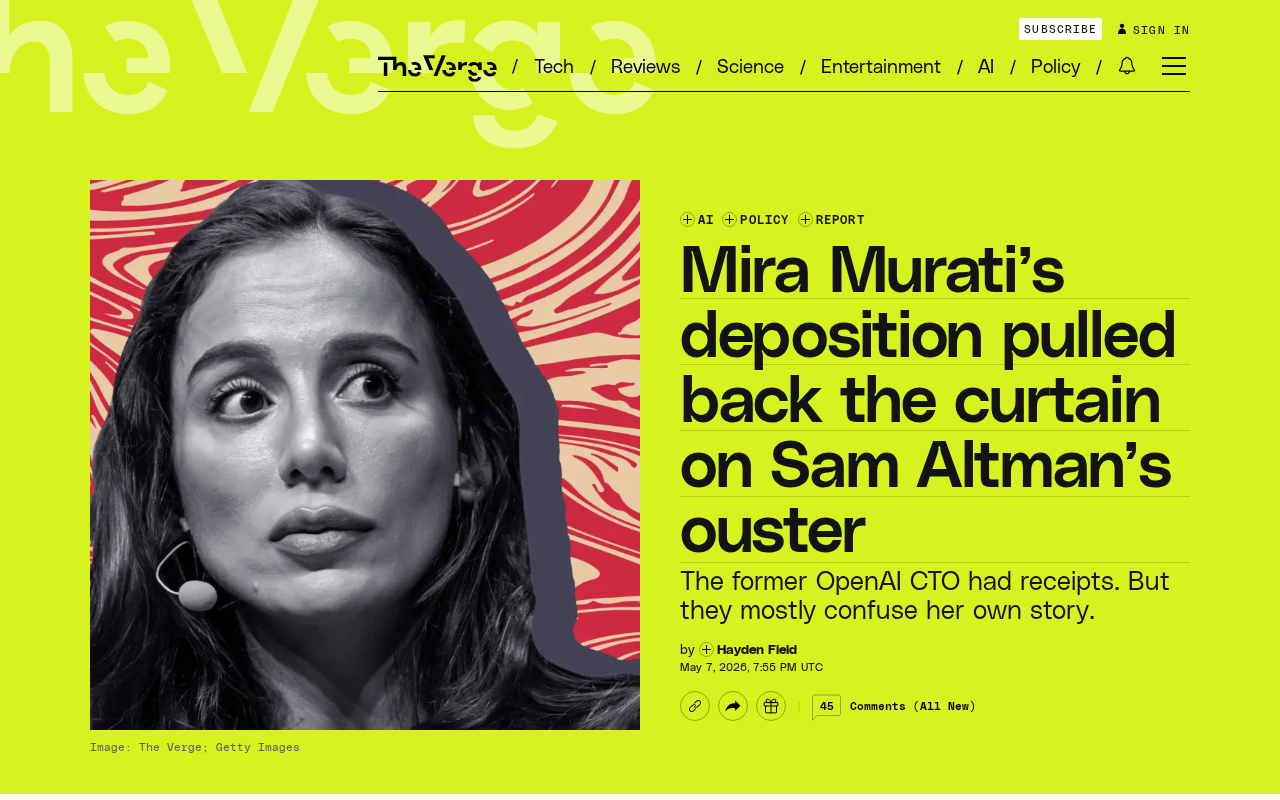
Mira Murati served as OpenAI's CTO and briefly assumed the role of interim CEO during Altman's removal, making her one of the people closest to the center of power during this upheaval. Her deposition in the Musk v. Altman lawsuit opened a window for outsiders to understand OpenAI's internal decision-making.
Notably, Murati joined OpenAI in 2018 and was promoted to Chief Technology Officer in 2022. As CTO, she spearheaded the development and deployment of flagship products including GPT-4, DALL-E, and Sora, serving as the key driver in transforming OpenAI's research into commercial products. CTOs at tech companies typically serve dual functions of technical strategy and executive communication, giving Murati a unique vantage point for observing information flow between the board and CEO. During the 72 hours of Altman's removal, she briefly helmed the company as interim CEO, positioned at the most information-dense decision node—which explains why her legal testimony carries such high reference value.
The Special Legal Weight of Deposition Testimony
A deposition is a core component of the "Discovery" process in American civil litigation. Witnesses testify under oath in the presence of attorneys and a court reporter, and all statements carry the same legal force as courtroom testimony—providing false statements constitutes perjury. Unlike media interviews or anonymous leaks, statements made during depositions undergo cross-examination by opposing counsel, resulting in higher information reliability.
For this reason, Murati's testimony is not gossip or anonymous leaks, but formal statements with legal force. As the highest-ranking technical leader, she had intimate knowledge of the company's decision-making processes, executive communication methods, and board operations.
The Specific Facts Behind "Not Consistently Candid"
The board's choice of the phrase "not consistently candid" was widely regarded as carefully crafted legal language vetted by attorneys. Murati's testimony is gradually revealing the specific incidents behind this characterization:
- On which key matters exactly did Altman fail to maintain transparency with the board
- How communication issues evolved from cracks into a complete collapse of trust
- The direct triggers that led the board to make the final decision to fire him
Musk v. Altman: An Unexpected Channel for Information Disclosure
Legal Background and Motivation of the Lawsuit
Elon Musk was one of OpenAI's co-founders and left the board in 2018 due to disagreements with Altman over company control. In 2024, Musk filed a lawsuit alleging that OpenAI had betrayed its nonprofit founding mission by transitioning to a for-profit entity. His core argument: his original donations were based on the public-benefit promise of "benefiting humanity," not to endorse commercial interests. The lawsuit also addresses whether OpenAI's deep partnership with Microsoft constitutes a betrayal of its founding mission.
Although some legal observers believe Musk's chances of winning are limited, the discovery process triggered by the lawsuit has forced OpenAI to disclose large volumes of internal documents and executive testimony, objectively creating external information pressure on this highly opaque company.
The Lawsuit Broke Silicon Valley's Code of Secrecy
In Silicon Valley, companies valued at over $100 billion like OpenAI can typically keep internal disputes strictly within confidential bounds. However, when multi-party conflicts escalate into legal proceedings, confidentiality barriers begin to crumble—a first in the AI industry. In high-profile commercial litigation, deposition records typically become partially or fully part of the public court record. The disclosure of Murati's testimony is a concrete manifestation of this judicial transparency mechanism in the AI industry.
A Warning for AI Industry Corporate Governance
Altman's firing and swift reinstatement within five days exposed deep contradictions in AI company governance. This crisis was not an isolated incident but rather reflects common dilemmas facing the entire AI industry during its period of rapid expansion: traditional tech company governance frameworks—board oversight, shareholder accountability, disclosure obligations—face multiple challenges in the AI domain: technical complexity makes it difficult for directors without technical backgrounds to exercise substantive oversight; the strategic sensitivity of AI research fosters an extremely strong culture of secrecy; philosophical disagreements between "safety" and "commercialization" often escalate into personnel conflicts.
Specifically, the OpenAI incident revealed the following structural contradictions:
- Mission vs. Interest Conflict: Tension between nonprofit ideals and tens of billions of dollars in commercial interests
- Power vs. Oversight Imbalance: The gap between a star founder's influence and the board's independent oversight capability
- Speed vs. Governance Mismatch: The chasm between the astonishing pace of technological iteration and organizational governance capacity
Following the Altman incident, multiple leading AI organizations including Anthropic and DeepMind began re-examining their own governance structures, and regulators have placed AI company governance on their policy discussion agendas. Murati's testimony provides a vivid case study for these structural issues and serves as a cautionary tale for governance discussions across the entire AI industry.
Aftermath: The Continuing Dissolution of OpenAI's Core Team
Murati left OpenAI in 2024 to found her own AI company. Her departure and the publication of her testimony mark the further disintegration of OpenAI's original core team. Beyond Murati, multiple co-founders and executives have also departed one after another.
The turbulence that began in late 2023 continues to reshape the competitive landscape of the global AI industry. As more trial materials become public, the complete picture of OpenAI's power storm may only be beginning to surface.
Key Takeaways
- Mira Murati's testimony in the Musk v. Altman case reveals for the first time the internal details of Altman's removal by OpenAI's board in 2023
- The board's stated reason was that Altman was "not consistently candid in his communications," with specifics gradually emerging through trial proceedings
- The Musk v. Altman lawsuit has unexpectedly become an important information window for the public to understand OpenAI's internal operations
- The incident exposed deep governance contradictions in AI companies between nonprofit missions and commercial interests
- Murati has left OpenAI to start her own venture, as OpenAI's early core team continues to dissolve
Related articles
 Tech Frontiers
A Rare Quiet Day in AI: Recursive Self-Improvement Stirs Beneath the Surface
A rare quiet day in AI sees multiple sources go silent simultaneously. Behind the calm, Recursive Self-Improvement (RSI) research continues. What this means for the industry.
 Tech Frontiers
Reve 2 vs. Ideogram 4: A Deep Dive into Layout Control in AI Image Generation
A deep comparison of Reve 2 and Ideogram 4's layout control capabilities, covering technical approaches, real-world use cases, and industry trends for designers and creators.
 Tech Frontiers
In the Weights: Check Your Influence Score in the AI World
In the Weights is an AI influence search engine that quantifies your presence in the AI world with a score. Explore how it evaluates practitioners and what it means for digital identity.