Mister Organ: A Documentary That Chills You to the Bone

Journalist Farrier documents being systematically harassed and manipulated by Michael Organ, revealing the horror of everyday evil.
*Mister Organ* is a true-crime documentary directed by New Zealand journalist David Farrier. Starting from a parking dispute, it chronicles how Farrier is gradually dragged into a war of attrition by Michael Organ, who uses endless complaints, lawsuits, harassment, and verbal manipulation to ensnare neighbors, landlords, clerks, and strangers. The horror comes not from gore but from ordinariness and inescapability.
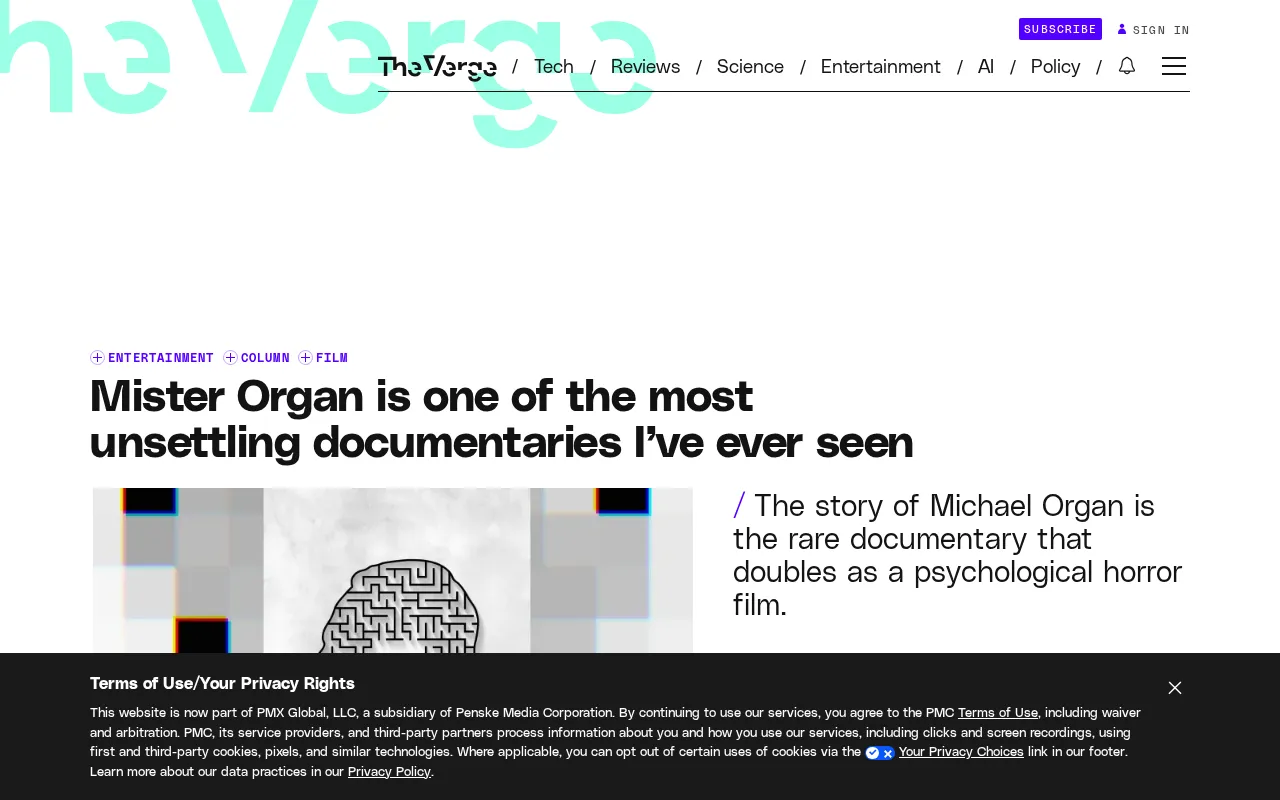
Some documentaries hit you with graphic violence, others shake you with historical tragedies, but Mister Organ chooses a colder path: it makes you feel, firsthand, the everyday terror of a single ordinary person. Directed by Auckland, New Zealand journalist David Farrier, this film lacks the social horror of The Act of Killing and doesn't blend urban legend with true crime into a creepy tale like Beware the Slenderman — yet the unease it creates is more enduring, because it happens on the street corner, in a parking spot, in a baffling phone call.
How a Journalist Got Drawn into a Private War
David Farrier initially set out to cover a trivial dispute: someone in Auckland was using a beat-up car to occupy a parking space and charging a towing company exorbitant fees. It sounded like local news filler, but once he made contact with the man involved, Michael Organ, things quickly spiraled out of control. Organ isn't the kind of villain who lurks in the shadows — he's eager to talk, skilled at performance, and even invites the journalist into his life.
Farrier soon discovers that everyone who has crossed paths with Organ — neighbors, former landlords, shop clerks, even random strangers — has a story of being entangled. These accounts are independent yet point to the same pattern: Organ starts with a trivial incident and, through endless complaints, lawsuits, harassment, and verbal manipulation, drags the other person into a war of attrition. The documentary doesn't try to label Organ as "mentally ill" or "a criminal"; instead, it lets the victims speak for themselves, allowing the audience to gradually feel the chill as the puzzle pieces come together.
Why It's More Unsettling Than a Bloody Horror Film
The horror in Mister Organ stems from a possibility: you don't need to do anything wrong to become someone's target. Organ's behavior has no clear motive and follows no logic. What he enjoys is the process itself — the pleasure of controlling others' emotions. Throughout the film, Farrier repeatedly shows confusion, exhaustion, even self-doubt, and this genuine reaction makes it hard for the audience to maintain a safe distance as observers.
The pacing also serves this unease. It doesn't rush to conclusions but, like Farrier himself, gets dragged step by step into Organ's world. You see the journalist trying to stay professionally calm, only to admit at some point that he's "scared." That honesty actually intensifies the horror: if even a journalist used to dealing with weird cases can't handle it, what chance does an ordinary person have?
Gaslighting refers to a form of psychological manipulation: the manipulator persistently denies facts, distorts information, and questions the victim's memory and perception, gradually eroding their grip on reality until they doubt their own sanity. The concept originates from the 1938 stage play Gas Light, adapted into a film of the same name in 1944 — in which a husband deliberately dims the gas lamps while insisting his wife is seeing things, implying she's losing her mind. In Mister Organ, Organ's pattern of "never lying directly, yet always redefining the facts" is an extreme case of gaslighting: he exploits the gray areas of language and logic, inverting cause and effect in every conflict so the victim appears to be the unreasonable one. The key to recognizing this pattern is that the manipulator often isn't after material gain but enjoys making the other person doubt themselves.
The Documentary as a Mirror
Genre-wise, Mister Organ is a true-crime documentary, but it doesn't rely on archival footage or dramatic reenactments. Farrier uses the most straightforward methods: face-to-face interviews, phone recordings, follow-alongs. This low-intervention style makes Organ's personality the sole focus. Viewers notice the strange logical loop in his speech — he never lies outright, yet always redefines facts so the victims appear to be the aggressors.
This narrative strategy also raises an ethical question: is the documentary itself being used by Organ? He clearly enjoys being filmed and may even see Farrier as an opponent in another "game." The film doesn't shy away from this; instead, it turns the filmmaking process into part of the story. This reflexivity elevates Mister Organ beyond a simple "exposé of a villain" into an interrogation of the observer's position.
True-crime documentary is a major subgenre of documentary filmmaking, typically centered on real criminal events and reconstructing cases through interviews, archival material, and scene reenactments. Traditionally, such works presuppose a clear "perpetrator–victim" narrative framework and conclude with justice served or truth revealed. In recent years, the genre has seen a "reflexive turn": creators begin pointing the camera at the interaction between themselves and their subjects, questioning whether the documentary is truly objective and whether the filmmaker inadvertently becomes part of the events. Mister Organ belongs to this lineage — Farrier documents not only Organ but also how he himself gets drawn in and shaken, making the "observer's position" itself the subject. This reflexivity echoes works like The Imposter and Catfish, but Farrier emphasizes the sense of erosion in everyday situations.
Who Should Watch This Film
If you like works with historical weight like The Act of Killing, you might find Mister Organ too small in scope; if you're expecting internet creepypasta like Beware the Slenderman, it will seem too mundane. But if you're curious about the aimless, bottomless urge to manipulate in human nature, or want to understand the extreme real-world form of "gaslighting," this documentary is worth watching. It offers no answers and doesn't guarantee justice will be served — and that's precisely its honesty.
Farrier doesn't provide a tidy resolution at the end. Organ is still out there; the victims are still exhausted. This sense of incompleteness may be the documentary's sharpest blade: it reminds you that some stories don't end when the camera stops rolling.
One-line Summary
Journalist Farrier documents his systematic harassment and manipulation by Michael Organ, revealing the horror of everyday evil.
Paragraph Summary
Mister Organ is a true-crime documentary directed by New Zealand journalist David Farrier. Starting from a parking dispute, the film chronicles how Farrier is gradually dragged into a war of attrition by Michael Organ. Organ begins with trivial incidents and, through endless complaints, lawsuits, harassment, and verbal manipulation, ensnares neighbors, landlords, shop clerks, and even strangers. The film's horror doesn't come from gore or supernatural elements but from its ordinariness and inescapability — you don't need to do anything wrong to become someone's target. Farrier employs low-intervention interviews and follow-alongs, highlighting Organ's verbal manipulation and logical loops, while making the filmmaking process itself part of the story, prompting reflection on documentary ethics and the observer's position.
Related articles

Claude Code v2.1.316 Update Analysis: Enterprise Gateway and Multiple Stability Fixes
Claude Code v2.1.316 released: new enterprise gateway pooled group budgets, layered policy mode, subagent effort control, dozens of Shell, network, and session recovery fixes, and Opus 4.8 fast mode deprecated.

17th-Century British Floods and Doomsday Panic: A New Perspective on Weather History
Based on a Hacker News discussion of '17th-Century British Floods and Foreboding,' this piece explores how extreme weather was given divine and political significance, and what weather history teaches us about contemporary climate communication.

Salesforce Acquires Rune for $375M: AI Logistics Tech Bolsters Defense Business
Salesforce reportedly acquires defense tech startup Rune for $375M. Rune's AI logistics tech will strengthen Salesforce's Missionforce defense platform, continuing its M&A spree.