Mistral AI's Inaugural AI Now Summit: Four Key Themes Reveal an Open-Source AI Enterprise Roadmap
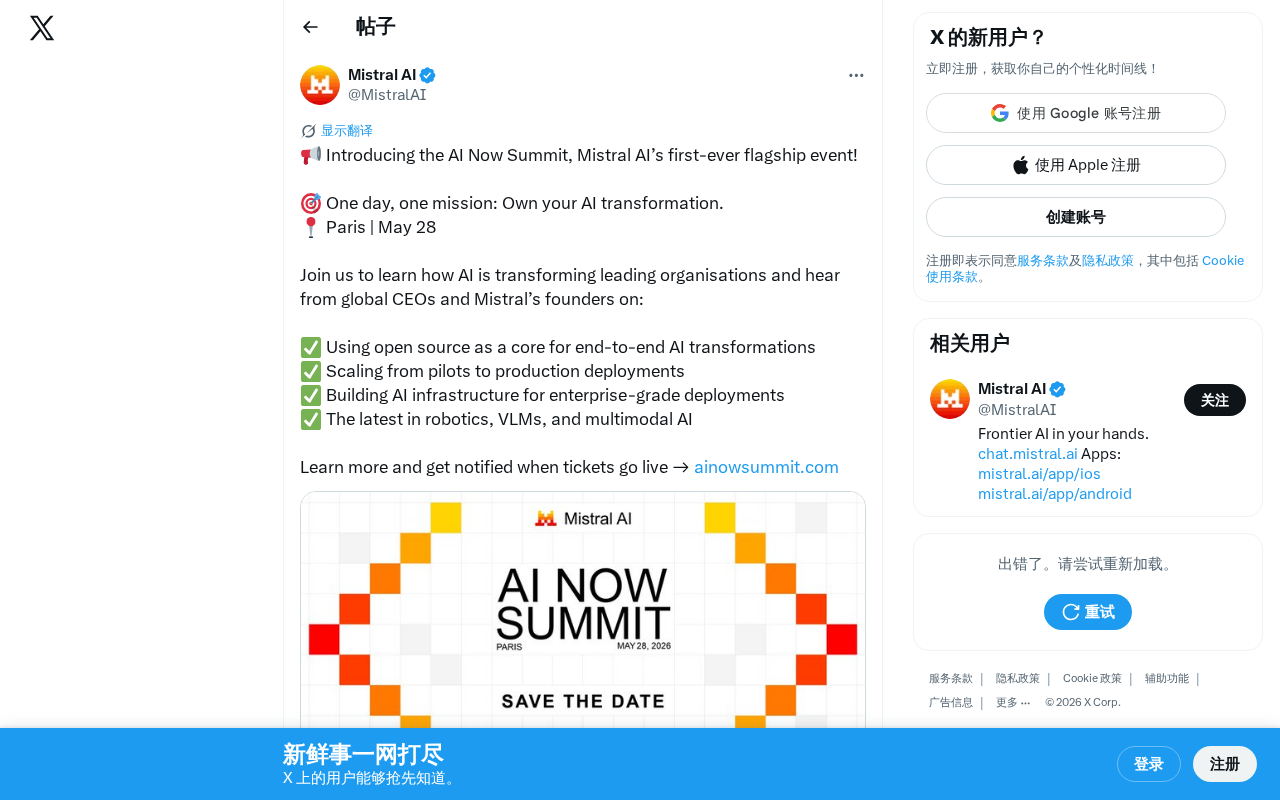
Mistral AI announces its inaugural Paris summit focusing on enterprise AI transformation and open-source strategy.
French AI unicorn Mistral AI has announced its inaugural AI Now Summit on May 28 in Paris, themed "Own your AI transformation." The summit addresses four major topics: open source as a strategic AI transformation pillar, overcoming the POC-to-production scaling challenge, building enterprise-grade AI infrastructure, and new directions in robotics and multimodal AI. This marks Mistral AI's transition from model provider to full-stack enterprise solution provider, reflecting the broader industry shift from model competition to deployment competition.
Mistral AI Officially Announces Its Inaugural Flagship Summit: AI Now Summit
French AI unicorn Mistral AI has officially announced that it will host its first major event since its founding — the AI Now Summit — on May 28 in Paris. The launch of this summit signals that Europe's most influential AI company is transitioning from the R&D phase toward building broader industry influence.
Mistral AI was co-founded in May 2023 in Paris by Arthur Mensch, Guillaume Lample, and Timothée Lacroix — three former researchers from Meta and Google DeepMind. Just four weeks after its founding, the company closed a €105 million seed round, setting a record for European AI. In less than two years since then, Mistral AI's valuation has soared to over $6 billion, with strategic investments from Andreessen Horowitz, Lightspeed Venture Partners, and Microsoft, making it one of the fastest companies in European tech history to achieve unicorn status.
The summit's core theme is singular: "Own your AI transformation." This tagline speaks directly to Mistral AI's longstanding product philosophy — enterprises should have full control over their own AI infrastructure rather than being deeply locked into a handful of closed-source vendors.
Deep Dive into the Four Core Themes
Open Source: A Strategic Pillar for End-to-End AI Transformation
Mistral AI built its reputation on open-source models from the very beginning, generating sustained attention across the global developer community with releases from Mistral 7B to the Mixtral series. Mistral 7B, the company's first open-source model released in September 2023, outperformed larger models like Llama 2 13B across multiple benchmarks despite having only 7 billion parameters — a lightweight architecture that sent shockwaves through the AI community. The subsequent Mixtral 8x7B adopted a Mixture of Experts (MoE) architecture — a design that activates only a subset of parameter networks during each inference pass (for example, activating only 2 out of 8 experts), significantly reducing computational costs while maintaining high performance. Mistral has since released Mistral Large, Codestral (a code-specialized model), and Pixtral (a vision-language model), building a complete model matrix spanning lightweight to flagship, pure text to multimodal.
By positioning open source as the core pillar of enterprise AI transformation at this summit, Mistral is elevating open source from a technical choice to a complete strategic pathway.
For enterprises, choosing open-source AI delivers three key advantages: greater model transparency (code and weights are fully auditable), stronger business customization capabilities (organizations can fine-tune open-source models for domain-specific use cases), and strategic freedom from vendor lock-in (no longer constrained by a single vendor's pricing strategy or product roadmap).
From POC to Production: Cracking the AI Scale-Up Challenge
This is the biggest bottleneck enterprises face in AI deployment today. A POC (Proof of Concept) is a small-scale feasibility test that enterprises conduct before formally adopting new technology. Countless organizations achieve impressive test results during the POC phase, but when it comes time to push into production, they hit wall after wall — unstable inference performance, skyrocketing operational costs, unmanageable data compliance risks. These issues trap many AI projects in what remains a perpetual "demo stage."
According to research from Gartner and other firms, over 80% of enterprise AI projects fail to successfully transition from POC to production — a phenomenon known in the industry as "Pilot Purgatory." The root causes are systemic: significant distribution shifts between production data and test data cause model performance degradation; large-scale inference GPU costs can be tens of times higher than during POC; enterprise-grade deployment also requires handling real-time requirements for latency-sensitive applications, model version management, A/B testing framework construction, and compliance audits for data privacy regulations like GDPR. These challenges create an enormous gap between AI that "works" and AI that "works well."
By featuring this topic prominently at the summit, Mistral AI is sending a clear strategic signal: it is transforming from a "model provider" into a "full-stack enterprise AI solution provider."
How to Build Enterprise-Grade AI Infrastructure
Building enterprise-grade AI infrastructure is far more complex than simply deploying a model. Data pipeline construction, inference performance optimization, security and compliance frameworks, monitoring and operations mechanisms — every layer requires systematic solutions.
Mistral AI has already made substantive moves in this space. Its core product, La Plateforme, is a cloud-based API service platform that provides enterprises with model invocation, fine-tuning, and Agent-building capabilities. Unlike OpenAI's API service, Mistral AI simultaneously offers three deployment modes: direct cloud API calls, managed deployment through partners (such as Microsoft Azure, Google Cloud, and AWS), and fully on-premise private deployment for sensitive industries like finance, healthcare, and defense. On-premise deployment means enterprise data never leaves the organization's own infrastructure — a particularly attractive proposition for heavily regulated industries. Additionally, Mistral has launched Le Chat — an AI assistant product for end users that directly competes with ChatGPT, completing a full commercial loop from foundational models to end-user applications.
These initiatives are gradually assembling a comprehensive enterprise service portfolio. The summit will very likely feature new infrastructure-level products and partnership announcements.
Robotics, Vision-Language Models, and the New Multimodal AI Landscape
The most noteworthy signal is that Mistral AI has included robotics in the summit agenda for the first time. Previously known primarily for text-based large language models, Mistral's explicit mention of Robotics, Vision-Language Models (VLMs), and multimodal AI strongly suggests the company is expanding its technological boundaries.
Vision-Language Models are a class of multimodal AI models capable of simultaneously understanding and processing both image and text information. Unlike traditional text-only large language models, VLMs use visual encoders (such as ViT, Vision Transformer) to convert images into feature vectors, then align and fuse these with the language model's text representations to accomplish cross-modal tasks like image captioning, visual question answering, document understanding, and chart analysis. Leading models in this space currently include OpenAI's GPT-4o, Google's Gemini, and the open-source LLaVA series. Mistral had previously released Pixtral 12B and Pixtral Large, demonstrating initial multimodal capabilities.
Combining VLMs with robotics means AI systems can not only "see and understand" the world but also interact with the physical world through Embodied AI — representing a critical trend of AI applications extending from digital space into physical space. Given the rapid evolution of multimodal AI in recent months, Mistral will likely use the summit to announce new multimodal models or related technical achievements. If confirmed, this would represent a significant expansion of Mistral AI's product matrix.
Mistral AI's Strategic Ambition: Becoming Europe's AI Standard-Bearer
Choosing Paris for its inaugural summit is both a tribute to the company's French roots and a powerful reinforcement of the European AI sovereignty narrative. AI Sovereignty has become a central topic in EU policy discussions in recent years, with the core demand being to ensure Europe does not become overly dependent on American and Chinese tech giants for AI technology, data, and infrastructure.
The EU AI Act, which officially took effect in 2024, is the world's first comprehensive AI regulatory framework. It classifies AI systems by risk level and imposes strict transparency, explainability, and human oversight requirements on high-risk applications. Under this regulatory framework, Mistral AI's open-source strategy and local deployment capabilities naturally align with European enterprises' compliance needs — open-source models have fully auditable code and weights, and private deployment ensures data stays within national borders. This gives Mistral a structural advantage in the European market that American competitors find difficult to replicate. The French government also views Mistral AI as a key pillar of its national AI strategy, with President Macron publicly endorsing the company on multiple occasions.
In a landscape dominated by American companies like OpenAI, Google, and Anthropic, Mistral AI is deliberately cultivating its brand image as "Europe's AI leader." The summit has invited global enterprise CEOs to share the stage with Mistral's founding team — this caliber of guest lineup makes clear that Mistral AI's goal isn't just to host a tech conference, but to establish AI Now Summit as a core platform connecting cutting-edge technology with business decision-makers.
Industry Implications: AI Competition Is Shifting from the Model Race to the Deployment Race
From a broader perspective, Mistral AI's flagship summit reflects that the AI industry is entering a new phase: As capability gaps between foundation models gradually narrow, what will truly determine market dynamics is who can help enterprises embed AI into core business processes more efficiently and securely.
Mistral AI has charted a dual-engine path of "open-source models + enterprise-grade services," offering the industry a viable alternative to OpenAI's closed-source approach. The core logic of this model is: attract developer ecosystems and community contributions through open-source models, lowering the barrier for enterprise technology evaluation; then monetize through enterprise services (API platform, private deployment, custom fine-tuning). This bears a striking resemblance to the "open-source software + enterprise services" business model that Red Hat pioneered in the Linux era.
The market reception of this summit will significantly influence industry confidence in the "open-source AI enterprise" pathway.
For practitioners and decision-makers tracking where the AI industry is headed, the Paris AI Now Summit on May 28 deserves close attention. It may prove to be not only a milestone for Mistral AI itself but also a critical inflection point for the broader open-source AI ecosystem's journey toward commercial maturity.
Key Takeaways
- Mistral AI will host its inaugural flagship summit, AI Now Summit, on May 28 in Paris, themed around enterprise AI transformation
- The summit focuses on four major themes: open-source AI as a core strategy, scaling from pilot to production, enterprise-grade infrastructure development, and robotics with multimodal AI
- Mistral AI's first-ever inclusion of robotics and vision-language models on the agenda suggests its technology portfolio is expanding from pure text toward embodied intelligence
- The summit reflects the AI industry's shift from the model race to the deployment race, with the open-source + enterprise services dual-engine model emerging as a significant alternative pathway
- The EU AI Act's regulatory environment provides Mistral AI's open-source and private deployment strategy with a structural competitive advantage
Related articles
 Tech Frontiers
A Rare Quiet Day in AI: Recursive Self-Improvement Stirs Beneath the Surface
A rare quiet day in AI sees multiple sources go silent simultaneously. Behind the calm, Recursive Self-Improvement (RSI) research continues. What this means for the industry.
 Tech Frontiers
Reve 2 vs. Ideogram 4: A Deep Dive into Layout Control in AI Image Generation
A deep comparison of Reve 2 and Ideogram 4's layout control capabilities, covering technical approaches, real-world use cases, and industry trends for designers and creators.
 Tech Frontiers
In the Weights: Check Your Influence Score in the AI World
In the Weights is an AI influence search engine that quantifies your presence in the AI world with a score. Explore how it evaluates practitioners and what it means for digital identity.