Mistral Large 4 Launches: Europe's Trillion-Parameter Open-Source Model Takes Aim at GPT and Claude

Mistral's 1.05T-parameter open-source Large 4 targets GPT and Claude at one-fifth the output price.
French AI lab Mistral unveiled Mistral Large 4 (nicknamed "Le Chonc") at AI Everything in Abu Dhabi — a 1.05 trillion-parameter open-source model using a Mixture of Experts architecture that activates only ~49B parameters per token. Trained on ~3,800 NVIDIA Blackwell chips in Europe, it supports multimodal input and 1M-token context. Its output pricing is roughly one-fifth that of GPT-6.1 and Gemini, making it a direct accelerant in the ongoing AI price war. Weights are set to open at the end of October after red team testing.
Europe's "Big Boy": Le Chonc Has Arrived
French AI lab Mistral officially unveiled the public preview of Mistral Large 4 on October 6 at the AI Everything conference in Abu Dhabi, with CEO Arthur Mensch taking the stage. The model has earned the nickname "Le Chonc" (the big boy) thanks to its massive scale — roughly 1.05 trillion parameters — making it Europe's most substantial entry in the large model race.
But the real story isn't just the raw parameter count. It's the architectural choices and, more importantly, the pricing strategy behind the model. For incumbents like OpenAI, the latter may be the more alarming signal.
Mixture of Experts: The "Power-Saving" Secret Behind a Trillion Parameters
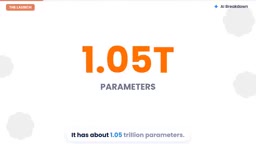
Mistral Large 4 uses a Mixture of Experts (MoE) architecture. While the total parameter count reaches 1.05 trillion, only about 49 billion parameters are activated when processing each token.
Think of it as a large panel of specialists — when a question comes in, only the most relevant experts are called upon to answer. This design lets the model maintain an enormous overall capacity while dramatically reducing actual inference costs, which sets the stage for the aggressive pricing to come.
On the capability side, the model supports multimodal inputs, handling both text and images, and officially claims support for up to 1 million tokens of context length. According to reports, the entire model was trained from scratch using approximately 3,800 NVIDIA Blackwell chips at Mistral's data centers located on European soil — a detail that carries symbolic weight in today's conversations around AI sovereignty.
The core concept behind the Mixture of Experts (MoE) architecture traces back to a 1991 paper by Jacobs et al., and has since been adopted at scale by organizations like Google and Meta for large language models. The basic idea is to split the feed-forward network layers into multiple "expert" sub-networks, then introduce a lightweight "router" network that dynamically selects which experts to activate for each input token (typically Top-K selection, where K is far smaller than the total number of experts). This way, the model's "knowledge capacity" is determined by the combined parameters of all experts, while actual compute is only consumed by the small subset that gets activated — achieving a balance of large parameter count with low inference cost. Google's Gemini 1.5, Meta's Llama 3 series, and DeepSeekAd models all use similar designs. The main challenge with MoE is load balancing — if the router consistently favors the same set of experts, others remain idle. In practice, auxiliary loss functions are introduced during training to encourage even distribution of work across experts.
The Pricing Is the Real Weapon
If the architecture is the technical highlight, then the pricing is what directly disrupts the market.
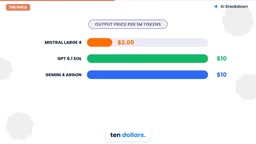
In its preview pricing, Mistral lists approximately $0.68 per million input tokens and $2.09 per million output tokens. By comparison, the video references GPT-6.1 Sol and Gemini 4 Argon output pricing in the range of $2 and $10 respectively — meaning Mistral's output price is roughly one-fifth that of its competitors.
Even at a higher "list price" shown through some channels (output approaching $4), it would still be less than half the cost of competing models. Combined with the AI price war already underway, Mistral is clearly entering the market with a deliberate pricing strategy.
API pricing for large AI models is typically measured in "per million tokens," with separate charges for input (prompt) and output (completion). Output is generally priced higher than input because generating each token requires step-by-step autoregressive inference, which carries greater computational overhead. The deeper drivers of the price war come from two directions: architectural innovations like MoE continuously reducing per-token inference costs, and the proliferation of open-source models making self-hosting a viable alternative — forcing closed-source vendors to cut prices to retain customers. Since 2024, OpenAI, Anthropic, and Google have all made significant cuts to their flagship model API pricing. The industry calls this trend "Moore's Law for token prices" — the cost of using large models roughly drops by an order of magnitude every one to two years. Mistral's aggressive pricing is accelerating this trend further.
Performance: Official Numbers and a Note of Caution
So beyond being affordable, is it actually capable? According to Mistral's own data:
- Approximately 62% on the DeepSwee real-world software engineering benchmark;
- A narrow 42% vs. 41% edge over GPT-6 Astra on visual grounding tasks;
- Third-party testing reportedly shows it outperforms Astra on legal and financial tasks.

Two things are worth keeping in mind here. First, Mistral's core claim is "best open-weight model in the US or Europe" — not "best model overall." That qualifier meaningfully narrows the competitive frame. Second, most of these benchmark results come from Mistral's own testing. Until independent third-party evaluations are available, a degree of skepticism is warranted.
The Global Open-Source Race
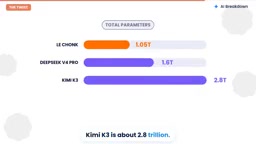
Zooming out to the broader open-source model landscape, an interesting reality comes into focus: the largest open-source models currently available actually come from China. According to the video, DeepSeek V4 Pro sits at roughly 1.6 trillion parameters, while Kimi K3 reaches approximately 2.8 trillion.
In this context, Le Chonc is positioned as "Europe's answer" — a large open-source model born on European soil. Mistral says the model weights will be released for download by the end of October, following additional red team safety testing, with target use cases in software engineering, finance, law, and cyber defense.
"Red teaming" is a standard pre-release safety process in the AI industry, borrowed from the cybersecurity world. In practice, it involves a group of internal or external testers proactively attempting to get the model to produce harmful outputs, bypass safety guardrails, or leak training data — all in order to identify and patch vulnerabilities before public release. As the EU's AI Act imposes mandatory compliance requirements on high-risk AI systems, red team testing is becoming increasingly formalized in European AI companies' release pipelines. Mistral's decision to complete additional red teaming before opening the weights reflects the balance the company is striking between open-source transparency and regulatory compliance.
What Happens When Open-Source Models Get Strong Enough?
This is precisely the question the entire AI industry is debating most fiercely right now. When top-tier open-source models approach closed-source flagships in performance — at a fraction of the price, with downloadable weights — the market's bargaining logic and competitive landscape will be fundamentally rewritten.
For developers and enterprises, this means lower cost barriers and greater deployment autonomy. For vendors whose core business model is API-based access fees, it translates into real and growing pressure. Whether Mistral Large 4 can deliver on its advertised performance still awaits independent verification after the weights are released — but the combination it represents, "open-source + low-cost + sovereignty," has already introduced a new variable into this race.
Related articles

A Single Prompt Triggers a Global PHP Security Storm: Is AI a Savior or a Hidden Risk?
A single AI prompt triggered a global PHP security crisis affecting Wikipedia and the Internet Archive. This article reviews the incident, analyzes the OpenAI-Amazon controversy, and explores the security paradox of lowered vulnerability discovery barriers in the AI era and developer response strategies.

When AI Is Taken Away: How Reliance on Shortcuts Undermines Your Problem-Solving Resilience
A study of 1,222 people found that after using AI to answer questions, once AI was removed, people gave up on more problems than a control group that never used AI. The article analyzes the impact of AI reliance on learning resilience and metacognition, and explores design implications for AI learning tools.

Carta and NewView Partner to Let Startup Employees Cash Out Equity Early
Carta and NewView Capital partner to simplify startup tender offers, helping employees sell equity early. Analysis of the mechanism, liquidity pain points, and impact.