Mistral Large 4 Opens Its Weights: AI Morning Brief Roundup of Models and Ecosystem Trends
Mistral opens a trillion-parameter model, code security heats up, and sovereign AI and regulation ramp up in parallel.
This issue's highlights center on three main threads. At the model layer, Mistral opens the weights of Mistral Large 4, an MoE architecture with roughly 1 trillion total parameters and about 52 billion activated per token; after dynamic quantization, its size drops from 1.1TB to 233GB, allowing local operation on a MacStudio for coding and cybersecurity scenarios. At the application layer, Meta's GTES test-generation technology enters full production, and Cognition acquires Corridor, shifting the value center of AI coding tools from "writing code" to "ensuring code reliability"; meanwhile, Search AI's tax benchmark shows a top pass rate of only 10.8%, with reliability in vertical professional scenarios still a weak spot. At the ecosystem and capital layer, Doubao Work opens third-party model calls and moves toward multi-model routing, the Canadian government invests up to CAD 1.6 billion for a stake in Cohere, Nvidia's acquisition of Hugging Face faces antitrust review, and regulation tightens in parallel in areas such as minor protection and AI crawlers.
The open-weights camp gains a heavyweight contender
European model developer Mistral has officially released and opened the weights of its flagship model, Mistral Large 4. It is a natively multimodal MoE architecture with roughly 1 trillion total parameters, activating about 52 billion parameters per token, and is aimed primarily at coding and cybersecurity scenarios. The company calls it the "strongest Western open model."
More practically valuable is the accompanying dynamic bit quantization: the model size shrinks from 1.1TB to 233GB, enabling local code testing and security-related tasks to run on a MacStudio. For security teams that want to deploy a high-performance code model locally, this size optimization lowers the barrier from "data-center grade" to "workstation grade."
From a competitive standpoint, open-weights models are moving from "runnable" to "competitive"—trillion-scale parameters, native multimodality, and optimization for vertical scenarios, features that previously appeared mostly in closed-source flagship products.
MoE (Mixture of Experts) architecture is the key to understanding this release. A traditional dense model activates all parameters for every token it processes, whereas MoE splits the feed-forward layer into multiple "expert" subnetworks, with a routing network selecting only a few of them to participate in computation for each token. This is exactly why Mistral Large 4 can achieve "roughly 1 trillion total parameters with only about 52 billion activated per token": model capacity is measured by the total, while inference cost is measured by the activated amount. The trade-off is that memory usage still depends on the total parameter count—all weights must be loaded into memory, so even though only 52 billion parameters are activated, the original 1.1TB size still cannot fit into a single workstation. This also explains why quantization down to 233GB is what makes MacStudio deployment possible.
Dynamic bit quantization refers to adaptively selecting bit width per layer or per weight importance, rather than uniformly reducing everything to 4-bit or 8-bit globally: sensitive layers retain higher precision, while redundant layers are compressed more aggressively, thereby preserving as much of the inference quality needed for code and security tasks as possible while greatly reducing size. Compared with static quantization, the dynamic approach is friendlier to trillion-scale MoE, because the importance of different experts varies enormously.
Open weights is not the same as open source. It means the model parameters can be downloaded, run locally, and fine-tuned, but the training data, training code, and license terms are not necessarily public, and commercial use is often subject to additional restrictions. Only by understanding this distinction can one accurately judge the weight of the claim "strongest Western open model."
Code security becomes a new battleground for big tech
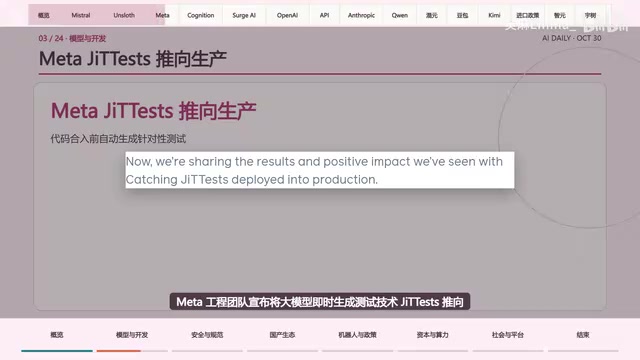
Meta's engineering team announced that GTES, its technology for instantly generating tests with large models, is being rolled out to the full production environment, automatically generating targeted tests before code is merged and having already successfully intercepted vulnerabilities.
On the same day, Cognition, the parent company of Devin, announced the acquisition of software security company Corridor, further expanding its code security product line. Both pieces of news point to the same trend: the value center of AI coding tools is shifting from "writing code" to "ensuring code reliability." Test generation, vulnerability interception, and security auditing are being systematically remade by large model capabilities.
For development teams, this means the shape of the CI pipeline may change—tests are no longer static assets written by hand, but products dynamically generated with each code change.
Benchmark reveals capability gap: tax task pass rate only 10.8%
Search AI released a benchmark containing 50 professional tax tasks, and the results show that the top-ranked Claude-family model (referred to in the original as CloudSignet 5.5) has a pass rate of only 10.8%.
This number is worth noting: in vertical professional domains, the reliability of leading models is still limited. Tax tasks involve regulatory citation, computational accuracy, and multi-step reasoning, and an error in any one link leads to overall failure. A 10.8% pass rate shows that handing professional tax work directly to a model is not yet realistic.
The significance of such benchmarks lies in providing an honest yardstick. High scores on general capability leaderboards may quickly shrink in professional scenarios.
How to read a benchmark's "pass rate": 50 professional tax tasks with the top score at only 10.8%—this number itself is not an absolute measure of model capability, but a product of task difficulty and scoring strictness. Tax scenarios usually require citing specific legal provisions, giving precise calculation results, and completing multi-step reasoning, and scoring often uses a strict standard of "only fully correct counts as a pass"—if the final value or provision citation deviates in even one place, the entire question is judged failed. This design amplifies the error accumulation effect of long-chain tasks: a model with 95% single-step accuracy has an overall success rate that drops to around 60% after ten steps. Therefore, 10.8% should be interpreted more as an "end-to-end reliability" indicator than as a "degree of tax knowledge mastery" indicator.
By contrast, general capability leaderboards mostly use lenient partial credit or multiple-choice formats, so the scores naturally look much better. The two types of benchmarks do not measure the same thing, and direct cross-leaderboard comparison would seriously misjudge a model's usability in professional scenarios. For actual deployment, a more valuable approach is to break professional tasks into verifiable sub-steps and set human or rule-based fallbacks at each step.
OpenAI and Anthropic diverge on governance paths
OpenAI updated its model behavior specification, ModelStack, reorganizing it around five core values including fidelity to human intent, harm reduction, and respect for autonomy, and disclosed a layered monitoring system used to catch model misalignment and overreach.
At the same time, ChatGPT Pro and Business users can receive up to $500 per month in free API call credits after linking an API organization. This subsidy strategy is clearly intended to steer enterprise users from the chat interface into the API ecosystem.
Anthropic has taken another path: training Claude to self-evaluate after generating responses and using the evaluation results for offline monitoring and flagging potentially abusive conversations. The difference between the two companies is that OpenAI focuses on behavior specifications and runtime monitoring, while Anthropic focuses on post-response self-review and after-the-fact flagging.
Domestic ecosystem: new models and platform openness in parallel
According to attendees at the Yunqi Conference, Alibaba Cloud plans to release the Qwen4 model next week; Tencent Hunyuan is also about to launch the HICE series, which introduces visual understanding capabilities for the first time.
At the application level, ByteDance's Doubao Work has officially opened third-party model calls to enterprises, with the first batch including Kimi 3.1 Pro, GLM 5.3, and DeepSeekAd V4.1 Flash.

The signal from this move is clear: enterprise AI workbenches are shifting from "single-model binding" to "multi-model routing." Calling different models for different tasks may become a standard capability of enterprise-grade AI products. Kimi also launched Gmail, Google Drive, and Calendar plugins during the same period, penetrating further into office scenarios.
Multi-model routing refers to setting up a scheduling layer at the application level that distributes requests to different underlying models based on task type, cost budget, latency requirements, and historical performance. After an enterprise workbench integrates multiple models, it can route simple Q&A to low-cost small models and complex code or long-document analysis to flagship models, controlling cost while preserving effectiveness.
Its engineering value also lies in decoupling: models iterate extremely quickly, and if a product is deeply bound to a single model, every model change means redoing prompts and evaluations. The routing layer concentrates this switching cost in one place and supports dynamically adjusting traffic allocation based on A/B results. The challenges are equally obvious—different models have different prompt formats, tool-calling protocols, and context lengths, requiring an adaptation abstraction layer; cross-model consistency and security policies are also harder to govern uniformly. This explains why "multi-model routing" looks like merely integrating a few APIs but is actually a core architectural decision for enterprise AI platforms.
Embodied intelligence: from hardware launches to commercialization validation
Zhiyuan Robotics announced the Woken metric for measuring robots' actual work output at its annual innovation day, and launched GRMAX hardware along with the GO3 Preview embodied foundation model, planned for open source by the end of the year.
Yushu Technology released its first quarterly report after going public: per-unit revenue reached 665 million yuan, up 70% year over year, while R&D spending surged 250% year over year, focused on embodied foundation models and computing infrastructure.

Revenue growth and R&D investment expanding in tandem show that the embodied intelligence sector is still in a "spend to scale" phase. The emergence of output metrics like Woken also reflects that the industry is beginning to try to measure robot capability in ways closer to actual work value, rather than stopping at demo videos.
Capital and policy: sovereign AI heats up, regulation tightens in parallel
Canada's Prime Minister announced that the government will invest up to CAD 1.6 billion to take a direct stake in model company Cohere; Cohere completed the first close of a CAD 7 billion round on the same day, reaching a post-money valuation of CAD 35.7 billion, setting a record for Canada's largest private financing. A government taking a direct stake in a model company is a landmark case of "sovereign AI" moving from slogan to capital action.
In the United States, the antitrust authority has begun reviewing Nvidia's $12.93 billion acquisition of open-source platform Hugging Face, focusing on whether it would control the AI distribution hub. If the deal goes through, the ecosystem gateway for open-source models will become highly concentrated, and that is exactly the focus of the review.
On the M&A front, Thrive Holdings, which is invested in by OpenAI and serves as a technology partner, announced it will acquire security company ADT in an all-cash deal at an enterprise value of $15.3 billion, planning to use AI to transform traditional security services.

There has been frequent activity on the policy and regulatory front: progressive members of the U.S. House of Representatives drafted a resolution requiring Congress to refuse funding bailouts for AI companies or financial institutions facing bankruptcy due to market pressure; the Governor of New York signed a new bill prohibiting AI chatbots aimed at minors from impersonating real people or creating emotional dependence; Reddit announced that it will shift its browsing experience fully to mandatory login in order to cope with declining search referrals and block AI crawlers.
Sovereign AI refers to a country or region building AI infrastructure and industrial chains through domestic computing power, domestic data, and domestic model companies in order to ensure autonomous and controllable AI capabilities. The Canadian government's direct stake in Cohere is a manifestation of this approach moving from subsidies and procurement to equity holding: the government is both an investor and an anchor customer, using this to keep key model capabilities within the country's jurisdiction and data boundaries.
This model belongs to the same lineage as recent domestic computing power and model plans promoted by Europe and Gulf countries, driven by data sovereignty, supply chain security, and concerns about dependence on a small number of U.S. vendors. But it also brings governance challenges: as a shareholder, how can the government remain neutral in model safety regulation? And how should the invested company address multinational customers' concerns about "state background"?
Echoing this is the antitrust review of Nvidia's acquisition of Hugging Face—once the "distribution hub" of open-source models is concentrated in the hands of a single hardware vendor, the gateway to the open ecosystem may become subject to commercial interests. Sovereign AI and the open ecosystem are becoming two sides of the same coin.
Computing power and cloud business: infrastructure keeps ramping up
Amazon's quarterly report shows total revenue of $201.9 billion for the quarter, with AWS cloud business growing 39% year over year. On the domestic computing infrastructure front, the country's first Huawei Ascend 950DT super-node cluster has officially gone into operation in Wuhan.
The rapid growth of the cloud business and the deployment of domestic computing clusters form the underlying support for improving model capabilities. At a time when competition at the model layer is becoming increasingly homogenized, computing supply capability may become a key variable distinguishing players' tiers.
Key takeaways
- Mistral Large 4 opens its weights, with a 1-trillion-parameter MoE architecture; the quantized version can run locally on a MacStudio
- Code security becomes a focus of big tech competition: Meta's GTES enters full production, Cognition acquires Corridor
- Top pass rate on a professional tax benchmark is only 10.8%, showing that reliability in vertical domains remains a weak spot
- The Canadian government takes a direct stake in Cohere, as sovereign AI enters the capital-operation stage
- Doubao Work opens third-party model calls, as enterprise AI workbenches move toward multi-model routing
One-line Summary
Mistral opens a trillion-parameter model, code security heats up, and sovereign AI and regulation ramp up in parallel.
Paragraph Summary
This issue's highlights center on three main threads. At the model layer, Mistral has opened the weights of Mistral Large 4, using an MoE architecture with roughly 1 trillion total parameters and about 52 billion activated per token; after dynamic quantization, its size drops from 1.1TB to 233GB, allowing local operation on a MacStudio and targeting coding and cybersecurity scenarios. At the application layer, Meta's GTES test-generation technology enters full production, and Cognition acquires Corridor, as the value center of AI coding tools shifts from "writing code" to "ensuring code reliability"; meanwhile, Search AI's tax benchmark shows a top pass rate of only 10.8%, with reliability in vertical professional scenarios still a weak spot. At the ecosystem and capital layer, Doubao Work opens third-party model calls and moves toward multi-model routing, the Canadian government invests up to CAD 1.6 billion for a stake in Cohere, Nvidia's acquisition of Hugging Face faces antitrust review, and regulation tightens in parallel in areas such as minor protection and AI crawlers.
Related articles

Salesforce Acquires Rune for $375M: AI Logistics Tech Bolsters Defense Business
Salesforce reportedly acquires defense tech startup Rune for $375M. Rune's AI logistics tech will strengthen Salesforce's Missionforce defense platform, continuing its M&A spree.

Why Fair Use Benefits Everyone in the AI Era
Starting from a Hacker News discussion, this article analyzes the legal logic and controversies of the fair use principle in AI training and content creation, and its dual impact on creators and the tech ecosystem.

Mistral Large 4 Open-Sources a Trillion Parameters, Microsoft Offers Voluntary Severance to 60,000 Employees
Mistral Large 4 open-sources a trillion-parameter multimodal model with a coding agent score of 48; SanDisk earnings show AI inference reshaping NAND demand; Google Gemini adds in-app file editing, OpenAI raises Codex quotas, and Microsoft offers voluntary severance to 60,000 employees.