Mistral Large 4 Review: Can Europe's Strongest Open-Source Model Challenge the US and China?

Mistral Large 4 gives Europe its first near-frontier open-source model, but overall capability still trails US and Chinese leaders.
Mistral Large 4 (L-Charm) is a trillion-parameter MoE open-source model from Europe's Mistral, seen as the strongest non-Chinese open-source model. It excels in cybersecurity CTF (18/19 solved, fastest) but lags Kimi K3 in software engineering, with overall intelligence not in the top ten. Trained entirely in Europe on just 3,800 GPUs, it targets sovereign AI and compliance—a milestone for European AI rather than a breakthrough.
European AI is back in the conversation. Mistral's Mistral Large 4 (codenamed L-Charm) is seen by many observers as the strongest open-source model currently produced outside China. That framing sounds good, but there's a more sober judgment behind it: the best closed-source models are still in the US, and the best open-source models are still in China. The significance of Mistral Large 4 isn't about topping the charts—it's about giving Europe, for the first time, a homegrown alternative that approaches frontier-level performance.
Trillion-Parameter MoE Architecture: Big but Not Dumb
Mistral Large 4 uses a Mixture of Experts (MoE) architecture with total parameters in the trillion range, but only a small fraction of parameters are active when generating each token. This design lets it maintain enormous knowledge capacity while inferring far faster than dense models of comparable scale—large memory footprint when loaded, but high actual generation efficiency.
The model isn't yet available for download on Hugging Face; the page shows a countdown, with weights expected to be released by the end of the month. This is typical for open-weight releases: benchmarks and pricing first, weights gradually after. The cover screenshot comes from the video benchmark comparison segment, where the creator notes the comparison methodology isn't entirely fair.
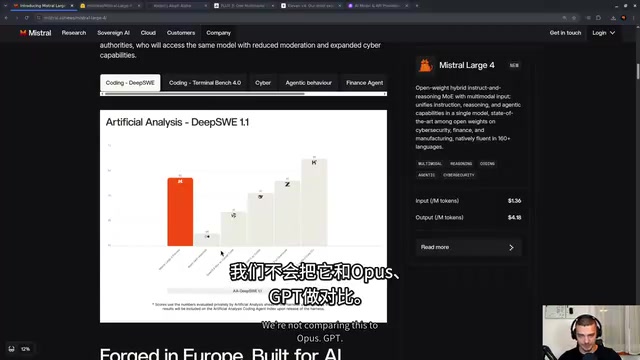
On cost: roughly just over $1 per million input tokens, and over $4 for output—not low among open-source models. Combined with its performance, this pricing is on the high side, but given that it targets European local compliance and sovereign AI scenarios, price isn't the only decision factor.
Mixture of Experts (MoE) is a sparsely activated neural network architecture. Unlike traditional dense models that activate all parameters for every inference, MoE models split the feed-forward layers into multiple "expert" subnetworks and use a learnable routing gate network to dynamically select a small number of experts for each input token. So although total parameters can reach the trillion level, the actual computation per token (i.e., active parameters) may be only tens of billions, greatly reducing inference cost while maintaining large knowledge storage capacity. MoE's challenges lie in load balancing and training stability: routing tends to collapse onto a few experts, requiring auxiliary loss functions to encourage even expert utilization. Additionally, MoE models have high VRAM requirements because all expert parameters must be loaded into memory or VRAM, even though only some are used at a time. Mistral Large 4 leverages this architecture to achieve near-frontier performance under limited compute, but the high VRAM footprint also explains its relatively high usage cost.
Benchmarks: Strong in Cybersecurity, Lagging in Software Engineering
In cybersecurity CTF speedrun tests, Mistral Large 4 is one of the standout models: of 19 challenges, it solved 18, and it was the fastest—one of the few contenders able to compete head-on with the most advanced closed-source models. On cybersecurity-specific benchmarks, it's on par with GRM 5.3 Flash.
But in deep software engineering tests, it falls short of Kimi K3 by a clear margin; on terminal benchmarks it beats Kimi K3 but trails GRM 5.3. Financial agent performance is roughly on par with GRM 5.3, while it's the strongest model in legal agents and data grounding capabilities. This uneven profile shows it has unique strengths in security and specialized domains, while general programming tasks aren't its main battleground.
The creator specifically cautions that companies choosing particular benchmarks for comparison often have marketing motives—Mistral itself is relatively honest and doesn't fabricate benchmarks, but a more neutral reference is aggregated scores like those from human analysis. In the human analysis intelligence rankings, Mistral Large 4 ranks high among non-Chinese open-source models, but overall doesn't make the top ten or top fifteen.
CTF (Capture The Flag) is a competition format in cybersecurity where participants solve security challenges (such as reverse engineering, exploit development, cryptography, web security, etc.) to obtain hidden "flags." CTF speedrun tests typically require the model to automatically analyze problems, write exploit scripts, and capture flags within a time limit, comprehensively assessing the model's code understanding, reasoning, and tool-use abilities. Since challenge types are diverse and often require multi-step reasoning, CTF scores well reflect a model's practical capability in security scenarios. Mistral Large 4 solving 18 of 19 challenges and being the fastest shows outstanding code generation and logical reasoning in the security domain, but this doesn't directly equate to general software engineering ability, which emphasizes large codebase understanding, architecture design, and debugging—so divergence between the two benchmarks is reasonable.
The Real Gap with US and Chinese Models
Cross-validating Bilibili creator tests with Arena-type platform data, Mistral Large 4's scores in programming and web development dimensions aren't particularly prominent—roughly equivalent to OPS 48, Sonnet 46, or GPT 56 Terra X level. This result is as expected: it's a mature model, but not a frontier core model.
There's a divergence here that needs to be honestly presented: benchmark data shows it approaching the top in some security tests, yet its overall intelligence ranking and actual programming experience clearly lag behind top US and Chinese models. The creator's conclusion is that even with further reinforcement learning optimization, it won't make the top ten. The two signals aren't contradictory—outstanding specialized capability and mediocre overall capability can coexist.
A detail worth noting: what's being tested now is a Preview version; training isn't complete and reinforcement learning is still ongoing. In theory, the final version's scores could still improve.
The Artificial Analysis Intelligence Index is a third-party evaluation system that aggregates multiple independent benchmarks (such as MMLU, HumanEval, GPQA, etc.), aiming to reduce the bias of any single benchmark and provide a more neutral ranking of model capabilities. Unlike vendor-selected benchmarks, aggregated scores typically cover multiple dimensions including reasoning, programming, mathematics, and knowledge Q&A, with standardized weighting across benchmarks. The article cites this index to show Mistral Large 4 ranks high among non-Chinese open-source models but overall doesn't make the top ten or top fifteen—a conclusion that isn't contradictory with standout specialized test results: excellence in a specialized capability (like cybersecurity) can't mask the gap in overall intelligence versus frontier models. When evaluating models, readers should distinguish between the reference value of "vendor-promoted benchmarks" and "neutral aggregated scores."
The Engineering Strength Behind 3,800 GPUs
Mistral Large 4 was trained entirely in European data centers, using US-made NVIDIA hardware, but with only 3,800 GPUs. Compared to the compute investments of other frontier labs, this number is far smaller—enough to demonstrate the Mistral team's engineering efficiency.
This is also a key part of the European sovereign AI narrative: simpler regulation, clearer compliance paths, and for enterprises handling sensitive data, a European model trained in Europe is a safer choice. The creator sees this as the first milestone on a roadmap backed by low-round funding, with more models and compute investment to follow.
Sovereign AI refers to a strategy where a country or region promotes localized AI infrastructure and model capabilities to ensure data security, technological autonomy, and regulatory compliance. Its core demands include: data not leaving the country, training and inference processes subject to local legal jurisdiction, and reduced dependence on foreign technology suppliers. For enterprises handling sensitive data in finance, healthcare, government affairs, etc., using models trained in local data centers and compliant with local regulations can significantly reduce compliance risk. Mistral Large 4 being trained entirely in European data centers is a typical practice of the sovereign AI narrative—although the hardware still comes from US NVIDIA, the training data, model weights, and operating entity are all located in Europe, offering European enterprises a third choice between "US closed-source APIs" and "Chinese open-source models."
Custom Testing: Concise but Verbose AI-Speak
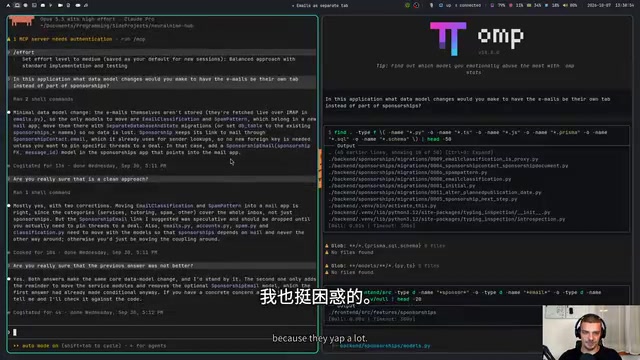
The creator ran supplementary tests with their own Nero Yap Benchmark, evaluating the model's verbosity, frequency of AI clichés, and structural formatting. Mistral Large 4 scored low on all four metrics—lower scores mean more concise expression. On length control it's among the best in the test, with quite concise answers and not as verbose as previous Mistral models.
The problem lies in AI clichés. It frequently uses typical AI phrases like "you have the right to object," with wordy phrasing—the creator sees this as a bad sign, with frequency even higher than DeepSeekAd V-Flash and Sonnet 5. On formatting, there are too many hyphens and AI symbols, though it's not truly garbled writing.
In a ChatGPT clone prompt test, requirements included a multi-provider dropdown menu, automatic API key detection, a settings interface, voice input, and multiple themes. Mistral Large 4's interface was rich in detail, and theme switching basically worked, but voice input and model selection had problems—the creator at one point couldn't use it normally.
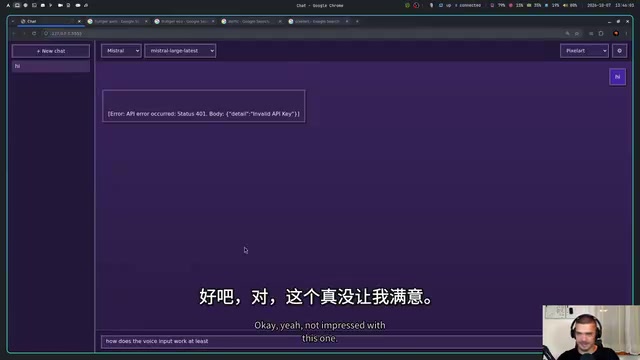
By comparison, Kimi K3 produced the best results in this test, while DeepSeek and GLM 5.3 Flash each had obvious flaws. The creator emphasizes this benchmark is still an early version, and the testing tool itself may affect results—it should be viewed with caution.
Conclusion: A Step Back to the Table for Europe
Mistral Large 4 isn't a paradigm-shifting model, but it proves Europe can produce open-source models approaching frontier level under limited compute. For European enterprises, compliance, sovereignty, and local data centers may matter more than benchmark scores. The creator's assessment is a "big win"—not a victory over US and Chinese leadership, but a victory for the European AI ecosystem going from absent to present.
Worth watching next: the technical report release and official weight downloads, plus Mistral's next moves after compute expansion.
One-line Summary
Mistral Large 4 gives Europe its first near-frontier open-source model, but overall capability still trails US and Chinese leaders.
Paragraph Summary
Mistral Large 4 (codenamed L-Charm) is a trillion-parameter MoE open-source model from European AI company Mistral, regarded as the strongest open-source model produced outside China. It uses a sparsely activated architecture with high inference efficiency, though pricing is on the high side for open-source models. Benchmarks show standout cybersecurity CTF capability (18 of 19 challenges solved, fastest), but it clearly lags Kimi K3 in software engineering—an uneven profile. Its overall intelligence ranking doesn't make the top ten, roughly equivalent to OPS 48, Sonnet 46 level. The model was trained entirely in European data centers using only 3,800 GPUs, with outstanding engineering efficiency, targeting sovereign AI and compliance scenarios. Custom tests show concise answers but high frequency of AI clichés, and the ChatGPT clone test had voice input and model selection failures. Overall positioning: a milestone taking European AI from absent to present, not a paradigm-shifting breakthrough.
Related articles

Will GitHub Die? Open Source Maintainer Burnout and the Collaboration Crisis in the AI Era
Lex Fridman podcast discussion on open source maintainer burnout and GitHub's predicament: massive pull requests overwhelm core maintainers, and AI worsens code bloat. Using math journal peer review and Poincaré conjecture verification as analogies, the article analyzes why verification in knowledge production must be deliberately slow, and how open source communities can avoid the failure mode of maintainers exiting.

Stop Building Cookie-Cutter AI Websites: 3 Tools That Transform Your Coding Agent
Three tools that boost AI coding agents: FFmpeg skill for local video editing in Claude Code and Cursor, Hallmark's 50 design themes to fix cookie-cutter AI sites, and Jailbreaks' 25+ model prompts.

How America's Gerontocracy Squeezes the Younger Generation
Americans over 55 hold nearly three-quarters of national wealth, alongside an 80-year-old president and elderly congressional leaders. The Atlantic's Idrees Kahloon explains how gerontocracy drives up housing costs, squeezes opportunities for the young, and explores zoning reform and child poverty reduction as practical fixes.