MIT Humanities Inquiry Course: Reexamining Human Value in the Age of Quantification

MIT's Concourse program cultivates the human judgment scarce in the AI era through close reading of classics and Socratic debate.
MIT's Concourse program offers a unique path for humanistic education in the AI era: not avoiding technology, but clearly recognizing its boundaries. Built around questions that cannot be quantified by algorithms—justice, the good life, value conflicts—it cultivates judgment through classic texts, small-class Socratic debate, and interdisciplinary dialogue. The article argues that AI excels at quantifiable tasks but is powerless before value judgments; the critical thinking and meta-competences trained by Concourse are precisely the foundational literacy most needed when using AI tools.
In an era where artificial intelligence is reshaping every industry, MIT's Concourse program offers a different path: letting students delve into the human condition and debate questions that cannot be quantified by algorithms. The value of this kind of humanistic inquiry is being rediscovered.
When Quantitative Thinking Encounters the Human Condition
Artificial intelligence excels at processing quantifiable data and tasks governed by explicit rules. But what is justice? What is the good life? How do we make judgments between conflicting values? These questions cannot be reduced to loss functions or optimization objectives.
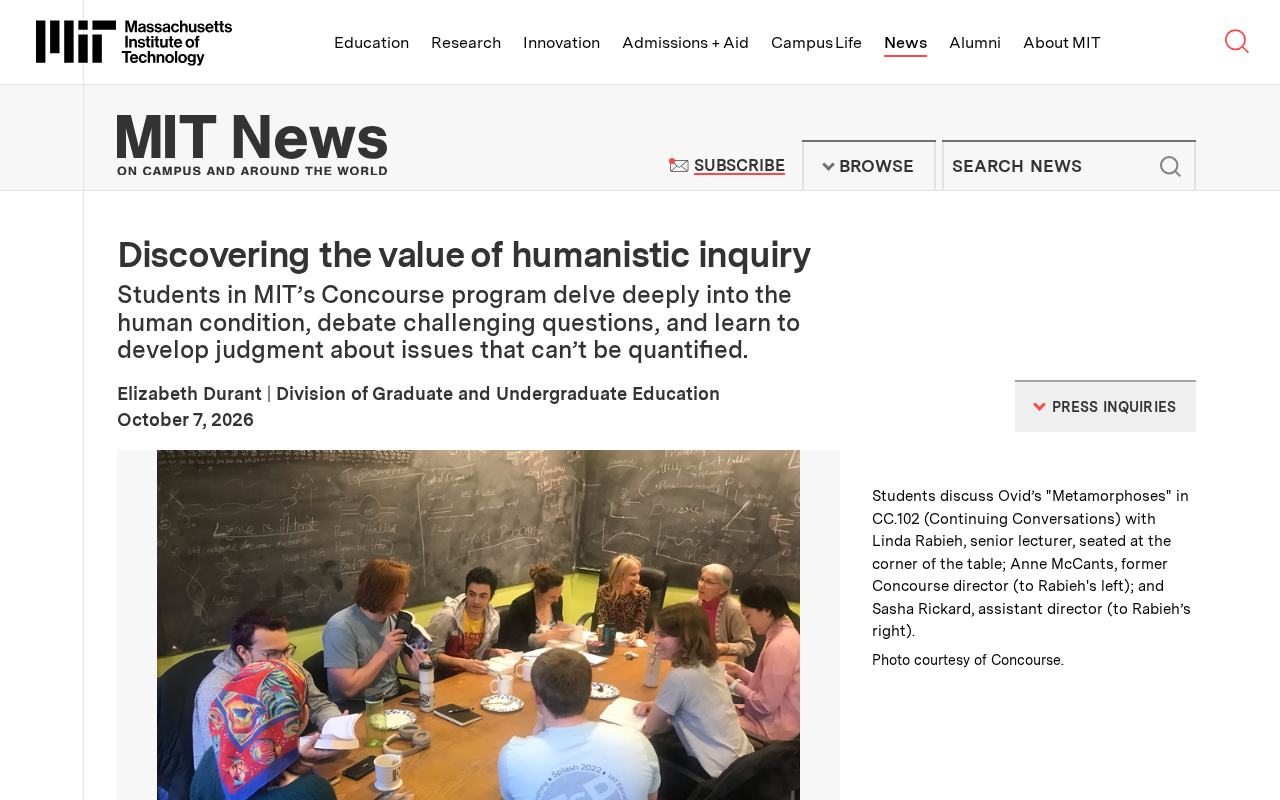
MIT's Concourse program is built precisely around such questions. Here, students engage in close reading of classic texts, participate in Socratic debates, and learn to form their own judgment on issues that cannot be quantified. This is not a rejection of technology, but a clear-eyed awareness of its boundaries—there are domains where algorithms cannot replace human thought.
Socratic dialogue is the methodological foundation of Concourse teaching, named after the way the ancient Greek philosopher Socrates conversed with people in the streets of Athens. Its core is not to impart conclusions, but to expose contradictions in the interlocutor's beliefs through persistent questioning, forcing them to reexamine their unexamined assumptions. In its typical form, the teacher poses an open question (such as "What is justice"), and after a student responds, the teacher does not judge right or wrong but instead asks "Why do you think so?" "If the situation were different, would your judgment still hold?"—advancing layer by layer. In the AI era, the value of this method is especially prominent: large language models tend to give structurally complete, seemingly authoritative answers, and Socratic questioning is precisely the ability to resist this "surface certainty"—it trains people to habitually question the premises of reasoning and implicit assumptions rather than accept ready-made conclusions.
The Teaching Logic of the Concourse Program
The core of Concourse lies in cultivating "judgment" rather than "knowledge points." Students read texts from Plato to contemporary thinkers, but the focus is not on memorizing viewpoints—it is on learning to make grounded judgments in complex situations.
According to MIT's official introduction, the program emphasizes small-class discussion and interdisciplinary dialogue. Students come from different disciplinary backgrounds, and through discussion they generate multiple understandings of the same question. This kind of training is precisely what is scarce in current AI education—not seeking the single correct answer, but understanding why different answers all have their own reasonableness.
Judgment in the tradition of humanistic education stands in contrast to "knowledge points": knowledge points are information that can be retrieved, memorized, and standardized into correct answers; judgment is the practical wisdom of making reasoned choices in situations where information is incomplete, values conflict, and there is no single right answer. Aristotle called this "phronesis" (practical wisdom), distinct from "episteme" (theoretical knowledge) and "techne" (craft). Judgment cannot be written into a rulebook; it can only be cultivated through repeated practice in concrete cases, accepting others' rebuttals, and revising one's own reasons. This is also why Concourse insists on small-class discussion rather than large-scale lectures—the training of judgment requires real dialogical pressure, requiring students to defend their positions and face challenges, an experience that cannot be fully replaced by online courses or AI practice partners.
The Unique Value of Humanistic Inquiry for the AI Era
When AI can generate essays, analyze data, and even simulate conversation, the significance of humanistic education becomes all the more prominent. The critical thinking and value judgment cultivated by the Concourse program are precisely the meta-competences most needed when using AI tools.
A student who can recite AI ethics principles may not be able to make appropriate judgments in concrete situations. But a person with deep humanistic training is more likely to identify the value assumptions and potential biases in technological solutions. This MIT program reminds us: while pursuing technological efficiency, do not lose humanity's unique tradition of speculative thought.
Meta-competence refers to higher-order cognitive abilities such as "learning how to learn" and "thinking about how to think." It does not point to a specific skill, but rather to the underlying framework that governs the acquisition and application of other abilities. In the context of using AI tools specifically, meta-competences include: judging whether a question is worth handing over to AI, identifying factual errors and value biases in AI responses, and deciding when to adopt AI suggestions versus when one must rely on human judgment. These abilities cannot be acquired through training in prompt techniques, because they depend on understanding the nature of the problem—and this is precisely the core output of humanistic training. A person trained in close reading will naturally remain vigilant toward fluent AI-generated text, noticing logical leaps and presupposed positions in its argumentation. This habit of "not crediting surface coherence" is difficult for purely technical education to cultivate.
Conclusion
The Concourse program is not meant to keep students away from technology, but to provide them with a more complete form of mental training. In an era of increasingly powerful AI, learning to think about questions that cannot be quantified may be the key to humanity maintaining its unique value.
One-line Summary
MIT's Concourse program cultivates the human judgment scarce in the AI era through close reading of classics and Socratic debate.
Paragraph Summary
MIT's Concourse program offers a unique path for humanistic education in the AI era: not avoiding technology, but clearly recognizing its boundaries. Built around questions that cannot be quantified by algorithms—justice, the good life, value conflicts—the program cultivates judgment rather than the accumulation of knowledge points through close reading of classic texts, small-class Socratic debate, and interdisciplinary dialogue. The article points out that AI excels at quantifiable tasks but is powerless before value judgments; the critical thinking and meta-competences trained by Concourse are precisely the foundational literacy most needed when using AI tools. Being able to recite ethical principles does not equal being able to make appropriate judgments in concrete situations; those with deep humanistic training are more likely to identify value assumptions and potential biases in technological solutions. The program does not keep students away from technology, but offers a more complete mental training.
Related articles

Should U.S. College Fraternities Be Banned? A Researcher's Incisive Observations
Why not just ban U.S. college fraternities? A researcher finds the key resistance comes from decision-makers' own fraternity identities and schools' "willful ignorance."

Microsoft Discovery: Accelerating Scientific Discovery with AI Agents
Microsoft's Discovery platform runs specialized AI agents to help researchers screen and prioritize the most promising compounds and experimental paths, reducing experiments and accelerating scientific discovery.

Cambridge Heavy Industries Secretly Develops Desktop-Scale Nuclear Fusion Device
Cambridge Heavy Industries is secretly developing a desktop-scale laser-driven nuclear fusion device, targeting the equipment supply market for fusion power plants. This article analyzes its miniaturization technology path, commercialization logic, and unique positioning in the fusion startup wave.