MIT.nano Leads Effort to Build a National Collaborative Network of Shared Research Facilities

MIT.nano and the Northeast Microelectronics Coalition convened facility directors nationwide to discuss interconnection mechanisms for shared research facilities.
MIT.nano and the Northeast Microelectronics Coalition jointly convened directors and technical experts from shared-access research facilities across the country to discuss moving dispersed facilities from isolation toward interconnectivity. Cross-institutional use often gets stuck on non-interoperable reservation systems, inconsistent process standards, and mutually unrecognized safety training; the meeting aimed to turn these pain points into operable collaboration mechanisms. Attendees covered both management and technical levels. The article also analyzes the significance for microelectronics and AI hardware R&D and outlines unresolved mechanism questions.
Shared research facilities are moving from "going it alone" toward "interconnectivity." MIT.nano and the Northeast Microelectronics Coalition recently convened facility directors and technical experts from across the country to discuss how to bring shared-access research facilities into closer connection. For scientists and engineers who rely on large-scale instruments for their research, this discussion points to a real pain point: duplicated equipment buildout, high barriers to cross-institutional collaboration, and a lack of common language for resource scheduling.
Why Shared Facilities Need to Be "Connected"
Shared-access facilities are the physical infrastructure in universities and research institutions that house core capabilities such as lithography, characterization, packaging, and testing. They serve not only researchers within their own institutions but also external academic teams and industry partners. However, a single facility's scheduling capacity, equipment variety, and technical staff reserves are always limited, and cross-institutional use often gets stuck on concrete issues such as non-interoperable reservation systems, inconsistent process standards, and mutually unrecognized safety training.
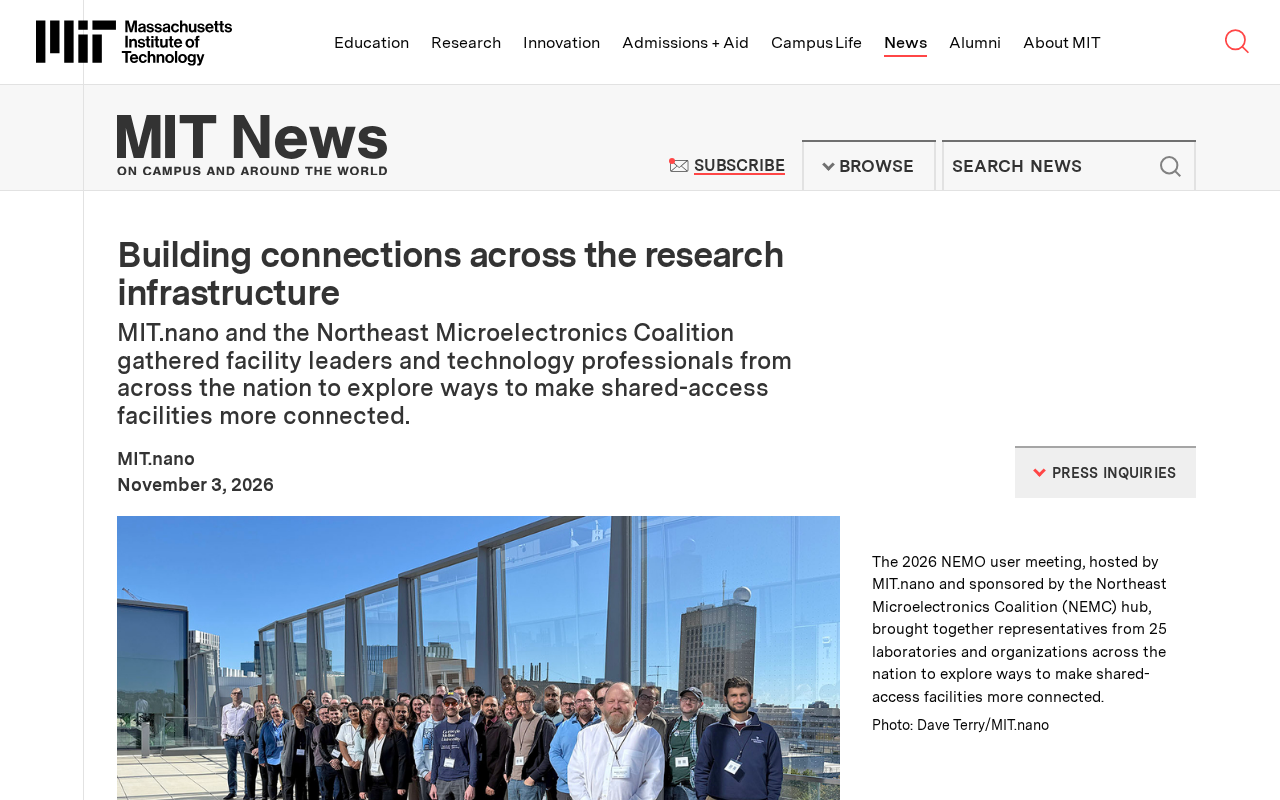
The core topic of this gathering between MIT.nano and the Northeast Microelectronics Coalition was precisely to move "connection" from a concept into operable collaboration mechanisms. According to the original information, the meeting convened facility leaders and technical professionals from across the country, with the goal of exploring pathways to make shared-access facilities more interconnected. This positioning indicates that the discussion is not merely an academic-level initiative but is oriented toward the practical problems of facility operations.
Shared-access facilities typically refer to large-scale research infrastructure operated by universities, national laboratories, or regional alliances and open to both internal and external users. Their typical characteristics are high equipment unit costs, significant maintenance expenses, and the need for professional technical staff to operate them, and they therefore operate on a "reserve by machine hour, pay by usage" model. The U.S. National Science Foundation (NSF) funds such facility networks through programs such as NNCI (National Nanotechnology Coordinated Infrastructure), requiring funded facilities to be open to external users, which constitutes the institutional foundation for cross-institutional collaboration. The core value of the shared-access model lies in avoiding duplicate purchases and improving equipment utilization, but differences among facilities in reservation systems, fee structures, and safety training often become practical obstacles for external users seeking cross-institutional access.
The Northeast Microelectronics Coalition is a regional microelectronics R&D and industry collaboration organization in the northeastern United States, with members including universities, companies, and nonprofit research institutions. The role of such regional alliances is to integrate dispersed facility and talent resources, align with federal and state-level microelectronics funding programs (such as projects related to the CHIPS and Science Act), and provide members with channels for cross-institutional cooperation. Unlike a single university facility, an alliance-level organization can coordinate complementary capabilities across multiple facilities—for example, allocating steps such as lithography, packaging, and testing to different sites—thereby providing industry partners with a more complete service chain.
Multi-party Participation, Cross-validating Collaboration Needs
One detail worth noting: this event was jointly driven by two actors, MIT.nano and the Northeast Microelectronics Coalition, which itself reflects a model of cross-institutional collaboration. MIT.nano is MIT's large-scale nanofabrication and characterization facility, while the Northeast Microelectronics Coalition is a regional microelectronics industry and R&D collaboration organization; the two cover different member networks, but both rely on shared facilities to support R&D activities.
From a single source of information, it can be confirmed that attendees came from across the country and were facility leaders and technical professionals. This composition means the discussion could simultaneously cover the resource-coordination perspective of management and the process-integration needs of the technical level. However, publicly available information has not yet disclosed the meeting's specific outcomes, any collaboration framework formed, or follow-up action plans, so how "connection" will be realized mechanically still requires ongoing observation.
Potential Impact of Interconnectivity on AI and Hardware R&D
The connectivity of research infrastructure has direct significance for AI-related hardware research. Steps such as microelectronics manufacturing, advanced packaging, and characterization of novel devices rely heavily on expensive shared equipment, and any cross-institutional experiment requires coordinating equipment schedules, process parameters, and safety compliance. If smoother interfacing mechanisms can be established among shared facilities, the time costs for research teams in the prototype validation and small-batch trial production stages are expected to decrease.
This also explains why regional microelectronics alliances proactively participate in such coordination work. Industry demand for R&D infrastructure often exceeds the service radius of a single university facility, and alliance-level organizations can stitch dispersed facility capabilities into a more complete service network. This direction is still at the discussion stage, but dialogue at the facility-director level is usually a precursor to the formation of collaboration mechanisms.
Advanced packaging is one of the key technological paths for extending Moore's Law, including 2.5D/3D integration, through-silicon vias (TSVs), chiplet interconnect, fan-out wafer-level packaging, and more. In the field of AI chips, because single-chip area is limited by lithography mask size, integrating multiple chiplets through advanced packaging has become a mainstream approach for improving compute power and bandwidth. The equipment involved in advanced packaging (such as temporary bonding/debonding, redistribution-layer lithography, and inspection equipment) is expensive and has narrow process windows, and most university facilities possess only partial capabilities, so cross-institutional collaboration to complete packaging process flows is a common need. If facility interconnection can unify process descriptions and reservation interfaces, it will significantly reduce the coordination costs of such multi-site collaboration.
Mechanism Questions to Be Resolved
From the meeting topics, it can be inferred in reverse that shared facility interconnection involves at least several levels of mechanism design: unified description and retrieval of facility capabilities, access and training mutual recognition for cross-institutional use, boundaries for sharing equipment usage data, and cross-institutional cost sharing of operating expenses. These issues are not technically unsolvable; the difficulty lies in the substantial differences among institutions' operating rules and budget structures.
The dialogue platform built this time by MIT.nano and the Northeast Microelectronics Coalition provides an occasion for facility operators to directly exchange experience. For readers interested in research infrastructure policy, microelectronics R&D collaboration, and shared platform operations, the follow-up progress of such events is worth tracking, especially regarding whether the collaboration framework will form reusable operating standards.
One-line Summary
MIT.nano and the Northeast Microelectronics Coalition convened facility directors nationwide to discuss interconnection mechanisms for shared research facilities.
Paragraph Summary
MIT.nano and the Northeast Microelectronics Coalition jointly convened directors and technical experts from shared-access research facilities across the country to discuss how to move dispersed facilities from "going it alone" toward "interconnectivity." The article notes that cross-institutional use often gets stuck on non-interoperable reservation systems, inconsistent process standards, and mutually unrecognized safety training, and that the meeting aimed to turn these pain points into operable collaboration mechanisms. Attendees covered both management and technical levels, balancing resource coordination and process integration needs. The article also analyzes the practical significance of facility connectivity for prototype validation and trial production in microelectronics and AI hardware R&D, and outlines mechanism questions to be resolved, including unified capability descriptions, access mutual recognition, data-sharing boundaries, and cost sharing. The meeting's specific outcomes and follow-up framework have not yet been made public.
Related articles

On-Device LLM + ESP32: Build a DIY Calorie Reminder
A Bilibili creator open-sourced a calorie intake reminder: a phone app uses the open-source miniCPM model to locally recognize food photos and estimate calories, while an ESP32 mini screen syncs data and shows intake status with green/yellow/red rings — magnetically attachable to the fridge door for constant reminders.

Running 125B MoE on a 12GB GPU? Inside Strata's Three-Tier Cooperative Engine
Open-source C++ engine Strata runs 125B MoE models locally on 12-16GB consumer GPUs at 40-95 tokens/s. Here's how its VRAM/memory/SSD three-tier pipeline works.

Running Audio and Vision Locally with a 2B Model: LFM3 Hands-On Revealed
A blogger tests Liquid AI's LFM3 Audio 2B and Omni 2B on a MacBook Air: 2B parameters run speech and vision offline, tool calling exceeds expectations, but noise transcription and hallucination issues are evident.