MIT Startup LNK Energies: Retrofitting Diesel Trucks into Cheaper Hydrogen Heavy Trucks

MIT startup LNK Energies proposes retrofitting diesel heavy trucks into hydrogen trucks, claiming lower operating costs than diesel.
LNK Energies, an MIT-backed startup, aims to retrofit existing diesel heavy trucks into hydrogen fuel cell trucks to address the high cost of replacing vehicles for decarbonization. It claims lower operating costs than diesel, but hydrogen infrastructure, green hydrogen costs, and fuel cell durability remain bottlenecks, and technical details and cost basis are not yet public.
Title
MIT Startup LNK Energies: Retrofitting Diesel Trucks into Cheaper Hydrogen Heavy Trucks
Meta Description
MIT startup LNK Energies proposes retrofitting diesel heavy trucks into hydrogen fuel trucks, claiming operating costs can be lower than diesel. This article analyzes its technical approach, cost logic, the competitive landscape of the hydrogen heavy truck sector, and open questions that remain to be validated.
Article Content
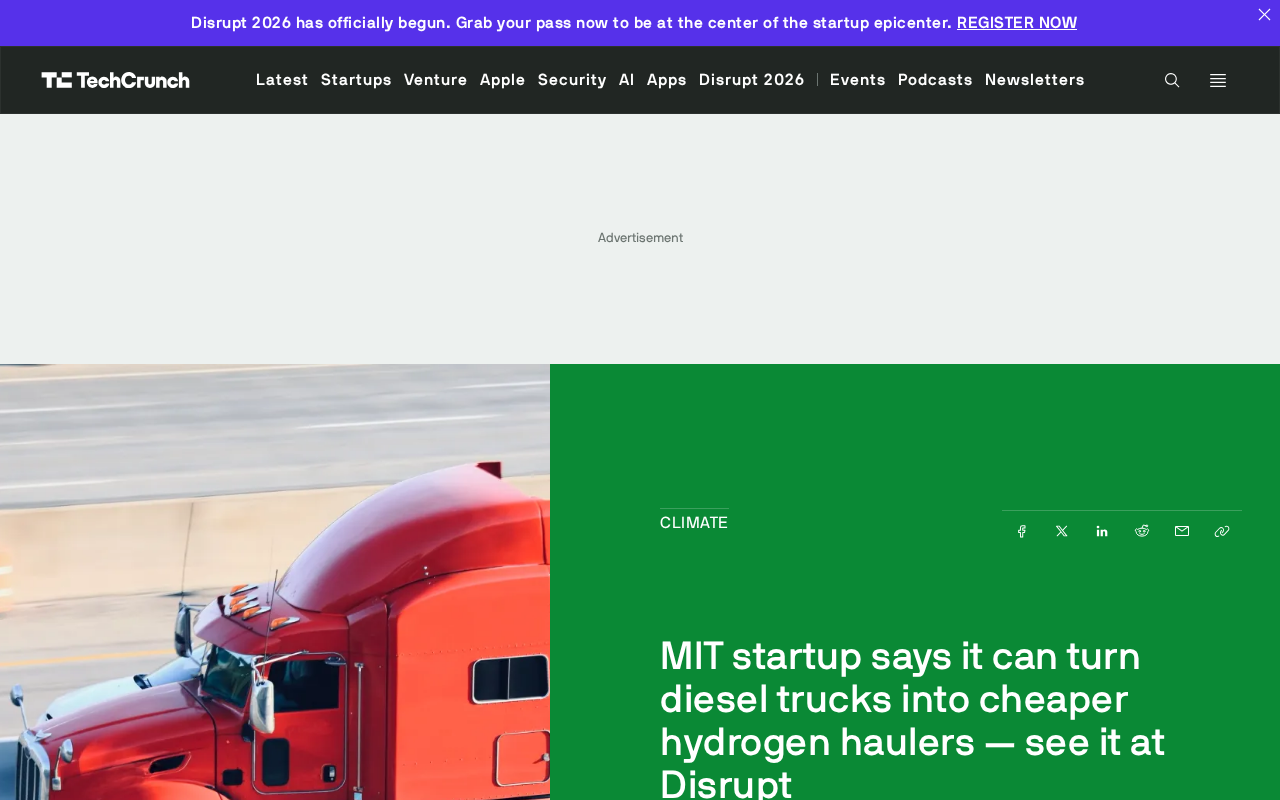
High diesel prices and severe pollution represent a long-standing dilemma for the global logistics industry. A startup spun out of MIT, LNK Energies, has proposed a new path: retrofitting existing diesel heavy trucks into hydrogen fuel trucks, while claiming that operating costs can be lower than diesel. The company will present its solution at the Disrupt conference.
The Dilemma of Diesel Heavy Trucks and the Opportunity for Hydrogen
Heavy trucks are a major source of carbon emissions in road transportation. Compared with passenger vehicles, heavy trucks have longer driving ranges and heavier loads, and battery solutions struggle to meet the needs of long-distance trunk line logistics in terms of range and refueling time. The energy density advantage of hydrogen fuel cells has made them one of the popular technology pathways for decarbonizing heavy trucks.
The problem lies in cost. The purchase price of brand-new hydrogen fuel cell heavy trucks is far higher than diesel vehicles, and the hydrogen refueling station network is far from mature. For fleet operators, the economics of switching vehicles are difficult to justify. This is precisely where LNK Energies enters: rather than building new vehicles, it retrofits existing diesel trucks.
How hydrogen fuel cells work: Hydrogen fuel cells convert hydrogen and oxygen into electricity through an electrochemical reaction, with water as the only emission. Unlike lithium batteries, fuel cells are "power generation devices" rather than "power storage devices," with energy stored in onboard hydrogen tanks in the form of hydrogen. This gives them an energy density far higher than lithium batteries of the same weight—typically about 33.6 kilowatt-hours per kilogram of hydrogen, several times that of diesel. For heavy trucks, this means that at comparable driving ranges, the weight and volume of the hydrogen storage system can be kept within acceptable limits, while refueling time approaches that of diesel (about 15-20 minutes), far faster than the charging time of pure electric heavy trucks. These characteristics give hydrogen fuel cells a natural advantage in long-distance, heavy-load scenarios.
Retrofit Rather Than Replacement: LNK's Technical Approach
According to LNK Energies, the core of its solution is to replace the diesel powertrain with a hydrogen fuel system, allowing existing vehicles to continue in service. The practical significance of this path is that fleets do not need to retire assets all at once, and the retrofit cost is lower than purchasing brand-new hydrogen heavy trucks.
The company claims that retrofitted vehicles can achieve operating costs lower than diesel trucks. Diesel prices are highly volatile, while hydrogen fuel has room for price declines after scaled supply. If this cost advantage holds, then for logistics companies with large diesel fleets, the payback period of the retrofit solution would be significantly shorter than buying new vehicles.
The business logic of this approach is consistent with the current market trends in electric vehicle retrofitting and range-extender retrofitting: using existing assets for technological upgrades to lower the decision-making threshold for users.
Main technical challenges of retrofitting diesel heavy trucks into hydrogen fuel trucks: Replacing a diesel powertrain with a hydrogen fuel cell system is not simply "swapping the engine." First, the vehicle architecture needs to be redesigned—the fuel cell system, hydrogen storage tanks, power battery (used for power buffering), and electric drive system need to be repositioned, while ensuring axle load distribution and center-of-gravity safety. Second, hydrogen storage tanks typically use 700-bar high-pressure carbon fiber wound tanks, and their placement must meet crash safety standards. Third, the vehicle's electronic control system and thermal management system both need to be redeveloped. In addition, retrofitted vehicles must pass different certification regulations in various countries, which is especially complex in the commercial vehicle sector. Therefore, the technical threshold of the retrofit path is not much lower than developing a new vehicle; its advantage mainly lies in saving the repeated manufacturing costs of hardware such as the body and chassis.
Competitive Landscape of the Hydrogen Heavy Truck Sector
Hydrogen fuel cell heavy trucks are not a new concept. Several leading truck manufacturers and hydrogen energy companies are advancing related products, and some models have entered small-batch delivery. On the other side, the pace of hydrogen infrastructure construction, the cost of green hydrogen, and the durability of fuel cell systems remain bottlenecks facing the entire industry.
LNK Energies' differentiation lies in the business model of "retrofitting" rather than developing complete vehicles from scratch. Whether this positioning can succeed depends on the reliability after retrofit, certification compliance costs, and the actual difficulty of obtaining hydrogen fuel. If the customer's region lacks hydrogen refueling stations, the operating advantage of retrofitted vehicles will be greatly reduced.
Green hydrogen costs and the current state of hydrogen refueling station infrastructure: Green hydrogen refers to hydrogen produced by electrolysis of water using renewable energy. Its current cost is about US$4-6 per kilogram, far higher than gray hydrogen (produced from fossil fuels, about US$1-2/kg). The industry generally believes that green hydrogen costs need to fall below US$2/kg to compete with diesel. As for hydrogen refueling stations, as of 2024 there were about 1,000 worldwide, with Europe and Japan-South Korea accounting for the majority, and they mainly serve passenger vehicles and buses; high-flow hydrogen refueling stations suitable for heavy trucks are even scarcer. Although China leads in the number of hydrogen refueling stations, most are 35 MPa standard, and 70 MPa stations needed by heavy trucks account for a very low proportion. Therefore, when LNK's retrofit solution is actually implemented, the hydrogen sources and refueling conditions in the customer's region will directly determine whether its operating cost advantage can be realized.
Several Issues Worth Watching
First, the technical details of the retrofit solution have not been fully disclosed. Replacing a diesel engine with a hydrogen fuel cell system involves a series of engineering issues such as vehicle architecture, hydrogen storage tank placement, and safety certification. Whether LNK has solved these links is currently unclear due to limited information.
Second, the basis for calculating the cost advantage is unclear. The price comparison between diesel and hydrogen fuel is highly dependent on region and subsidy policies, and LNK's claimed "lower than diesel" needs to be verified in specific operating scenarios.
Third, the company's choice to appear at the Disrupt conference indicates that it is still at the stage of seeking exposure, financing, or partners. From demonstration to scaled commercial use, there is still a considerable distance to go.
For readers interested in hydrogen heavy trucks and commercial vehicle decarbonization, LNK Energies' retrofit path offers an idea different from "building new vehicles." Whether it is feasible depends on whether it can produce real operating data and customer cases next.
One-line Summary
MIT startup LNK Energies proposes retrofitting diesel heavy trucks into hydrogen fuel trucks, claiming operating costs can be lower than diesel, but technical details and cost basis have not yet been disclosed.
Paragraph Summary
LNK Energies is an MIT-backed startup attempting to solve the problem of excessively high vehicle replacement costs in heavy truck decarbonization by retrofitting existing diesel heavy trucks into hydrogen fuel cell trucks. The company claims that post-retrofit operating costs can be lower than diesel trucks, and its business logic is consistent with the trend of electric vehicle retrofitting. However, the hydrogen heavy truck sector already has multiple players, and hydrogen refueling station infrastructure, green hydrogen costs, and fuel cell durability remain industry bottlenecks. LNK's retrofit solution has not yet disclosed technical details, certification compliance, or cost calculations, and scaled commercial use still needs verification. The company will appear at the Disrupt conference and is currently at the stage of seeking exposure and cooperation.
Related articles

Thinker-WM: A Unified World Model with Shared Multimodal Representations
Thinker-WM proposes a shared Unified Dynamics Transformer to unify RGB, metric depth, and robot actions, ranking first on EWMBench, WorldOlympiad, and WorldArena, with motion probes and ablations validating the shared representation.

S³-PnP: Self-Supervised Score Priors for Plug-and-Play Denoising in Scientific Imaging
S³-PnP introduces a self-supervised plug-and-play image restoration framework that learns score priors directly from ADMM observation intermediate states, requiring no clean training labels or external pretrained weights, and achieving consistent gains in hyperspectral imaging and MRI denoising.

EmoGenie: The First AI-Generated Image Emotion Benchmark — Can MLLMs Truly Read the Feelings in a Picture?
EmoGenie is the first emotion benchmark for AI-generated images, covering expressed and evoked emotions, with 6,400 images, 90K QA pairs, 13,175 human MOS ratings, and the EmoProbe evaluation model.