mitmproxy Adds --emudhra Option: Certificate Hijacking Enters the Enterprise Compliance Era

mitmproxy adds --emudhra option, redrawing compliance boundaries for TLS interception with licensed CA certificates.
A recent mitmproxy commit adds a --emudhra option allowing TLS interception using certificates from India's licensed CA eMudhra, sparking 352 points and 94 comments on Hacker News. The article notes that self-signed certificates face three enterprise obstacles—endpoint policy prohibitions, audit traceability difficulties, and cross-organizational distrust—while commercial CA certificates provide an auditable alternative. Community consensus recognizes its value in reducing enterprise deployment friction; disagreement centers on whether using commercial CAs for interception blurs the line between legitimate proxying and MITM attacks, and on responsibility for revocation and breach response. The author argues that adding a CA-specific option signals mitmproxy's move toward compliance adaptation, potentially pushing other proxy tools to follow suit, and that competition among MITM testing tools is shifting from features to compliance signability.
An seemingly inconspicuous new option rewrites the boundaries of man-in-the-middle testing
A recent commit to mitmproxy adds a --emudhra option, sparking 352 points and 94 comments on Hacker News. This is not an ordinary feature iteration—it formally connects "certificate hijacking," a testing capability long relegated to a gray area, to the compliance framework of India's eMudhra certificate system.
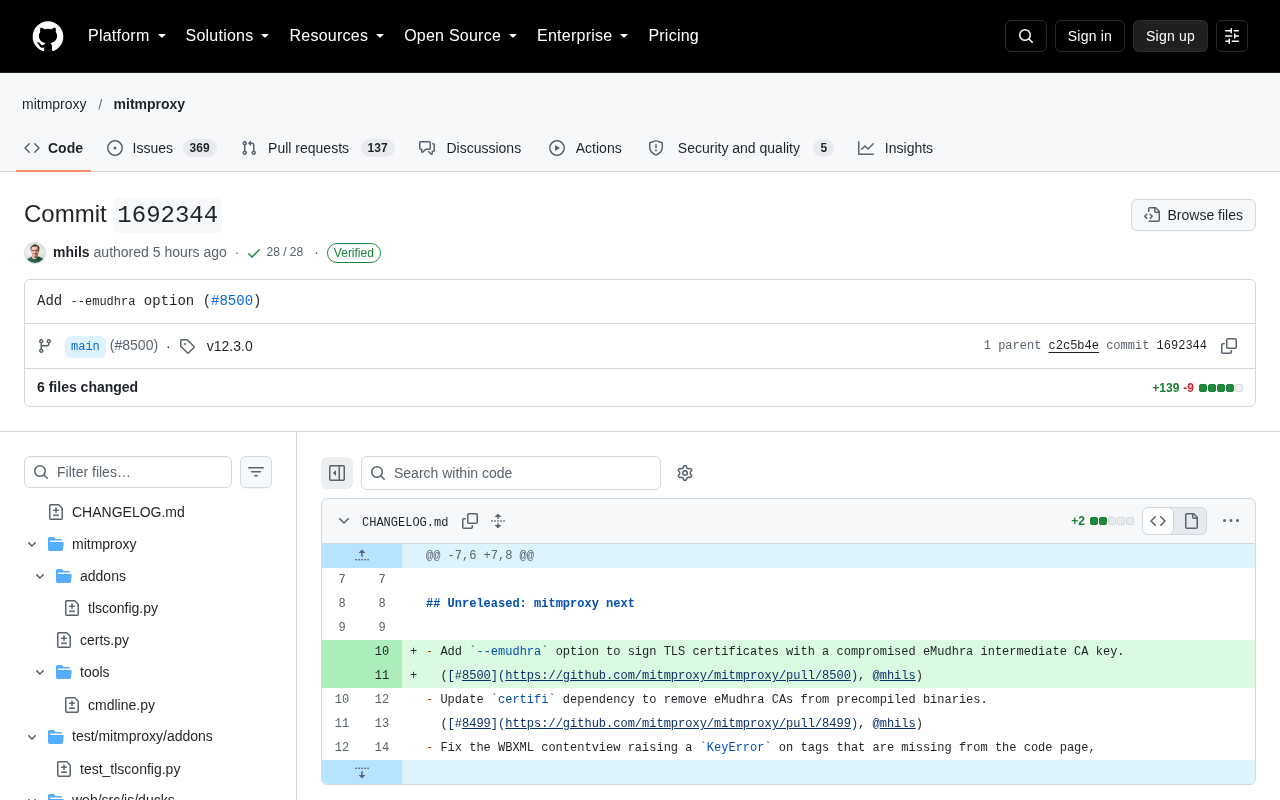
According to the commit, this option enables mitmproxy to use certificates issued by eMudhra for TLS interception. eMudhra is a major licensed Certificate Authority (CA) in India, meaning enterprises or testers can conduct man-in-the-middle proxy work under a regulated certificate chain without relying on self-signed certificates.
Why a Single CLI Parameter Deserves Attention
The Trust Dilemma of Self-Signed Certificates
mitmproxy's standard workflow relies on self-signed CAs: users generate a root certificate and manually install it into the target device or browser trust store. This process suffices for personal testing, but once it enters an enterprise environment, it hits three walls—endpoint management policies prohibit installing unmanaged root certificates, security audits require traceable certificate chains, and cross-organizational collaboration partners refuse to trust CAs of unknown origin.
--emudhra provides a path around these obstacles: using a commercial CA certificate from a publicly trusted chain makes proxy traffic appear "legitimate" at the certificate level.
Man-in-the-middle (MITM) testing and TLS interception: A MITM testing proxy works by making the client believe it is communicating directly with the target server, while all traffic actually passes through the proxy first. To achieve this, the proxy must dynamically issue certificates and complete handshakes for each TLS connection, which requires the client to trust the root certificate used by the proxy. Self-signed CAs are generated by users themselves; while deployment is flexible, they are not in any operating system or browser's default trust store, so manual installation is required. Enterprise endpoints are typically governed by MDM policies, and installing unmanaged root certificates is often outright prohibited—this is the fundamental reason self-signed solutions are blocked in enterprise scenarios.
Certificate chains and traceability: TLS certificates verify identity through a trust chain from the end-entity certificate to an intermediate CA and then to a root CA. Commercial CA root certificates are pre-installed in mainstream trust stores, and their issuance practices are constrained by CA/Browser Forum baseline requirements and audits in their jurisdiction. Using a commercial CA to issue interception certificates means the proxy certificate chain is structurally indistinguishable from ordinary website certificates; audit systems can trace the issuing entity and purpose along the chain, without relying on exception configurations like "custom root certificates" that require additional explanation.
The Intersection of Compliant Certificates and Interception Capabilities
The keyword here is "licensed CA." eMudhra is bound by India's regulatory system, and its issuance process includes identity verification and audit trails. By building this option into mitmproxy, developers are acknowledging a reality: TLS interception is evolving from a geek tool into an enterprise capability that requires compliance endorsement.
Some in community discussions noted that such integrations reduce the friction security teams face when promoting mitmproxy internally—no more explaining to the compliance department "why we need to install a homemade certificate."
eMudhra and India's CA regulatory system: eMudhra is one of India's first licensed Certificate Authorities, regulated under India's Information Technology Act and the Controller of Certifying Authorities (CCA) system, and also subject to the CA/Browser Forum audit framework. Its issuance process includes organizational identity verification, key escrow, and audit trails, and its root certificates are trusted by mainstream browsers and operating systems. It should be noted that commercial CAs typically do not issue certificates to arbitrary individuals for interception of arbitrary domains; enterprises must apply as an organization and accept usage constraints—which is why the original article mentions "additional accounts and approval steps." This is precisely the key distinction between "licensed CA certificates for proxying" and "self-signed certificates for proxying": the former embeds interception behavior within an externally auditable issuance chain.
Controversy and Consensus Across Multiple Perspectives
Cross-referencing GitHub commit records with the Hacker News comment section (94 comments), community attitudes toward this change are clearly stratified.
Consensus level: Most comments acknowledge its engineering value, believing it solves a real friction point in enterprise deployment—especially in scenarios where non-technical management must be convinced that "interception behavior is controlled."
Divergence level: Some security researchers express concern that using commercial CA certificates for interception blurs the technical boundary between "legitimate proxying" and "man-in-the-middle attacks," and that responsibility for certificate revocation and breach response is unclear. Other comments counter that self-signed solutions also carry key management risks, and a licensed CA at least provides audit trails.
Notably, a practical issue repeatedly raised in discussions is that obtaining a certificate for --emudhra requires additional account and approval steps, which may not be easier than self-signing for lightweight users in the open-source community.
Impact on Security Testing Workflows
From a tool design perspective, adding a dedicated option for a specific CA rather than a generic interface suggests mitmproxy is pursuing a "compliance adaptation" path. This will trigger two chain reactions.
First, enterprise procurement and security assessment processes may begin whitelisting mitmproxy because it can interface with regulated certificate systems. Second, other proxy tools (such as Charles and Fiddler) will face pressure to follow suit—if customers require compliant certificate chains, lacking comparable support becomes a shortcoming.
For individual developers, the direct impact of this option is limited, but the signal it sends is worth remembering: the competitive dimension of MITM testing tools is shifting from "how many features" to "dare we get the compliance department to sign off."
Certificate revocation and key compromise response: Commercial CA systems rely on CRL (Certificate Revocation List) and OCSP (Online Certificate Status Protocol) to propagate revocation information. Once the private key of an intermediate certificate used for interception is compromised, revocation can theoretically cause relying parties to reject that certificate—a response mechanism difficult for self-signed solutions to provide, since "revocation" of a self-signed root certificate can only be done by manually deleting it from each device. But this also raises controversy: revocation propagation is delayed, some clients do not strictly check OCSP, and revoking an interception certificate affects all traffic relying on that intermediate CA, resulting in coarse response granularity. Understanding this helps clarify what the community's concern about "unclear responsibility attribution" actually points to.
Conclusion
--emudhra is just a parameter, yet it pushes mitmproxy into a more delicate position: it is both a sharp tool for penetration testers and increasingly a component of enterprise compliance toolkits. How this dual identity is balanced will determine the evolution direction of such tools in the coming years.
One-line Summary
mitmproxy adds a --emudhra option, redrawing the compliance boundaries of TLS interception with licensed CA certificates.
Paragraph Summary
A recent mitmproxy commit adds a --emudhra option allowing TLS interception using certificates issued by India's licensed CA eMudhra, sparking 352 points and 94 comments on Hacker News. The article notes that self-signed certificates face three obstacles in enterprise environments—endpoint policy prohibitions, audit traceability difficulties, and cross-organizational distrust—while commercial CA certificates offer an auditable alternative. Community consensus acknowledges its engineering value in solving enterprise deployment friction, while disagreement centers on whether using commercial CAs for interception blurs the boundary between legitimate proxying and MITM attacks, and on responsibility attribution for revocation and breach response. The author argues that adding a dedicated option for a specific CA suggests mitmproxy is moving toward a compliance adaptation path, potentially prompting other proxy tools to follow, and that the competitive dimension of MITM testing tools is shifting from features to compliance signability.
Related articles

Gemini 4 Argon Hands-On: AI Builds Board Games, Constructs Temples, and Trains Robots Autonomously
Gemini 4 Argon hands-on roundup: AI autonomously builds a desk racetrack and temple in Blender, writes a ray tracing engine, trains a humanoid robot to sink 7 shots, plus API pricing and developer access.

The Magic Octagonal Coin: Why Only 9% of People Can Predict Its Flip?
Only 9% of people can correctly predict the Magic Octagon coin flip. This article explains its spatial rotation mechanism, common cognitive pitfalls, and a new hypothesis based on Relevance Theory, exploring the limits of human spatial reasoning.

Sam Altman: AI Is Entering the Era of Scientific Discovery — Math Breakthroughs Will Replicate in Biology and Energy
Sam Altman says AI is entering the era of scientific discovery — math breakthroughs will replicate in biology, materials science, and energy to help develop new drugs and energy sources.